
Paper: GS-II, Subject: Social Justice, Topic: Welfare Schemes for Vulnerable Sections, Issue: Resetting India’s Food Security Framework
Context
Recently, the draft National Food Security (Amendment) Bill, 2026 proposed linking Antyodaya foodgrain entitlements with household size. This has renewed debate over equitable distribution, beneficiary coverage and dietary diversity.
Explanation
Why is entitlement reform needed?
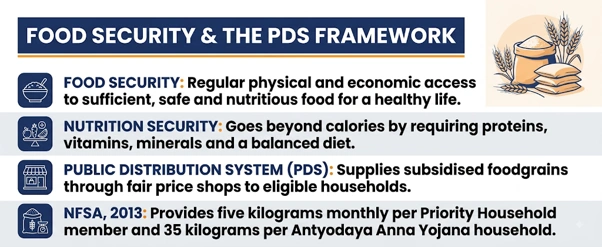
- Under the present system, every Antyodaya Anna Yojana (AAY) household receives 35 kilograms, regardless of its size.
- Consequently, a seven-member household receives five kilograms per person, while an eight-member family receives only about 4.4 kilograms per person.
- The proposed formula provides seven kilograms per person but caps the household entitlement at 35 kilograms.
- While intended to improve fairness, it would reduce benefits for households having fewer than five members without helping larger families.
- Small households may contain widows, elderly persons or persons with disabilities. Therefore, size alone cannot measure vulnerability.
The wider coverage problem
- NFSA’s beneficiary ceiling of 81.35 crore remains based on Census 2011, despite substantial population growth.
- Updated population estimates and deprivation criteria are therefore necessary to prevent eligible families from being excluded.
From food security to nutrition security
- Entitlement reform must also recognise India’s double burden of malnutrition: persistent undernutrition alongside rising diabetes and other non-communicable diseases.
- Cereals prevent hunger, but a cereal-heavy diet may lack pulses, milk, eggs, vegetables and other protein-rich foods.
- However, available research does not prove that PDS cereals directly cause diabetes. Reducing essential grain support would therefore be misguided.
A balanced reform strategy
- Existing AAY households should retain 35 kilograms through an explicit no-loss guarantee.
- Additional support for large or highly dependent households should be based on consumption and nutritional evidence.
- Dietary diversification should be financed separately through pulses, oils and complementary programmes such as Anganwadi services and PM POSHAN.
- Fair price shops should ensure offline access, prevent denial after biometric failure and provide voluntary nutrition referrals.
Conclusion
Food-security reform must correct unequal entitlements without weakening protection against hunger. Updated coverage, protected grain support and separately financed dietary diversity can move India towards equitable, nutritious and dignified food access.
Source: (The Hindu)
La Excellence IAS Academy, the best IAS coaching in Hyderabad, known for delivering quality content and conceptual clarity for UPSC 2026 preparation.
FOLLOW US ON:
◉ YouTube : https://www.youtube.com/@CivilsPrepTeam
◉ Facebook: https://www.facebook.com/LaExcellenceIAS
◉ Instagram: https://www.instagram.com/laexcellenceiasacademy/
GET IN TOUCH:
Contact us at info@laex.in, https://laex.in/contact-us/
or Call us @ +91 9052 29 2929, +91 9052 99 2929, +91 9154 24 2140
OUR BRANCHES:
Head Office: H No: 1-10-225A, Beside AEVA Fertility Center, Ashok Nagar Extension, VV Giri Nagar, Ashok Nagar, Hyderabad, 500020
Madhapur: Flat no: 301, survey no 58-60, Guttala begumpet Madhapur metro pillar: 1524, Rangareddy Hyderabad, Telangana 500081
Bangalore: Plot No: 99, 2nd floor, 80 Feet Road, Beside Poorvika Mobiles, Chandra Layout, Attiguppe, Near Vijaya Nagara, Bengaluru, 560040
AAY entitlement reform