
Paper: GS-II, Subject: Polity, Topic: Legislature, Issue: Decline in Parliamentary Deliberation and Accountability
Context
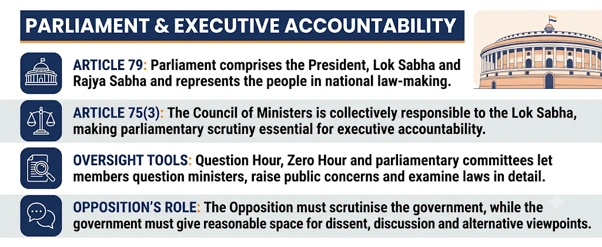
Recently, another parliamentary session witnessed repeated disruptions and limited discussion on important public issues. This has renewed concerns about political hostility, inadequate legislative scrutiny and the declining effectiveness of Parliament.
Explanation
Causes of declining parliamentary functioning
- The government and Opposition increasingly treat compromise as political weakness, creating a cycle of refusal, disruption and adjournment.
- Political disagreement has become mutual demonisation, with rivals often presented as illegitimate or opposed to the national interest.
- Parties defend disruption while in Opposition but condemn the same practice after entering government, revealing inconsistent standards.
- Strong party whips and the anti-defection law reduce the freedom of Members of Parliament to exercise independent legislative judgment.
- Electoral success often depends more on party popularity and local influence than attendance, debates, questions or committee performance.
- Television-driven politics encourages slogan-shouting and grandstanding instead of informed discussion, negotiation and consensus-building.
Major implications
- Disruptions weaken Question Hour, prevent constituency issues from being raised and waste limited parliamentary time.
- Bills passed without adequate debate or committee examination may contain drafting weaknesses and unintended consequences.
- Excessive executive control can reduce Parliament to a formal approving body rather than an independent deliberative institution.
- Persistent conflict weakens public confidence, limits bipartisan cooperation and gradually hollows out parliamentary democracy.
Way forward
- Fixed weekly time should be provided for Opposition-sponsored debates on urgent national issues.
- Important Bills should receive adequate discussion and normally undergo detailed scrutiny by parliamentary standing committees.
- Party whips should be limited mainly to confidence motions, financial matters and government stability.
- Parliament should have a predictable annual calendar, protected Question Hour and regular government–Opposition consultations.
- Political parties and voters should reward attendance, legislative expertise, committee participation and constructive conduct.
Conclusion
Parliament needs disagreement, but disagreement must operate through debate, scrutiny and constitutional procedure. The government must accommodate legitimate dissent, while the Opposition must avoid routine disruption. Restoring dialogue and legislative accountability is essential for protecting India’s parliamentary democracy.
Source: (The Indian Express)
La Excellence IAS Academy, the best IAS coaching in Hyderabad, known for delivering quality content and conceptual clarity for UPSC 2026 preparation.
FOLLOW US ON:
◉ YouTube : https://www.youtube.com/@CivilsPrepTeam
◉ Facebook: https://www.facebook.com/LaExcellenceIAS
◉ Instagram: https://www.instagram.com/laexcellenceiasacademy/
GET IN TOUCH:
Contact us at info@laex.in, https://laex.in/contact-us/
or Call us @ +91 9052 29 2929, +91 9052 99 2929, +91 9154 24 2140
OUR BRANCHES:
Head Office: H No: 1-10-225A, Beside AEVA Fertility Center, Ashok Nagar Extension, VV Giri Nagar, Ashok Nagar, Hyderabad, 500020
Madhapur: Flat no: 301, survey no 58-60, Guttala begumpet Madhapur metro pillar: 1524, Rangareddy Hyderabad, Telangana 500081
Bangalore: Plot No: 99, 2nd floor, 80 Feet Road, Beside Poorvika Mobiles, Chandra Layout, Attiguppe, Near Vijaya Nagara, Bengaluru, 560040