
Paper: GS-III, Subject: Science and Technology, Topic: Fourth Industrial Revolution Technologies, Issue: Destructive Book Scanning for AI Training
Context:
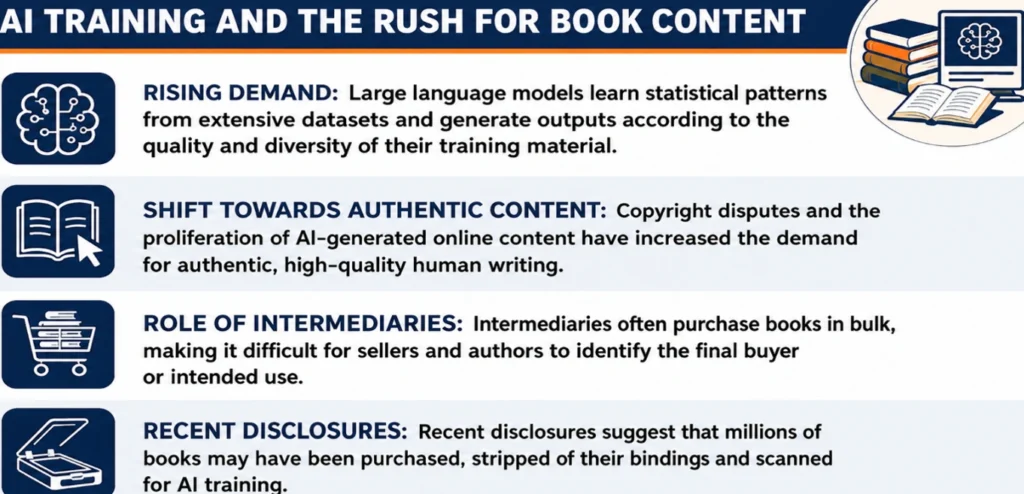
Artificial intelligence companies require vast quantities of reliable, human-written material to train large language models. Their growing acquisition and digitisation of physical books, sometimes through irreversible scanning methods, have raised significant questions concerning copyright, transparency and cultural preservation.
Explanation
Methods of Digitisation
- Non-destructive scanning uses overhead cameras and protective cradles to photograph pages while preserving the original binding. It is appropriate for rare, valuable and archival books.
- Destructive scanning removes the spine, separates the pages and processes them through high-speed scanners. It produces clear images efficiently but permanently destroys the physical copy.
- Optical character recognition converts scanned images into machine-readable text, which can subsequently be incorporated into AI training datasets.
Commercial and Ethical Dimensions
- Purchased books may offer AI firms an intermediate approach between negotiating publisher licences and relying on unauthorised digital repositories.
- Nevertheless, destroying books may reduce the availability of older, scarce or out-of-print works and undermine their cultural and archival value.
- Opaque procurement practices prevent authors, publishers and booksellers from knowing whether copyrighted works are being used commercially.
Legal Dimension
- Ownership of a physical book does not automatically transfer the copyright or permit unrestricted reproduction of its contents.
- In India, Section 52 of the Copyright Act, 1957 permits limited fair dealing for private study, research, criticism, review and news reporting.
- Whether large-scale commercial AI training qualifies as fair dealing remains legally unsettled. The purpose of digitisation, storage of copies, extent of reproduction, market impact and similarity of generated outputs may influence judicial assessment.
- Potential solutions include licensing agreements, transparent disclosure, author compensation, mandatory AI-content labelling and dedicated support for affected creators.
Conclusion
AI innovation must be balanced with intellectual-property rights, cultural preservation and accountability. Clear legal standards and equitable licensing frameworks are essential to ensure that technological progress does not depend upon opaque or uncompensated exploitation of creative works.
Source: (The Indian Express)
La Excellence IAS Academy, the best IAS coaching in Hyderabad, known for delivering quality content and conceptual clarity for UPSC 2026 preparation.
FOLLOW US ON:
◉ YouTube : https://www.youtube.com/@CivilsPrepTeam
◉ Facebook: https://www.facebook.com/LaExcellenceIAS
◉ Instagram: https://www.instagram.com/laexcellenceiasacademy/
GET IN TOUCH:
Contact us at info@laex.in, https://laex.in/contact-us/
or Call us @ +91 9052 29 2929, +91 9052 99 2929, +91 9154 24 2140
OUR BRANCHES:
Head Office: H No: 1-10-225A, Beside AEVA Fertility Center, Ashok Nagar Extension, VV Giri Nagar, Ashok Nagar, Hyderabad, 500020
Madhapur: Flat no: 301, survey no 58-60, Guttala begumpet Madhapur metro pillar: 1524, Rangareddy Hyderabad, Telangana 500081
Bangalore: Plot No: 99, 2nd floor, 80 Feet Road, Beside Poorvika Mobiles, Chandra Layout, Attiguppe, Near Vijaya Nagara, Bengaluru, 560040
AI book scanning