
Paper: GS-II, Subject: Society and Social Justice, Topic: Social Sector – Education, Issue: Private Medical Education and India’s Access – Affordability Paradox
Context:
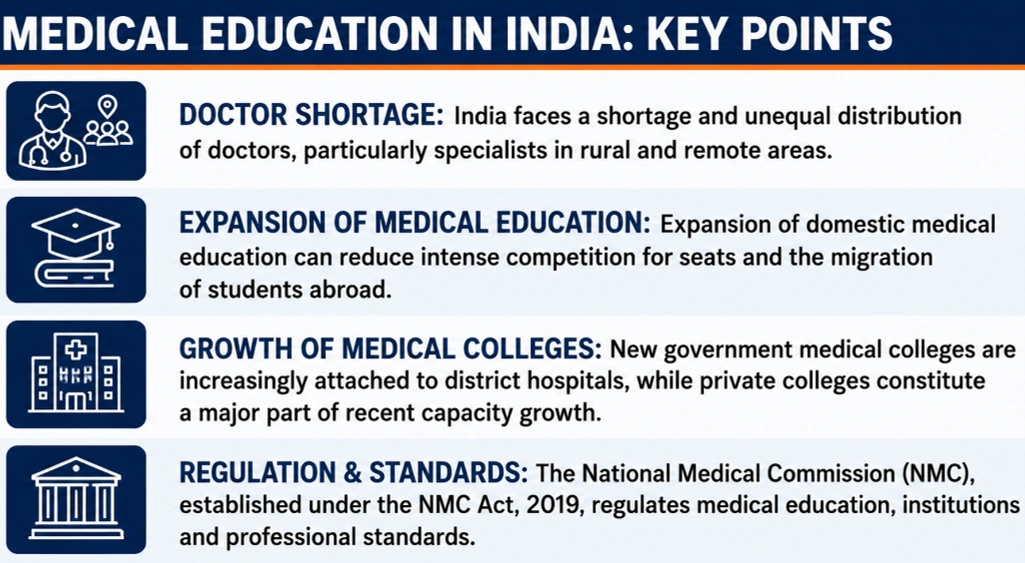
India’s medical-education capacity has expanded rapidly, with private institutions now accounting for more than half of all MBBS seats. Although this growth improves numerical access, high fees, geographical concentration, uneven quality and poor distribution of doctors continue to limit equitable healthcare.
Explanation
Expansion Driven by Private Institutions
- India has nearly doubled its number of medical seats in about 12 years.
- Private institutions now provide more than half of all MBBS seats and account for approximately 79% of around 10,000 newly added seats.
- This expansion increases opportunities and may help retain students who would otherwise pursue medical education abroad.
Affordability and Social Exclusion
- Government-college MBBS fees generally remain relatively low, while private-college education may cost several times more.
- High fees restrict access for capable students from low- and middle-income families.
- Education loans and informal capitation fees may create heavy debt, influencing graduates to select more remunerative specialties or urban practice.
Geographical and Healthcare Inequality
- Private colleges cluster in prosperous States and tier-I or tier-II cities, where demand and payment capacity are higher.
- Without incentives, graduates often remain in these centres, while rural and underserved areas continue to face doctor shortages.
- Thus, more medical seats do not automatically produce an equitable distribution of healthcare professionals.
Quality and Regulatory Concerns
- Rapid expansion may encourage institutions to satisfy minimum accreditation requirements without adequate faculty, clinical exposure, laboratories or hospital facilities.
- The NMC must strengthen surprise inspections, digital verification and scrutiny of institutional records.
- The rule permitting regulation of fees for 50% of seats in private medical institutions requires effective implementation.
Way Forward
- Governments should expand affordable public seats, including through new AIIMS-like institutions and district-hospital-based colleges.
- Scholarships, transparent fees and action against capitation charges are necessary.
- Rural service must be supported through competitive salaries, housing, schools, career progression and safe working conditions.
Conclusion
Private medical education can supplement public capacity but cannot substitute the State’s responsibility to provide affordable and equitable education. Expansion must be accompanied by strong regulation, quality assurance and incentives that direct medical professionals towards underserved regions.
Source: (The Hindu)
La Excellence IAS Academy, the best IAS coaching in Hyderabad, known for delivering quality content and conceptual clarity for UPSC 2026 preparation.
FOLLOW US ON:
◉ YouTube : https://www.youtube.com/@CivilsPrepTeam
◉ Facebook: https://www.facebook.com/LaExcellenceIAS
◉ Instagram: https://www.instagram.com/laexcellenceiasacademy/
GET IN TOUCH:
Contact us at info@laex.in, https://laex.in/contact-us/
or Call us @ +91 9052 29 2929, +91 9052 99 2929, +91 9154 24 2140
OUR BRANCHES:
Head Office: H No: 1-10-225A, Beside AEVA Fertility Center, Ashok Nagar Extension, VV Giri Nagar, Ashok Nagar, Hyderabad, 500020
Madhapur: Flat no: 301, survey no 58-60, Guttala begumpet Madhapur metro pillar: 1524, Rangareddy Hyderabad, Telangana 500081
Bangalore: Plot No: 99, 2nd floor, 80 Feet Road, Beside Poorvika Mobiles, Chandra Layout, Attiguppe, Near Vijaya Nagara, Bengaluru, 560040