
Paper: GS-II, Subject: International Relations, Topic: Agreements involving India and/or affecting India’s interests, Issue: Makkah Defence Pact: An Emerging West Asian Security Triangle
Context:
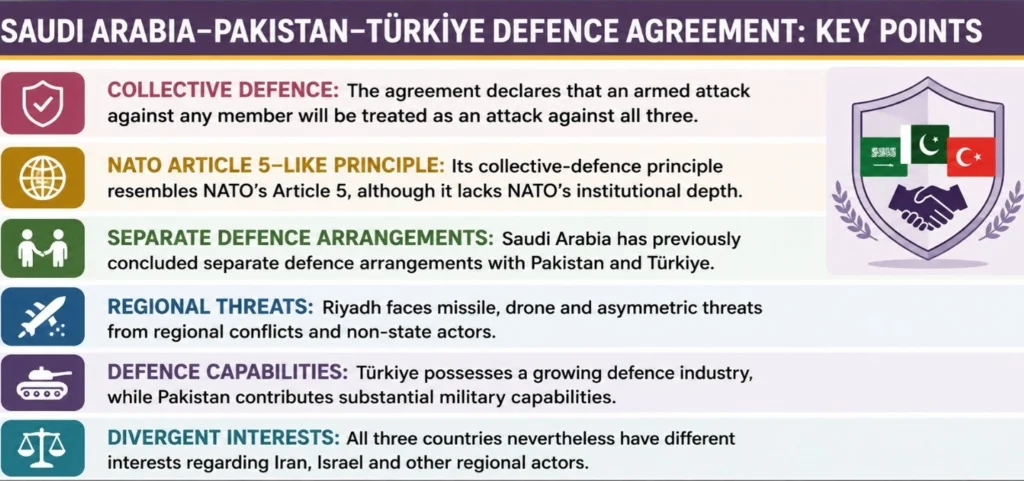
The Makkah Joint Defence Agreement (MJDA) was recently signed by Saudi Arabia, Türkiye and Pakistan, establishes a trilateral framework for collective defence. Emerging amid regional wars, Iranian tensions and uncertainty about United States security guarantees, it may reshape West Asia’s strategic balance and affect India’s interests.
Explanation
Nature and Purpose
- The agreement reportedly treats an armed attack against one member as an attack against all, resembling the principle of collective defence.
- It seeks to strengthen deterrence through intelligence-sharing, joint exercises, interoperability, training and defence-industrial cooperation.
- However, it is not automatically equivalent to NATO because its enforcement machinery, command structure and precise military obligations remain uncertain.
Strategic Motivations
- Saudi Arabia seeks stronger security options as American regional commitments appear less predictable.
- Türkiye may gain political influence, defence markets and opportunities to export weapons and military technology.
- Pakistan could obtain economic support and strategic relevance, although extensive overseas commitments may strain its resources.
Limitations and Regional Effects
- Differing policies towards Iran, Israel, the Muslim Brotherhood and regional conflicts could weaken cohesion.
- Pakistan’s economic difficulties, Türkiye’s NATO obligations and Saudi dependence on Western weapons constrain strategic autonomy.
- The arrangement may stimulate counter-alignments, arms competition and greater regional polarisation.
Implications for India
- India must monitor whether the partnership strengthens Pakistan’s military capabilities or affects the regional balance.
- Instability could threaten India’s energy imports, trade routes, diaspora and maritime interests.
- India should maintain issue-based partnerships with all three members while deepening relations with Iran, Israel, the Gulf states and other regional actors.
Conclusion
The MJDA signals growing regional efforts to diversify security partnerships, but its effectiveness will depend on political cohesion and credible implementation. India should avoid alarmism while pursuing balanced diplomacy, energy security and strategic preparedness.
Source: (The Hindu)
La Excellence IAS Academy, the best IAS coaching in Hyderabad, known for delivering quality content and conceptual clarity for UPSC 2026 preparation.
FOLLOW US ON:
◉ YouTube : https://www.youtube.com/@CivilsPrepTeam
◉ Facebook: https://www.facebook.com/LaExcellenceIAS
◉ Instagram: https://www.instagram.com/laexcellenceiasacademy/
GET IN TOUCH:
Contact us at info@laex.in, https://laex.in/contact-us/
or Call us @ +91 9052 29 2929, +91 9052 99 2929, +91 9154 24 2140
OUR BRANCHES:
Head Office: H No: 1-10-225A, Beside AEVA Fertility Center, Ashok Nagar Extension, VV Giri Nagar, Ashok Nagar, Hyderabad, 500020
Madhapur: Flat no: 301, survey no 58-60, Guttala begumpet Madhapur metro pillar: 1524, Rangareddy Hyderabad, Telangana 500081
Bangalore: Plot No: 99, 2nd floor, 80 Feet Road, Beside Poorvika Mobiles, Chandra Layout, Attiguppe, Near Vijaya Nagara, Bengaluru, 560040