
Paper: GS – I/II, Subject: Society and social Justice, Topic: Social Sector – Education, Issue: Ensuring Equity amid India’s Educational Progress (UDISE+).
Context:
Recently, the Unified District Information System for Education Plus (UDISE+) 2025-26 report recorded improvements in enrolment, retention, teacher availability and school infrastructure. However, substantial regional and social disparities continue to prevent equal access to quality education.
Key Takeaways:
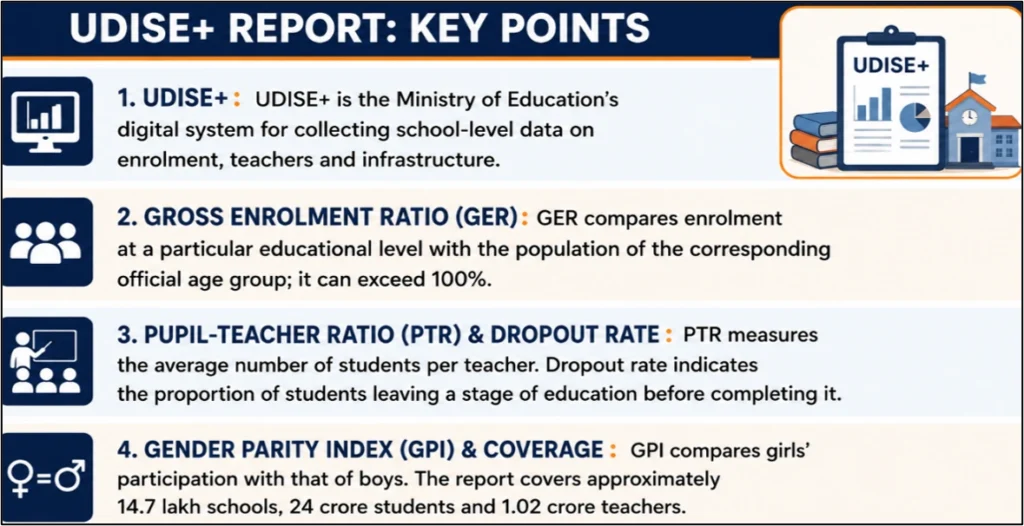
Explanation:
Progress Recorded:
- Gross enrolment, student retention, teacher availability and access to drinking water and electricity have generally improved.
- Girls’ enrolment is higher than boys’ enrolment across most school levels and States.
- Aadhaar seeding has reached 90.2% nationally, although it ranges from 99.6% in Andhra Pradesh to 35% in Meghalaya.
Regional Imbalances:
- GER varies sharply across educational stages and States; high values may reflect over-age or under-age enrolment, migration and cross-border attendance.
- Bihar records some of the lowest GER levels, including 24 at the foundational stage and 48 at the secondary stage.
- Average school size ranges from 1,194 students in Chandigarh to 64 in Ladakh, demonstrating unequal institutional scale.
- Rural, tribal, border and remote regions still face distance, transport, digital-connectivity and infrastructure barriers.
Teacher and Learning Gaps:
- High PTR increases teachers’ workload and reduces individual attention. Jharkhand records a secondary-level PTR of 43, while Sikkim records 6.
- Rural teachers often manage multiple classes, subjects and non-teaching duties.
- Recruitment has improved, but unequal deployment continues to produce shortages in disadvantaged regions.
Social and Inclusion Concerns:
- Scheduled Castes, Scheduled Tribes, minorities, economically weaker families and children with disabilities face greater risks of irregular attendance and non-completion.
- Ladakh records a secondary dropout rate of 14.8%, compared with 1.5% in West Bengal.
- Accessible classrooms, assistive facilities and supportive teaching remain inadequate for many children with disabilities.
Way Forward:
- Funding should prioritise educationally backward districts through transparent, outcome-based criteria.
- Teacher deployment must be rationalised, with incentives for service in remote areas.
- Digital access, school transport, inclusive infrastructure and local-language learning support should be expanded.
- Data must guide early-warning systems for students at risk of dropping out.
Conclusion:
India has expanded schooling successfully, but access alone does not guarantee educational justice. A regionally targeted strategy integrating equity, accessibility and learning quality is essential for fulfilling the objectives of the National Education Policy, 2020.
Source: (The Hindu)
La Excellence IAS Academy, the best IAS coaching in Hyderabad, known for delivering quality content and conceptual clarity for UPSC 2026 preparation.
FOLLOW US ON:
◉ YouTube : https://www.youtube.com/@CivilsPrepTeam
◉ Facebook: https://www.facebook.com/LaExcellenceIAS
◉ Instagram: https://www.instagram.com/laexcellenceiasacademy/
GET IN TOUCH:
Contact us at info@laex.in, https://laex.in/contact-us/
or Call us @ +91 9052 29 2929, +91 9052 99 2929, +91 9154 24 2140
OUR BRANCHES:
Head Office: H No: 1-10-225A, Beside AEVA Fertility Center, Ashok Nagar Extension, VV Giri Nagar, Ashok Nagar, Hyderabad, 500020
Madhapur: Flat no: 301, survey no 58-60, Guttala begumpet Madhapur metro pillar: 1524, Rangareddy Hyderabad, Telangana 500081
Bangalore: Plot No: 99, 2nd floor, 80 Feet Road, Beside Poorvika Mobiles, Chandra Layout, Attiguppe, Near Vijaya Nagara, Bengaluru, 560040