
Paper: GS-III, Subject: Economy, Topic: Fiscal policy and Budgeting, Issue: Centre’s Fiscal Outlook: Balancing Revenue Pressures and Geopolitical Risks (Tax buoyancy).
Context:
The Centre’s finances for 2026-27 face pressure from weak tax collections, higher subsidies and geopolitical instability, particularly elevated crude-oil prices. Nevertheless, strong non-tax receipts, front-loaded capital expenditure and remedial revenue measures may keep the overall fiscal outcome broadly near the Budget estimates.
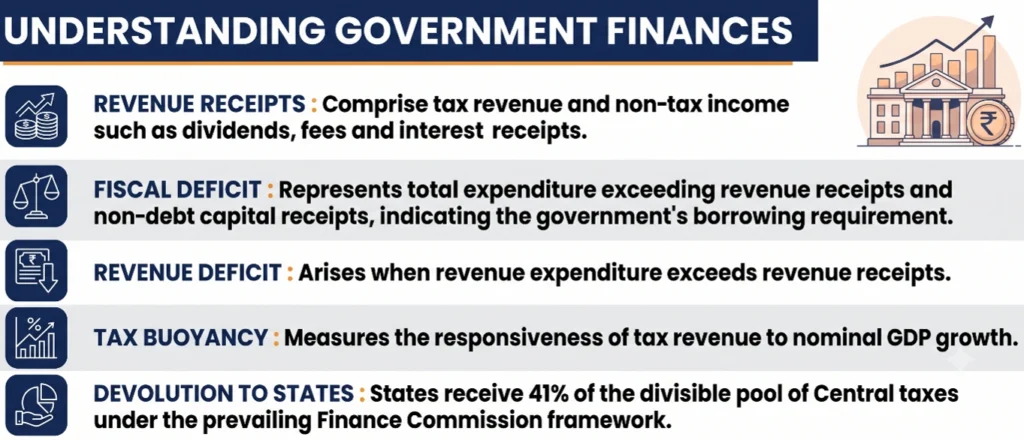
Explanation
Tax-Revenue Pressures
- The Centre’s gross tax revenue grew by only 3.7% during the first quarter of 2026-27.
- Personal income-tax receipts increased by 6.8%, while GST revenue contracted by 11%, partly reflecting rate rationalisation and initial revenue sacrifices.
- Higher fuel prices led to reductions in excise duty; consequently, Union excise collections contracted by 22.4%.
- Increased customs duties, a windfall tax on fuel exports and the Health Security and National Security Cess were introduced to partly compensate for revenue losses.
Growth and Revenue Outlook
- Nominal GDP growth may reach 12.5–13%, compared with the budgeted 10.04%, supported by about 7% real growth and 5–5.5% inflation.
- However, the estimated nominal GDP of ₹391 lakh crore may remain below the budgeted ₹393 lakh crore because of base-year revisions.
- Therefore, gross tax revenue may meet or marginally miss its target.
Transfers to States
- Tax devolution to States contracted by 19.5% in the first quarter but is expected to recover later.
- Non-shareable cesses can reduce the divisible pool, although some proceeds may return to States through grants.
- Finance Commission grants to States are budgeted to decline by ₹23,556 crore.
Geopolitical Risks
- A prolonged West Asian conflict may disrupt energy supplies and keep global crude-oil prices elevated.
- A higher oil-import bill can weaken the rupee, widen the current-account deficit and increase imported inflation.
- Conflict, sanctions and shipping disruptions can raise freight, insurance, fertiliser and industrial-input costs
Expenditure, Deficit and Debt
- Major subsidies increased by 37.4%; sustained oil-price pressure could produce a subsidy overrun of nearly ₹50,000 crore.
- Capital expenditure grew by 23.7%, supporting infrastructure and aggregate demand.
- Strong non-tax receipts, including RBI dividends, helped limit the first-quarter fiscal deficit to 18.2% of the annual target.
- The full-year fiscal deficit is estimated at ₹18.16 lakh crore, or 4.6% of GDP, while Central debt may remain near 55.8% of GDP.
Conclusion
India’s fiscal position presently appears manageable, but it remains vulnerable to oil-price shocks, weak tax buoyancy and subsidy escalation. Sustained fiscal stability requires broader tax bases, prudent subsidy management, predictable transfers to States and protection of growth-enhancing capital expenditure
Source: (The Hindu)
La Excellence IAS Academy, the best IAS coaching in Hyderabad, known for delivering quality content and conceptual clarity for UPSC 2026 preparation.
FOLLOW US ON:
◉ YouTube : https://www.youtube.com/@CivilsPrepTeam
◉ Facebook: https://www.facebook.com/LaExcellenceIAS
◉ Instagram: https://www.instagram.com/laexcellenceiasacademy/
GET IN TOUCH:
Contact us at info@laex.in, https://laex.in/contact-us/
or Call us @ +91 9052 29 2929, +91 9052 99 2929, +91 9154 24 2140
OUR BRANCHES:
Head Office: H No: 1-10-225A, Beside AEVA Fertility Center, Ashok Nagar Extension, VV Giri Nagar, Ashok Nagar, Hyderabad, 500020
Madhapur: Flat no: 301, survey no 58-60, Guttala begumpet Madhapur metro pillar: 1524, Rangareddy Hyderabad, Telangana 500081
Bangalore: Plot No: 99, 2nd floor, 80 Feet Road, Beside Poorvika Mobiles, Chandra Layout, Attiguppe, Near Vijaya Nagara, Bengaluru, 560040