
Paper: GS-III, Subject: Economy, Topic: Irrigation – Types and Systems, Issue: Solar Irrigation and Groundwater Sustainability
Context:
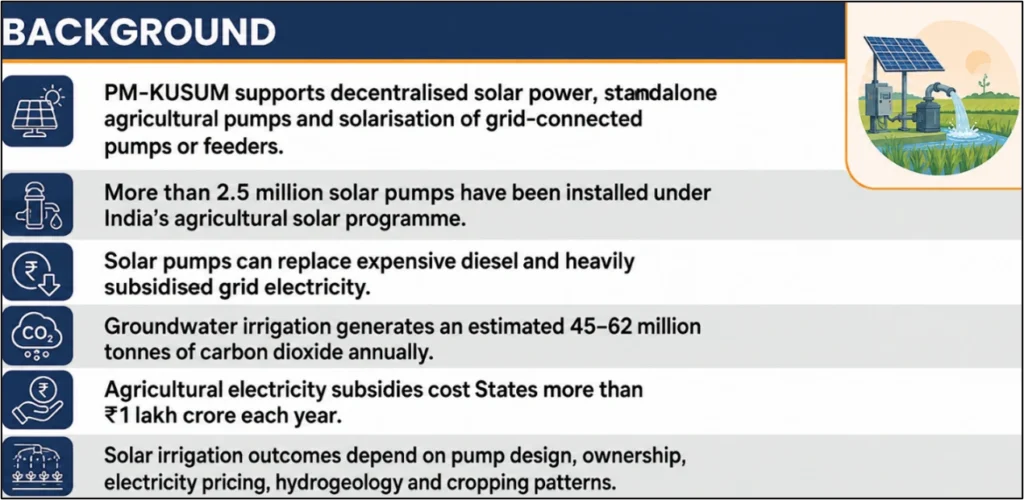
India’s PM-KUSUM programme has installed more than 2.5 million solar pumps, expanding affordable and clean irrigation. However, as PM-KUSUM 2.0 is prepared, policy design must ensure that nearly free solar energy does not encourage excessive.
Explanation
Diverse Irrigation Models
- Standalone pumps provide reliable irrigation in regions lacking electricity, but unrestricted operation may encourage excessive pumping.
- Grid-connected systems allow farmers to sell surplus electricity, creating a financial incentive to conserve water.
- Community or fee-for-service models can supply water to multiple farmers and improve access for smallholders.
Regional Variation
- Solar irrigation can improve productivity and climate resilience in rain-fed areas with unreliable electricity and limited irrigation.
- In Punjab and Haryana, where water-intensive crops and irrigation are already widespread, additional pumping may worsen aquifer depletion.
- Consequently, a uniform national policy cannot address India’s diverse groundwater conditions.
Environmental and Economic Benefits
- Solar pumps can lower emissions, diesel consumption and government subsidy burdens.
- Gujarat’s grid-connected model indicates that rewarding farmers for exported electricity can moderate pumping and generate farm income.
- Community models may discourage over-extraction because operators must preserve water for multiple users.
Policy Priorities
- Groundwater conditions should determine where standalone and grid-connected pumps are deployed.
- Buy-back tariffs must reflect local water scarcity, crops and electricity-distribution costs.
- Solarisation should be combined with micro-irrigation, groundwater monitoring, water budgeting and crop diversification.
- DISCOMs should receive incentives to support feeder solarisation and electricity purchases.
- Irrigation-deficient regions should prioritise expanding access, while over-exploited regions should emphasise conservation and collective water management.
- States should introduce metering, water-use monitoring and attractive tariffs for selling surplus solar electricity.
- Farmer cooperatives and water-user associations should manage shared systems, while periodic evaluation should measure groundwater, income and emission outcomes.
Conclusion
Solar irrigation is neither inherently harmful nor automatically sustainable. Its success depends on deploying appropriate models in appropriate regions and integrating renewable energy policy with groundwater governance, agricultural incentives and equitable access.
Source: (The Hindu)
La Excellence IAS Academy, the best IAS coaching in Hyderabad, known for delivering quality content and conceptual clarity for UPSC 2026 preparation.
FOLLOW US ON:
◉ YouTube : https://www.youtube.com/@CivilsPrepTeam
◉ Facebook: https://www.facebook.com/LaExcellenceIAS
◉ Instagram: https://www.instagram.com/laexcellenceiasacademy/
GET IN TOUCH:
Contact us at info@laex.in, https://laex.in/contact-us/
or Call us @ +91 9052 29 2929, +91 9052 99 2929, +91 9154 24 2140
OUR BRANCHES:
Head Office: H No: 1-10-225A, Beside AEVA Fertility Center, Ashok Nagar Extension, VV Giri Nagar, Ashok Nagar, Hyderabad, 500020
Madhapur: Flat no: 301, survey no 58-60, Guttala begumpet Madhapur metro pillar: 1524, Rangareddy Hyderabad, Telangana 500081
Bangalore: Plot No: 99, 2nd floor, 80 Feet Road, Beside Poorvika Mobiles, Chandra Layout, Attiguppe, Near Vijaya Nagara, Bengaluru, 560040