
Paper: GS – III, Subject: Economy, Topic: Industry and Industrial policies, Issue: Redefining “Industry”: The Supreme Court and Labour Protection (Industry Definition).
Context:
Recently, a nine-judge Constitution Bench of the Supreme Court held that the definition of “industry” under the Industrial Relations Code, 2020 must be interpreted independently. The expansive interpretation developed under the repealed Industrial Disputes Act, 1947 will continue only for disputes governed by that Act.
Key Takeaways:
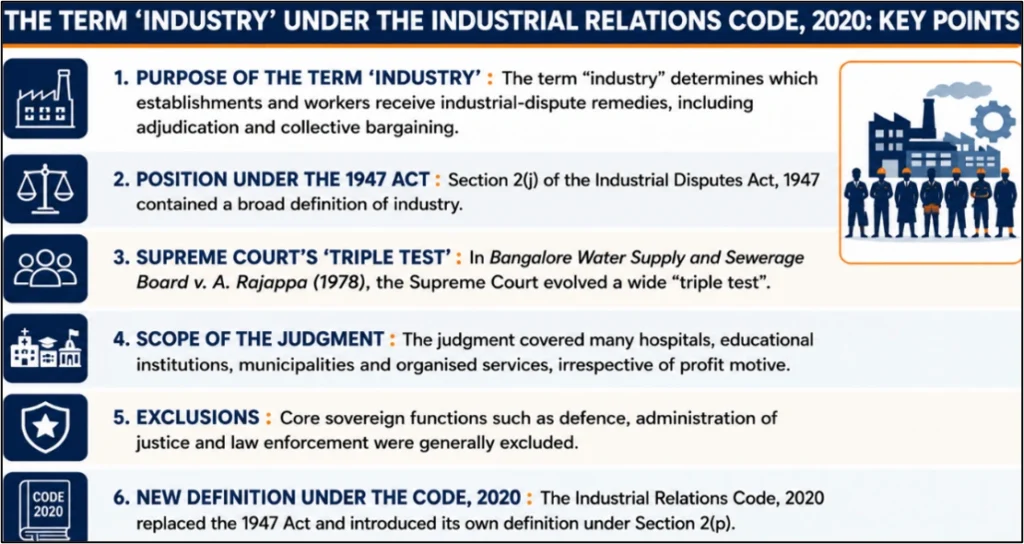
Explanation:
The 1978 Triple Test:
- An activity was treated as an industry when there was:
- systematic activity;
- cooperation between employer and employees; and
- production or distribution of goods or services calculated to satisfy human wants.
- Capital investment or a profit motive was not essential, making the test strongly protective of workers.
Majority Ruling:
- The majority held that the 2020 Code is an independent legislative enactment with distinct text, purposes and exclusions.
- Therefore, the Bangalore Water Supply test cannot automatically serve as a “sheet anchor” for interpreting the new Code.
- Pending disputes under the repealed 1947 Act will, however, continue to be decided according to the 1978 precedent.
- Future disputes under the 2020 Code must be interpreted from its own wording and contemporary industrial context.
- This creates a “clean slate” while preserving legal certainty for older disputes.
Differences within the Bench:
- The Chief Justice supported independent interpretation but suggested that the older triple test could potentially be reformulated for modern conditions.
- Three judges considered reconsideration of the 1978 ruling unnecessary and cautioned that altering a long-standing definition could create uncertainty.
- They emphasised judicial consistency, institutional credibility and respect for settled precedent.
Implications for Labour Rights:
- A narrower interpretation could exclude some establishments and workers from specialised industrial-dispute remedies.
- Employers may gain operational flexibility, but workers with weaker bargaining power could lose access to labour courts and collective protections.
- Future courts must balance ease of doing business with constitutional commitments to dignity, humane working conditions and social justice under Articles 23, 39 and 42.
Conclusion:
The ruling separates the new labour regime from the legacy of the 1978 precedent without disturbing pending cases. Its long-term significance will depend on whether future interpretation maintains industrial efficiency while protecting workers against unequal bargaining power.
Source: (The Hindu)
La Excellence IAS Academy, the best IAS coaching in Hyderabad, known for delivering quality content and conceptual clarity for UPSC 2026 preparation.
FOLLOW US ON:
◉ YouTube : https://www.youtube.com/@CivilsPrepTeam
◉ Facebook: https://www.facebook.com/LaExcellenceIAS
◉ Instagram: https://www.instagram.com/laexcellenceiasacademy/
GET IN TOUCH:
Contact us at info@laex.in, https://laex.in/contact-us/
or Call us @ +91 9052 29 2929, +91 9052 99 2929, +91 9154 24 2140
OUR BRANCHES:
Head Office: H No: 1-10-225A, Beside AEVA Fertility Center, Ashok Nagar Extension, VV Giri Nagar, Ashok Nagar, Hyderabad, 500020
Madhapur: Flat no: 301, survey no 58-60, Guttala begumpet Madhapur metro pillar: 1524, Rangareddy Hyderabad, Telangana 500081
Bangalore: Plot No: 99, 2nd floor, 80 Feet Road, Beside Poorvika Mobiles, Chandra Layout, Attiguppe, Near Vijaya Nagara, Bengaluru, 560040