
Paper: GS – II, Subject: Social Justice, Topic: Protection of Vulnerable Sections, Issue: Institutional Discrimination against Dalits, tribal communities, and minorities.
Context:
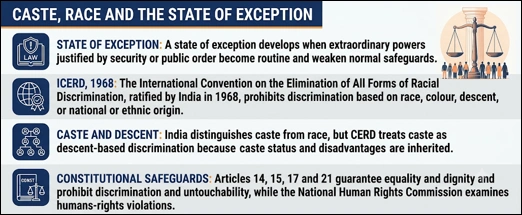
Recently, the United Nations Committee on the Elimination of Racial Discrimination (CERD) reviewed India after 2007. It raised concerns about discrimination against Dalits, tribal communities, minorities, refugees and non-citizens.
Key Takeaways:
Explanation:
Key concerns:
- CERD highlighted alleged law-enforcement violence against minorities, Dalits and non-citizens, and inadequate information about inquiries, punishments and compensation.
- Hazardous manual sewer cleaning persists despite prohibition. Hate speech and poor living conditions also demonstrate occupational and socioeconomic discrimination.
- Returning Rohingya refugees may violate non-refoulement, the principle against sending people to places where they face persecution.
- The National Register of Citizens (NRC) may exclude residents lacking documents. Special Intensive Revision (SIR) electoral-roll deletions may similarly disenfranchise eligible voters.
Legal and institutional gaps:
- The Foreign Contribution (Regulation) Act (FCRA), Unlawful Activities (Prevention) Act (UAPA), Armed Forces (Special Powers) Act (AFSPA) and Prevention of Money Laundering Act (PMLA) serve legitimate purposes, but disproportionate use may restrict civil society.
- The Bharatiya Nyaya Sanhita (BNS) does not expressly criminalise racist hate speech. Forest-law exemptions for national-security projects may weaken tribal consultation.
- Remedies remain fragmented across courts and commissions. Delayed Census and National Crime Records Bureau (NCRB) data obstruct community-wise assessment.
- Dependence on the 2011 Census may hide worsening tribal conditions. The Global Alliance of National Human Rights Institutions (GANHRI) recommended downgrading the NHRC over police-led investigations and inadequate pluralism.
- Treating caste only as a domestic matter, or dismissing CERD as political, may weaken international accountability.
Way forward:
- India should publish disaggregated data, investigate violence independently, disclose prosecution outcomes and ensure transparent electoral revisions.
- The NHRC needs autonomy, diverse membership and independent investigators. Mechanised sewer cleaning, rehabilitation, affirmative action and precise hate-speech provisions are necessary.
- Civil society should document violations, assist victims and engage with domestic and multilateral institutions.
Conclusion:
Security and sovereignty are legitimate, but cannot justify routine suspension of equality, consultation and accountability. Strong institutions, current data and fair enforcement must prevent exceptional powers from normalising discrimination.
Source: (The Hindu)
La Excellence IAS Academy, the best IAS coaching in Hyderabad, known for delivering quality content and conceptual clarity for UPSC 2026 preparation.
FOLLOW US ON:
◉ YouTube : https://www.youtube.com/@CivilsPrepTeam
◉ Facebook: https://www.facebook.com/LaExcellenceIAS
◉ Instagram: https://www.instagram.com/laexcellenceiasacademy/
GET IN TOUCH:
Contact us at info@laex.in, https://laex.in/contact-us/
or Call us @ +91 9052 29 2929, +91 9052 99 2929, +91 9154 24 2140
OUR BRANCHES:
Head Office: H No: 1-10-225A, Beside AEVA Fertility Center, Ashok Nagar Extension, VV Giri Nagar, Ashok Nagar, Hyderabad, 500020
Madhapur: Flat no: 301, survey no 58-60, Guttala begumpet Madhapur metro pillar: 1524, Rangareddy Hyderabad, Telangana 500081
Bangalore: Plot No: 99, 2nd floor, 80 Feet Road, Beside Poorvika Mobiles, Chandra Layout, Attiguppe, Near Vijaya Nagara, Bengaluru, 560040