
Paper: GS – II, Subject: Polity, Topic: Rights issues, Issue: Religion, Women’s Public Participation and Constitutional Equality.
Context:
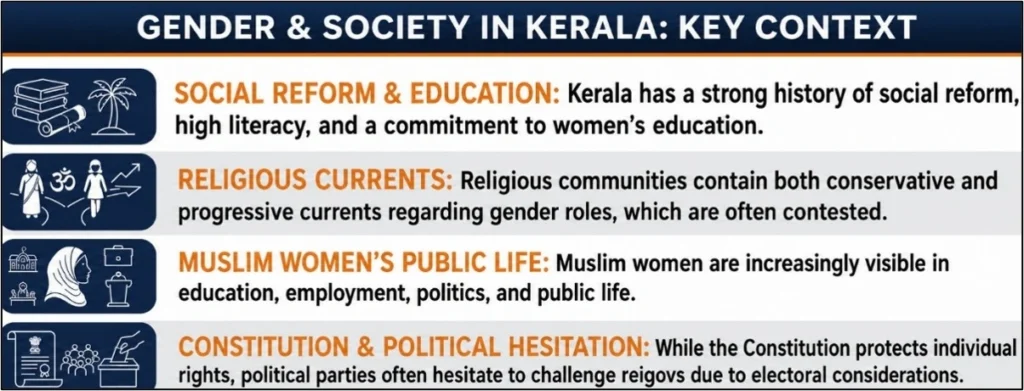
A recent controversy in Kerala over restrictions on Muslim women’s participation in public religious celebrations has revived the debate on the limits of religious authority. The issue concerns the balance between freedom of religion, women’s autonomy and constitutional equality.
Key Takeaways:
Explanation:
Religious authority versus individual rights:
- Religious groups may regulate genuine religious practices, but community authority cannot automatically determine women’s movement, association or participation in public spaces.
- Gender-based exclusion from public life therefore becomes a constitutional issue, not merely a religious one.
- Article 14 guarantees equality before law.
- Article 15(1) prohibits discrimination on grounds including religion and sex.
- Article 19(1)(d) protects freedom of movement.
- Article 21 protects life, dignity and personal autonomy.
Religious freedom and constitutional limits:
- Article 25 guarantees freedom of conscience and the right to profess, practise and propagate religion.
- However, it is subject to public order, morality, health and other Fundamental Rights.
- Article 26 protects the autonomy of religious denominations in managing religious affairs.
- Article 25(2) permits State intervention in secular activities associated with religion and for social welfare and reform.
- Thus, religious freedom must coexist with equality, dignity and liberty.
Women and the public sphere:
- Participation in education, employment, politics and public events is an element of equal citizenship.
- Restrictions based only on gender can reinforce patriarchy and social segregation.
- Article 15(3) permits special provisions for women to promote substantive equality.
- Article 51A(e) calls upon citizens to renounce practices derogatory to the dignity of women.
Diversity within religious communities:
- Religious communities are not monolithic.
- Muslim society includes orthodox, reformist, progressive and feminist voices.
- Sustainable reform is stronger when women themselves participate in reinterpretation and social change.
Political responsibility and way forward:
- Political parties should not remain silent merely to protect organised vote banks.
- Women’s education, employment and political representation should be expanded.
- Constitutional awareness and dialogue within communities should be encouraged.
- Religious freedom must be balanced with autonomy, dignity and equality.
Conclusion:
India’s constitutional framework does not require a choice between religion and women’s rights. It seeks to protect religious freedom under Articles 25–26 while safeguarding equality and dignity under Articles 14, 15 and 21.
Source: (The Hindu)
La Excellence IAS Academy, the best IAS coaching in Hyderabad, known for delivering quality content and conceptual clarity for UPSC 2026 preparation.
FOLLOW US ON:
◉ YouTube : https://www.youtube.com/@CivilsPrepTeam
◉ Facebook: https://www.facebook.com/LaExcellenceIAS
◉ Instagram: https://www.instagram.com/laexcellenceiasacademy/
GET IN TOUCH:
Contact us at info@laex.in, https://laex.in/contact-us/
or Call us @ +91 9052 29 2929, +91 9052 99 2929, +91 9154 24 2140
OUR BRANCHES:
Head Office: H No: 1-10-225A, Beside AEVA Fertility Center, Ashok Nagar Extension, VV Giri Nagar, Ashok Nagar, Hyderabad, 500020
Madhapur: Flat no: 301, survey no 58-60, Guttala begumpet Madhapur metro pillar: 1524, Rangareddy Hyderabad, Telangana 500081
Bangalore: Plot No: 99, 2nd floor, 80 Feet Road, Beside Poorvika Mobiles, Chandra Layout, Attiguppe, Near Vijaya Nagara, Bengaluru, 560040
Muslim Women Rights: Religion and Constitutional Equality