
Indian farming has moved from bullocks and manure to tractors, diesel pumps, chemical fertilisers and petroleum-based pesticides (‘fossilisation’), while high crude prices make it profitable to turn food crops into fuel (‘fuelisation’). Recent conflicts have exposed both risks together.
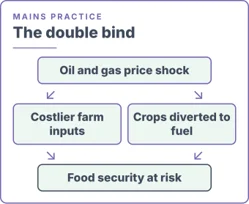
Fossilisation of Farming
- Fertilisers: Urea depends on natural gas (LNG) and phosphatic fertilisers on sulphur; both have seen steep price rises.
- Energy use: Tractors, combines and diesel pumps tie farm costs to oil prices.
- Import dependence: India imports gas, ammonia, rock phosphate, potash and pesticide intermediates.
Fuelisation of Food
- Ethanol blending (up to 20%) draws on sugarcane, rice and maize; biodiesel mandates abroad tighten edible oil supplies.
- During droughts such as a strong El Niño year, diverting grain to fuel can raise food prices.
Implications
- Food security: Costlier inputs and lower yields can raise food inflation and hurt small farmers.
- Fiscal and external stress: A larger fertiliser subsidy and import bill widen deficits and pressure the rupee.
- Twin shock risk: As in 1979-80, an oil shock combined with drought can sharply cut farm output.
Way Forward
- Replace urea and DAP with balanced complex fertilisers, nano and bio-fertilisers, and soil health-based dosing.
- Expand solar pumps (PM-KUSUM), drip irrigation and electric farm machinery.
- Prioritise surplus and non-food feedstocks for ethanol, and keep food ahead of fuel during droughts.
- Secure inputs through joint ventures abroad and strategic reserves.
Conclusion
Diversification and irrigation have made Indian agriculture more resilient than in 1979-80. Lowering its hydrocarbon intensity and sequencing biofuel policy around food needs will safeguard both food and energy security.
La Excellence IAS Academy, the best IAS coaching in Hyderabad, known for delivering quality content and conceptual clarity for UPSC 2026 preparation.
FOLLOW US ON:
◉ YouTube: https://www.youtube.com/@CivilsPrepTeam
◉ Facebook: https://www.facebook.com/LaExcellenceIAS
◉ Instagram: https://www.instagram.com/laexcellenceiasacademy/
GET IN TOUCH:
Contact us at info@laex.in, https://laex.in/contact-us/
or Call us @ +91 9052 29 2929, +91 9052 99 2929, +91 9154 24 2140
OUR BRANCHES:
Head Office: H No: 1-10-225A, Beside AEVA Fertility Center, Ashok Nagar Extension, VV Giri Nagar, Ashok Nagar, Hyderabad, 500020
Madhapur: Flat no: 301, survey no 58-60, Guttala begumpet Madhapur metro pillar: 1524, Rangareddy Hyderabad, Telangana 500081
Bangalore: Plot No: 99, 2nd floor, 80 Feet Road, Beside Poorvika Mobiles, Chandra Layout, Attiguppe, Near Vijaya Nagara, Bengaluru, 560040
Indian Agriculture Energy Security: Policy Reforms