
Paper: GS-II | Subject: Polity | Topic: Federalism, Union Territories and Tribal Autonomy | Issue: Constitutional Safeguards and Democratic Governance in Ladakh
Context
Recently, the Union Ministry of Home Affairs proposed a governance framework for Ladakh through a new Article 371K. However, representatives from Leh and Kargil opposed the draft, citing inadequate legislative powers, administrative autonomy and constitutional safeguards.
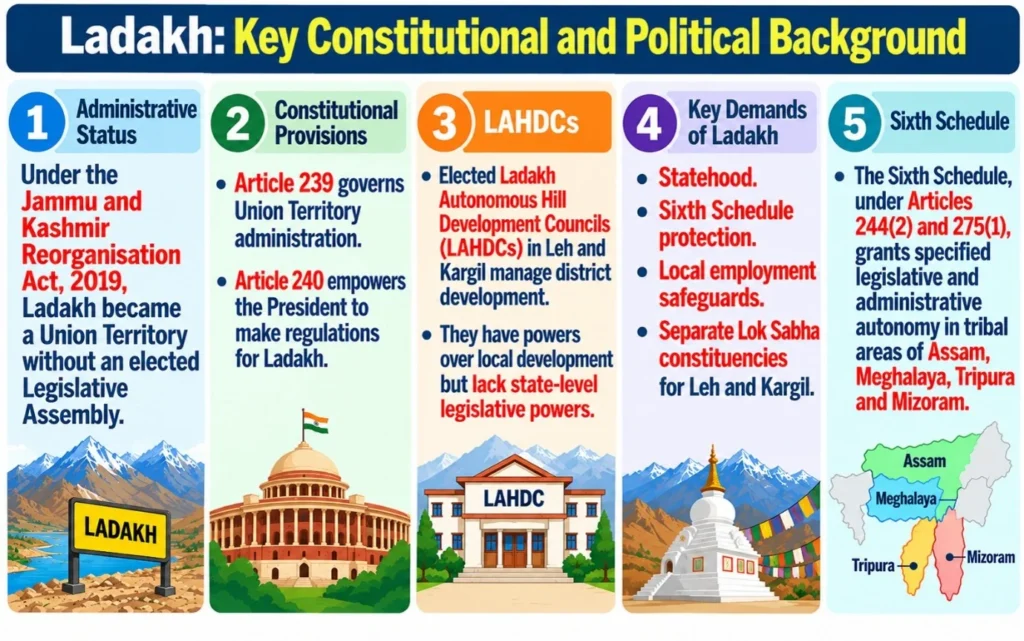
Explanation
Proposed Governance Mechanism
- Article 371K remains a proposal and would require a constitutional amendment under Article 368 before taking effect.
- It envisages an elected Union Territory-level body with specified legislative, executive and financial powers.
- Its proposed subjects include community land, culture, certain forests, environmental planning and local development in the fragile Himalayan region.
- However, its law-making powers would remain narrower than those of a state Legislative Assembly under the Seventh Schedule.
- Presidential regulations under Article 240 would define its authority, while Lieutenant Governor approval for local regulations would preserve considerable Union control.
Challenges and Implications
- The Leh Apex Body (LAB) and Kargil Democratic Alliance (KDA) seek greater powers over official appointments, transfers and administrative supervision.
- They argue that the draft falls short of earlier understandings on legislative, executive, financial and administrative autonomy, weakening democratic decentralisation.
- Article 371A protects specified Naga customary practices and land rights, but the proposed framework offers no equivalent safeguards.
- The Civil Society Forum of Ladakh (CSFL) has questioned whether negotiations adequately include diverse communities, raising concerns about participatory governance.
- Asymmetric federalism permits different levels of autonomy across regions; Ladakh illustrates tensions between tribal identity and Union oversight.
Way Forward
- Meaningful Autonomy: Constitutional provisions should clearly define legislative competence, fiscal devolution and administrative accountability while preserving necessary national security oversight.
- Inclusive Consultations: Negotiations should include the Hill Councils, organisations from Leh and Kargil, and other affected communities.
- Constitutional Safeguards: Enforceable protections for community land, local employment, customary practices and the fragile Himalayan environment can strengthen representative institutions.
Conclusion
Ladakh’s constitutional debate concerns the balance between central administration and meaningful local self-government. A durable settlement requires accountable elected institutions, inclusive negotiations and credible protection of tribal and regional interests.
Source: (The Indian Express, The Hindu)
La Excellence IAS Academy, the best IAS coaching in Hyderabad, known for delivering quality content and conceptual clarity for UPSC 2026 preparation.
FOLLOW US ON:
◉ YouTube: https://www.youtube.com/@CivilsPrepTeam
◉ Facebook: https://www.facebook.com/LaExcellenceIAS
◉ Instagram: https://www.instagram.com/laexcellenceiasacademy/
GET IN TOUCH:
Contact us at info@laex.in, https://laex.in/contact-us/
or Call us @ +91 9052 29 2929, +91 9052 99 2929, +91 9154 24 2140
OUR BRANCHES:
Head Office: H No: 1-10-225A, Beside AEVA Fertility Center, Ashok Nagar Extension, VV Giri Nagar, Ashok Nagar, Hyderabad, 500020
Madhapur: Flat no: 301, survey no 58-60, Guttala begumpet Madhapur metro pillar: 1524, Rangareddy Hyderabad, Telangana 500081
Bangalore: Plot No: 99, 2nd floor, 80 Feet Road, Beside Poorvika Mobiles, Chandra Layout, Attiguppe, Near Vijaya Nagara, Bengaluru, 560040