
Paper: GS Paper III; Subject: Environment, Ecology and Disaster Management; Topic: Pollution; Issue:Delhi’s Air Pollution Crisis
Context: Delhi’s Air Pollution Crisis
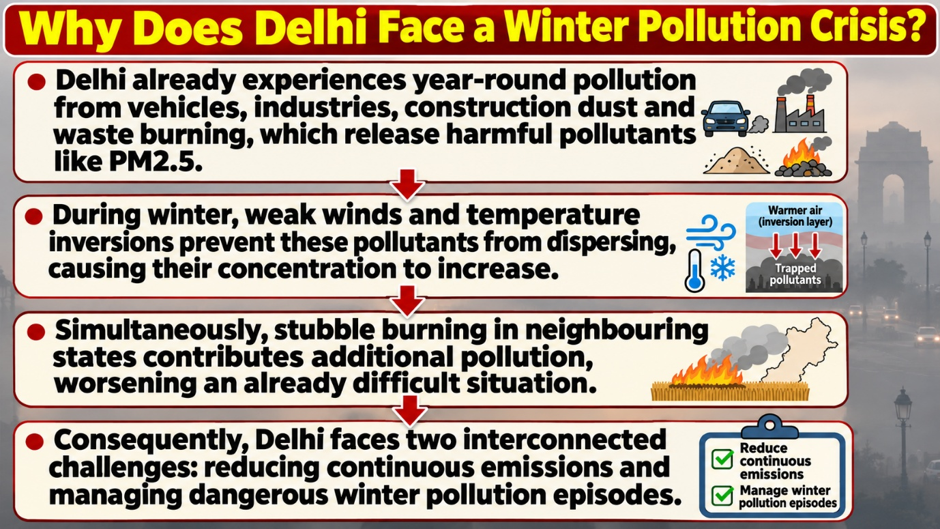
Despite repeated interventions, Delhi’s air quality deteriorated into the Very Poor category in November 2026. This has renewed concerns about the effectiveness of seasonal pollution-control measures and highlighted the need for a long-term, science-based approach.
1. Government Response: From Pollution Control to Emergency Restrictions
To address these challenges, authorities introduced several measures that have progressively become stricter.
- Long-Term Measures: The National Clean Air Programme (2019) and Commission for Air Quality Management (CAQM) seek sustained emission reductions and regional coordination.
- Winter Action Plan (November 1, 2026): Delhi introduced measures such as No PUCC, No Fuel, vehicle restrictions, construction curbs and stricter dust control.
- GRAP: As pollution worsens, authorities activate the Graded Response Action Plan, progressively restricting polluting activities according to AQI levels and forecasts.
However, Delhi’s AQI entered the Very Poor category on the first day of the Winter Action Plan, exposing the limitations of emergency measures.
2. Understanding GRAP: Four Stages of Pollution Control

3. Why Are Existing Measures Insufficient?
The fundamental limitation is that GRAP addresses pollution episodes rather than their underlying causes.
- Persistent Emissions: Even without stubble burning, vehicles, industries and dust contribute heavily to Delhi’s pollution.
- Scientific Monitoring Gaps: NASA satellites may miss afternoon stubble fires. Korean satellite observations indicate that over 90% of Punjab’s fires during 2024-25 occurred after 3 PM, revealing possible underestimation.
- Changing Meteorology: El Niño-related rainfall variations, weak winds and delayed winter conditions complicate forecasting and pollution management.
4. Way Forward: From Emergency Response to Scientific Planning
Therefore, Delhi must adopt airshed-based management, recognising that pollution crosses administrative boundaries. Continuous satellite monitoring, coordinated interstate action, cleaner transport, industrial emission control and year-round enforcement must complement emergency restrictions.
Conclusion
GRAP can temporarily reduce exposure, but it cannot eliminate Delhi’s structural pollution problem. Lasting improvement requires shifting from reactive crisis management to preventive, science-based environmental governance.
Source: (The Indian Express)
La Excellence IAS Academy, the best IAS coaching in Hyderabad, known for delivering quality content and conceptual clarity for UPSC 2026 preparation.
FOLLOW US ON:
◉ YouTube: https://www.youtube.com/@CivilsPrepTeam
◉ Facebook: https://www.facebook.com/LaExcellenceIAS
◉ Instagram: https://www.instagram.com/laexcellenceiasacademy/
GET IN TOUCH:
Contact us at info@laex.in, https://laex.in/contact-us/
or Call us @ +91 9052 29 2929, +91 9052 99 2929, +91 9154 24 2140
OUR BRANCHES:
Head Office: H No: 1-10-225A, Beside AEVA Fertility Center, Ashok Nagar Extension, VV Giri Nagar, Ashok Nagar, Hyderabad, 500020
Madhapur: Flat no: 301, survey no 58-60, Guttala begumpet Madhapur metro pillar: 1524, Rangareddy Hyderabad, Telangana 500081
Bangalore: Plot No: 99, 2nd floor, 80 Feet Road, Beside Poorvika Mobiles, Chandra Layout, Attiguppe, Near Vijaya Nagara, Bengaluru, 560040