
Paper: GS Paper III; Subject: Environment, Ecology and Disaster Management; Topic: Environmental Impact Assessment; Issue: Large Dams, Environmental Impact Assessment and Indigenous Rights.
Context: National Security vs Indigenous Rights
The proposed Siang Upper Multipurpose Project (SUMP) in Arunachal Pradesh has triggered protests by the indigenous Adi community. While the government considers the dam necessary for energy and water security, particularly against China’s upstream activities, local communities fear displacement, ecological destruction and loss of their ancestral homeland.
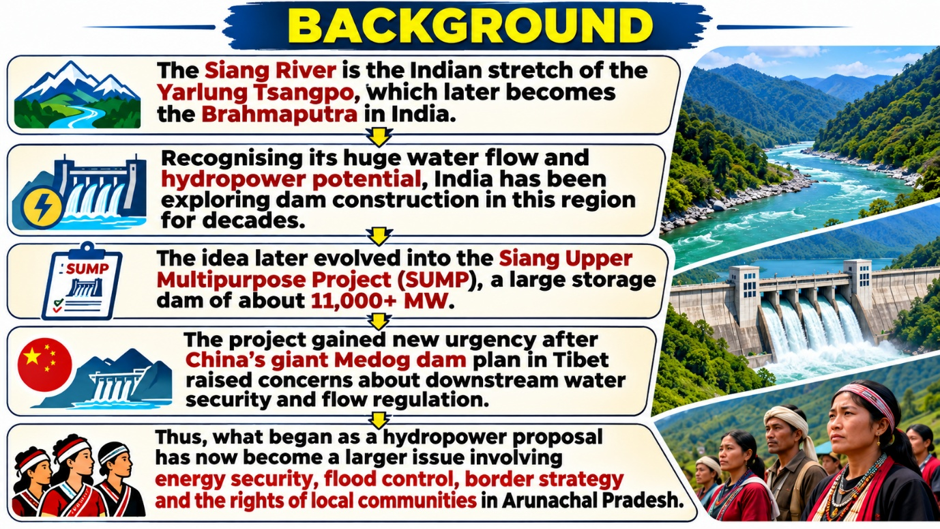
Why Does the Government Want the Dam?
1. Countering China’s Upstream Advantage
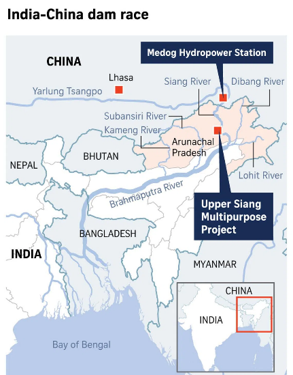
- China’s Medog project raises concerns about downstream water availability, sudden flow variations and inadequate hydrological information.
- Therefore, India proposes a large reservoir to regulate water flows and improve preparedness against potential disruptions.
2. Energy Security and Regional Development
- Beyond strategic concerns, the project would generate approximately 11,200 MW of hydropower, supporting India’s renewable energy transition.
- Associated infrastructure could also improve connectivity, employment and economic opportunities in the border region.
Why Are Local Communities Opposing It?
1. Threat to Land and Livelihoods
– The proposed reservoir could submerge around 27 villages and affect many others, threatening agriculture, settlements and traditional livelihoods.
2. Threat to Cultural and Ecological Security
- For the Adi community, the Siang is sacred and inseparable from ancestral identity, customary practices and community life.
- Moreover, large-scale submergence could damage forests, biodiversity and river ecosystems in an earthquake-prone Himalayan region.
3. Crisis of Democratic Consent
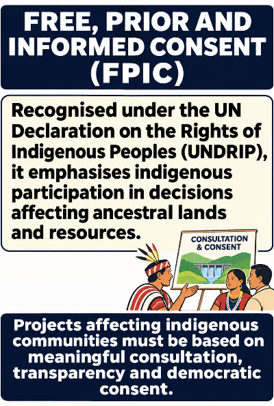
- These concerns intensified when villagers alleged that signatures supporting preliminary surveys were obtained through deception, intimidation and misleading assurances.
- Subsequent arrests, police action and security deployment further weakened public trust, transforming environmental opposition into a governance controversy.
What Should Be Done?
- Restore Trust: Suspend coercive measures, investigate disputed signatures and initiate genuine dialogue through traditional community institutions.
- Scientific Assessment: Complete independent environmental, social, seismic and cumulative-impact assessments before approving construction.
- Explore Alternatives: Evaluate smaller projects, flood-warning systems and stronger hydrological cooperation with China.
- Ensure Justice: Protect customary land rights and guarantee meaningful participation, rehabilitation and livelihood restoration.
Conclusion
The Siang controversy demonstrates that strategic infrastructure cannot achieve lasting security by undermining local communities. India must reconcile national interests with ecological sustainability, democratic consent and indigenous rights through transparent and participatory decision-making.
Source: (The Hindu)
La Excellence IAS Academy, the best IAS coaching in Hyderabad, known for delivering quality content and conceptual clarity for UPSC 2026 preparation.
FOLLOW US ON:
◉ YouTube: https://www.youtube.com/@CivilsPrepTeam
◉ Facebook: https://www.facebook.com/LaExcellenceIAS
◉ Instagram: https://www.instagram.com/laexcellenceiasacademy/
GET IN TOUCH:
Contact us at info@laex.in, https://laex.in/contact-us/
or Call us @ +91 9052 29 2929, +91 9052 99 2929, +91 9154 24 2140
OUR BRANCHES:
Head Office: H No: 1-10-225A, Beside AEVA Fertility Center, Ashok Nagar Extension, VV Giri Nagar, Ashok Nagar, Hyderabad, 500020
Madhapur: Flat no: 301, survey no 58-60, Guttala begumpet Madhapur metro pillar: 1524, Rangareddy Hyderabad, Telangana 500081
Bangalore: Plot No: 99, 2nd floor, 80 Feet Road, Beside Poorvika Mobiles, Chandra Layout, Attiguppe, Near Vijaya Nagara, Bengaluru, 560040