
Paper: GS Paper III | Subject: Economy | Topic: Inclusive Growth | Issue: Poverty Reduction and Economic Mobility
Context: From Poverty Alleviation to Shared Prosperity
India has significantly reduced extreme poverty. According to the World Bank, extreme poverty declined to 2.6% in 2023. However, millions still struggle to afford decent housing, healthcare and education. This highlights the need to move beyond poverty reduction towards sustainable prosperity.
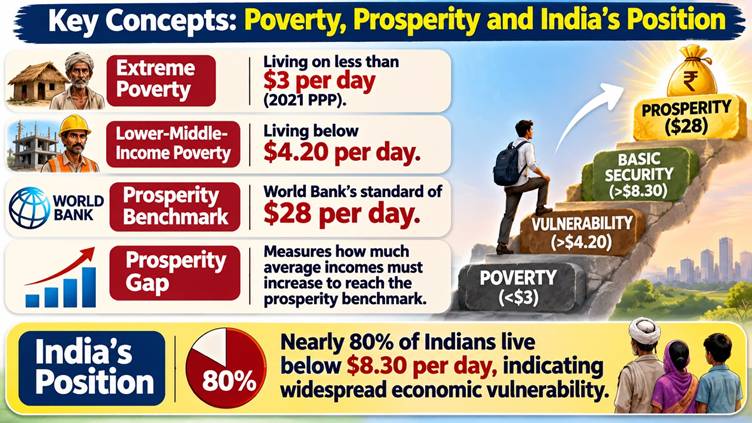
Why Poverty Reduction Has Not Ensured Prosperity
1. Poverty Reduction versus Economic Security
- Escaping poverty improves basic survival, but families may still lack savings, quality healthcare and secure livelihoods.
2. Poor Quality of Employment
- Nearly 90% of workers are informally employed, often without stable wages, job security or social protection.
- Consequently, employment does not necessarily guarantee a comfortable standard of living.
3. Human Capital Deficit
- Poor education, inadequate healthcare and skill mismatches limit access to productive, better-paying jobs.
- Educated unemployment further weakens upward economic mobility.
4. Stagnant Real Wages
- When wages fail to rise faster than inflation, purchasing power remains limited despite employment.
Way Forward
- Promote labour-intensive manufacturing and formal employment.
- Improve education, healthcare and market-relevant skills.
- Ensure productivity-linked wage growth and social security.
- Expand opportunities for women and disadvantaged communities.
Conclusion
India must move from merely helping people escape poverty to enabling them to achieve economic security and prosperity. This requires inclusive growth supported by quality employment, stronger human capital and equitable opportunities.
Amazon Rainforest: From Carbon Sink to Carbon Source (THE HINDU)
Paper: GS Paper III | Subject: Environment | Topic: Climate Change and Deforestation | Issue: Amazon’s Changing Carbon Balance
Context
A study published in Nature suggests that the Amazon rainforest emitted more carbon dioxide than it absorbed in 2024. This alarming development highlights how deforestation, wildfires and rising temperatures are weakening one of Earth’s most important natural climate regulators.
Background
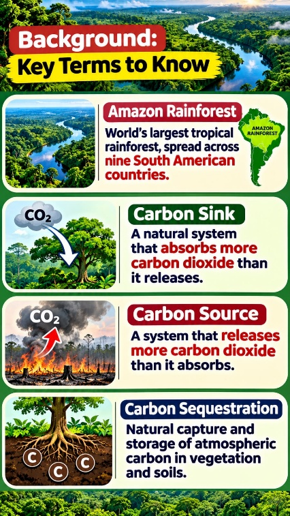
- Amazon Rainforest: World’s largest tropical rainforest, spread across nine South American countries.
- Carbon Sink: A natural system that absorbs more carbon dioxide than it releases.
- Carbon Source: A system that releases more carbon dioxide than it absorbs.
- Carbon Sequestration: Natural capture and storage of atmospheric carbon in vegetation and soils.
Why Is the Amazon Becoming a Carbon Source?
1. Rising Deforestation
- Agricultural expansion, mining and cattle ranching destroy trees, reducing the forest’s capacity to absorb carbon dioxide.
2. Increasing Wildfires
- Fires release stored carbon into the atmosphere while destroying vegetation that would otherwise absorb emissions.
- In 2024, fires reportedly accounted for 38% of deforestation.
3. Climate Change and Drought
- Rising temperatures and declining rainfall dry vegetation, making forests increasingly vulnerable to wildfires.
4. Dangerous Feedback Loop
- Forest destruction increases emissions, intensifying global warming and creating conditions for further forest degradation.
Way Forward
- Strengthen anti-deforestation enforcement and wildfire prevention.
- Promote forest restoration and sustainable land use.
- Support indigenous communities and international climate cooperation.
Conclusion
The Amazon’s changing carbon balance threatens global climate stability. Protecting it requires addressing deforestation and climate change together before irreversible ecological damage occurs.
Source: (The Hindu)
La Excellence IAS Academy, the best IAS coaching in Hyderabad, known for delivering quality content and conceptual clarity for UPSC 2026 preparation.
FOLLOW US ON:
◉ YouTube: https://www.youtube.com/@CivilsPrepTeam
◉ Facebook: https://www.facebook.com/LaExcellenceIAS
◉ Instagram: https://www.instagram.com/laexcellenceiasacademy/
GET IN TOUCH:
Contact us at info@laex.in, https://laex.in/contact-us/
or Call us @ +91 9052 29 2929, +91 9052 99 2929, +91 9154 24 2140
OUR BRANCHES:
Head Office: H No: 1-10-225A, Beside AEVA Fertility Center, Ashok Nagar Extension, VV Giri Nagar, Ashok Nagar, Hyderabad, 500020
Madhapur: Flat no: 301, survey no 58-60, Guttala begumpet Madhapur metro pillar: 1524, Rangareddy Hyderabad, Telangana 500081
Bangalore: Plot No: 99, 2nd floor, 80 Feet Road, Beside Poorvika Mobiles, Chandra Layout, Attiguppe, Near Vijaya Nagara, Bengaluru, 560040