
Paper: GS-I | Subject: Society and Social Justice | Topic: Urbanization – Problems and Remedies | Issue: Urban classification, rural-urban transition and institutional coordination
Context
The Union Budget 2026-27, Economic Survey 2025-26 and 16th Finance Commission recognise India’s changing urban landscape. However, Census 2027 will continue using the 2011 urban classification framework. This highlights the need for a National Urbanisation Policy to address fragmented planning, institutional coordination and the rural-urban continuum.
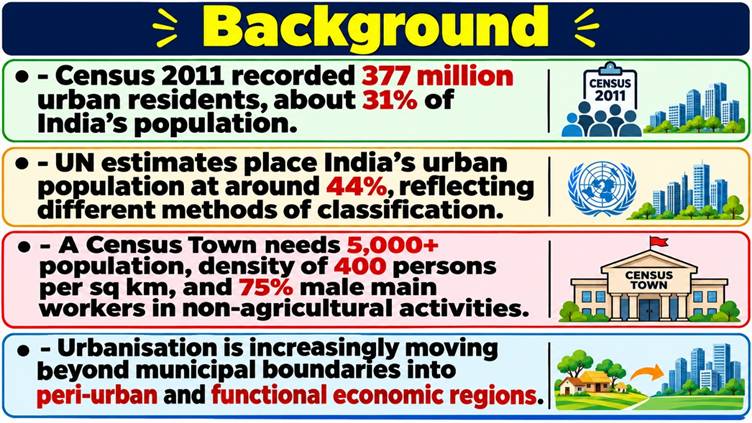
Explanation: Need for a Unified Urbanisation Plan in India
1. India’s Changing Urban Landscape
- Functional urbanisation: Economic activity, commuting networks and built-up areas increasingly extend beyond administrative boundaries.
- Urban agglomerations: Greater Mumbai and other metropolitan regions illustrate interconnected settlements functioning as single economic systems.
- Small-town urbanisation: Nearly 94% of urban settlements are small towns, but they accommodate only around 6% of urban residents.
2. Structural Challenges in Urban Governance
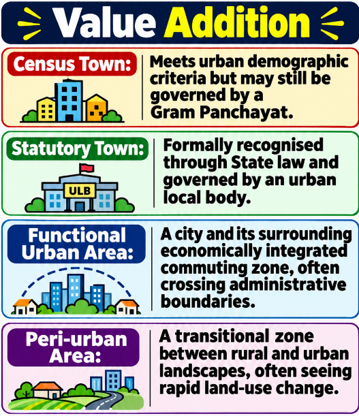
- Classification deficit: Outdated definitions underrecognise rapidly urbanising settlements, weakening evidence-based policymaking.
- Governance vacuum: Census towns may lack municipalities, municipal finance, professional planning capacity and urban infrastructure.
- Institutional fragmentation: Overlapping responsibilities among municipalities, development authorities and parastatal agencies undermine accountability.
- Fiscal constraints: Limited own-source revenue, property-tax collections and predictable intergovernmental transfers weaken local self-government.
- Rural-urban divide: Separate administrative frameworks obstruct integrated land-use planning, mobility, sanitation and service delivery.
3. Constitutional and Institutional Dimensions
- Article 243Q: Provides for Nagar Panchayats in transitional areas, Municipal Councils and Municipal Corporations.
- 74th Constitutional Amendment: Established constitutional recognition of urban local bodies and the Twelfth Schedule containing 18 municipal functions.
- Metropolitan and District Planning Committees: Articles 243ZE and 243ZD envisage integrated spatial and developmental planning.
- Fiscal federalism: The 16th Finance Commission emphasises strengthening local bodies and performance-linked urban financing.
4. Way Forward: National Urbanisation Policy
- Harmonise census classification with functional urbanisation, satellite imagery and economic indicators.
- Establish coordinated national, state and metropolitan planning frameworks respecting cooperative federalism.
- Empower municipalities through functional devolution, fiscal autonomy and administrative capacity-building.
- Develop peri-urban transition policies integrating housing, transport, climate resilience and infrastructure.
- Promote predictable formula-based transfers, municipal innovation and local accountability.
Conclusion
India needs to move from fragmented settlement administration towards integrated territorial governance. A National Urbanisation Policy, supported by empowered urban local bodies and functional planning regions, can advance inclusive, sustainable and economically productive urbanisation.
La Excellence IAS Academy, the best IAS coaching in Hyderabad, known for delivering quality content and conceptual clarity for UPSC 2026 preparation.
FOLLOW US ON:
◉ YouTube: https://www.youtube.com/@CivilsPrepTeam
◉ Facebook: https://www.facebook.com/LaExcellenceIAS
◉ Instagram: https://www.instagram.com/laexcellenceiasacademy/
GET IN TOUCH:
Contact us at info@laex.in, https://laex.in/contact-us/
or Call us @ +91 9052 29 2929, +91 9052 99 2929, +91 9154 24 2140
OUR BRANCHES:
Head Office: H No: 1-10-225A, Beside AEVA Fertility Center, Ashok Nagar Extension, VV Giri Nagar, Ashok Nagar, Hyderabad, 500020
Madhapur: Flat no: 301, survey no 58-60, Guttala begumpet Madhapur metro pillar: 1524, Rangareddy Hyderabad, Telangana 500081
Bangalore: Plot No: 99, 2nd floor, 80 Feet Road, Beside Poorvika Mobiles, Chandra Layout, Attiguppe, Near Vijaya Nagara, Bengaluru, 560040