
Paper: GS – III, Subject: Environment and Ecology, Topic: Climate Change, Issue: CBAM: Implications for Developing Economies.
Context:
The European Union has operationalised its Carbon Border Adjustment Mechanism (CBAM) to impose a carbon price on imports. This development raises concerns for exporting countries, as it may shift economic value linked to carbon pricing away from them unless appropriate domestic measures are adopted.
Key Takeaways:
Background:
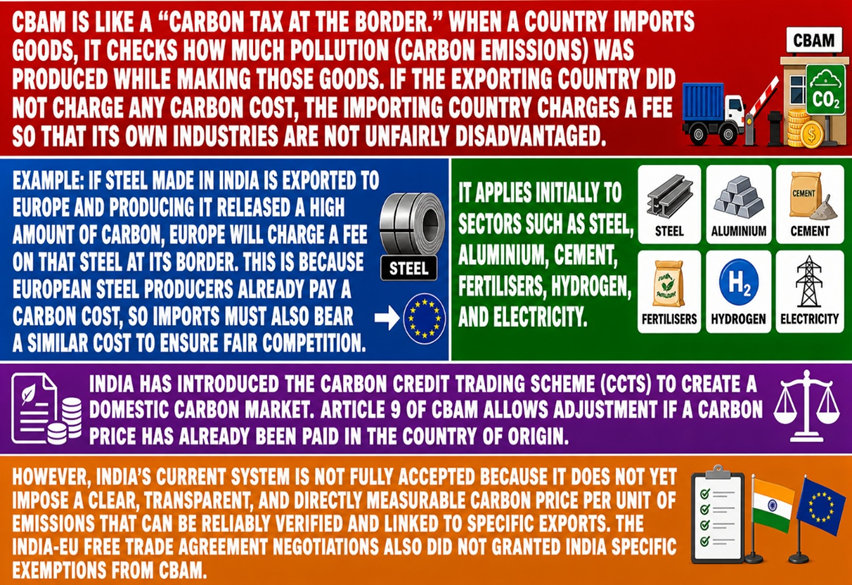
Explanation:
Nature of the Issue:
- CBAM claims to ensure fair competition by aligning carbon costs between domestic EU producers and foreign exporters. However, it effectively transfers part of the carbon revenue from exporting countries to the EU.
- Countries lacking domestic carbon pricing systems become “price takers,” bearing external regulatory costs without retaining associated economic benefits.
Implications for Exporting Economies:
- Exporters may face increased production costs, reducing competitiveness in global markets.
- There is a risk of revenue loss, as payments made under CBAM accrue to the importing jurisdiction.
- This also raises concerns related to climate equity, as developing economies bear adjustment burdens.
Existing Domestic Mechanism:
- A domestic carbon pricing system, such as a Carbon Credit Trading Scheme (CCTS), can generate tradable emission permits.
- If properly designed, it can align with international requirements and be recognised under CBAM provisions.
- This allows exporters to offset EU carbon costs through credits already paid domestically.
Example: How CBAM Currently Works
- Suppose an Indian steel exporter ships steel to the EU with embedded emissions of 2 tonnes of CO₂ per tonne of steel.
- If the EU carbon price is €80 per tonne, the exporter must pay €160 per tonne at the EU border (after adjusting for any domestic carbon price already paid).
- If no domestic carbon pricing exists, the full amount is paid to the EU.
Suggested Approach:
- Introduce a domestic carbon levy or border adjustment mechanism on exports to ensure carbon payments are made within the country.
- Align domestic pricing with global standards so it qualifies for recognition under CBAM rules.
- Use revenues generated domestically to fund green transition initiatives such as renewable energy, green hydrogen, and industrial decarbonisation.
- Ensure transparency, robust monitoring, and credible verification to gain international acceptance.
Example: Suggested Mechanism
- Instead of paying €160 at the EU border, the exporter pays an equivalent carbon charge domestically.
- This amount is then credited against CBAM obligations, reducing or eliminating payments to the EU.
- The revenue remains within the country and can be reinvested in sustainability efforts.
Conclusion:
A strategic domestic carbon pricing framework can convert a potential economic loss into an opportunity for green transformation. By aligning with global standards while retaining revenues, countries can protect competitiveness and strengthen their climate policy autonomy.
Source: (The Hindu)
La Excellence IAS Academy, the best IAS coaching in Hyderabad, known for delivering quality content and conceptual clarity for UPSC 2026 preparation.
FOLLOW US ON:
◉ YouTube : https://www.youtube.com/@CivilsPrepTeam
◉ Facebook: https://www.facebook.com/LaExcellenceIAS
◉ Instagram: https://www.instagram.com/laexcellenceiasacademy/
GET IN TOUCH:
Contact us at info@laex.in, https://laex.in/contact-us/
or Call us @ +91 9052 29 2929, +91 9052 99 2929, +91 9154 24 2140
OUR BRANCHES:
Head Office: H No: 1-10-225A, Beside AEVA Fertility Center, Ashok Nagar Extension, VV Giri Nagar, Ashok Nagar, Hyderabad, 500020
Madhapur: Flat no: 301, survey no 58-60, Guttala begumpet Madhapur metro pillar: 1524, Rangareddy Hyderabad, Telangana 500081
Bangalore: Plot No: 99, 2nd floor, 80 Feet Road, Beside Poorvika Mobiles, Chandra Layout, Attiguppe, Near Vijaya Nagara, Bengaluru, 560040