
Paper: GS – IV, Subject: Ethics, Topic: Ethical concerns and dilemmas in government and private institutions, Issue: Great Nicobar Project – Is What Can Be Justified Also Just?
Context:
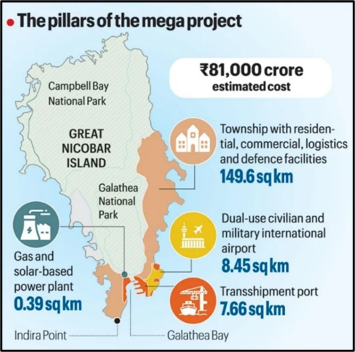
The Rs. 80,000-90,000 crore Great Nicobar Island project proposes major infrastructure at the southern end of the island, including an international transshipment port, an airport, a power plant, an integrated township and tourism facilities. The central concern is whether strategic and economic benefits can justify irreversible harm to indigenous communities and a fragile island ecosystem.
Key Takeaways:
Background: Historical Evolution of “Justification”
- From the 15th century onward, European colonial powers invoked the Doctrine of Discovery to claim territories already inhabited by indigenous communities. Such lands were often treated as terra nullius, or “nobody’s land”, because colonial authorities refused to recognise indigenous systems of ownership.
- In India, colonial laws such as the Waste Land Rules treated forests, grazing areas and shifting-cultivation lands as “unproductive” and transferred them for plantations, mines and railways.
- Modern states no longer openly use colonial language, but land may still be acquired in the name of public purpose, national security or development.
- The ethical question is therefore not merely whether a project is legally permissible or economically beneficial, but whether it respects justice, dignity and the survival of vulnerable communities.
Explanation:
MAJOR IMPACTS OF THE PROJECT:
I. Negative Social and Cultural Impacts:
- Threat to indigenous survival: The Shompen, a Particularly Vulnerable Tribal Group (PVTG) numbering fewer than 300, depend upon forests for food, mobility, medicine, cultural identity and social organisation. Habitat disruption may threaten their existence as a distinct community.
- Disease and external contact: Historical experience shows that isolated Andaman communities suffered severe population decline after exposure to unfamiliar diseases, alcoholism, trafficking and exploitation.
- Loss beyond compensation: Ancestral land cannot be replaced merely through money or alternative plots because it contains spiritual, cultural and intergenerational significance.
- Demographic marginalisation: Large-scale migration of workers and settlers may reduce indigenous communities to a powerless minority within their own homeland.
II. Environmental and Developmental Concerns:
- Irreversible ecological damage: Forest diversion, coastal construction and settlement expansion may affect endemic species, coral reefs, mangroves and nesting areas of turtles.
- Disaster vulnerability: Great Nicobar lies in a seismically active and tsunami-prone region; extensive coastal infrastructure may increase human and ecological risks.
- Uncertain benefits, certain costs: Strategic and commercial gains are projected for the future, while forest loss and social disruption are immediate and potentially permanent.
- Limits of compensatory afforestation: Newly planted forests elsewhere cannot reproduce the biodiversity and ecological functions of an ancient island rainforest.
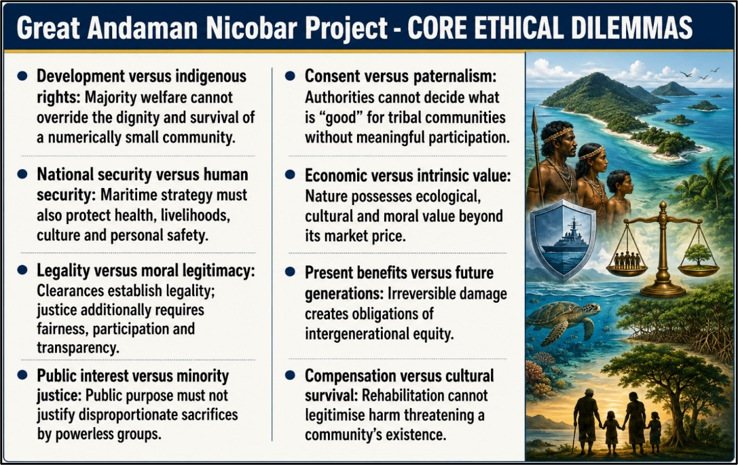
Ethical Decision-Making Test:
Before approving such a project, authorities should ask:
- Rights test: Does it violate any non-negotiable human or tribal right?
- Justice test: Are benefits and burdens fairly distributed?
- Consent test: Have affected people participated meaningfully?
- Alternatives test: Is there a less harmful option?
- Irreversibility test: Can the damage be repaired?
- Future generations test: Would the decision remain defensible decades later?
- Publicity test: Can the government transparently justify the decision before the public?
Ethical Resolution of such dilemmas:
- Secure Free, Prior and Informed Consent through culturally appropriate and continuous consultation.
- Conduct independent, cumulative environmental, health and social-impact assessments.
- Apply the precautionary principle where damage may be serious or irreversible.
- Test proportionality by examining whether the project’s scale is necessary and whether less destructive alternatives exist.
- Create inviolate tribal and ecological zones and strictly regulate tourism, migration and external contact.
- Establish independent monitoring, transparent disclosure, grievance redress and legally enforceable stop-work provisions.
- Apply the Public Trust Doctrine, under which the State protects forests, coasts and water for present communities and future generations.
Conclusion:
The ethical resolution lies in responsible and restrained development, not in treating economic growth as inherently superior to human dignity and ecological survival. Where consequences are irreversible and a community’s existence is at stake, the State must follow a higher standard of consent, precaution, justice and constitutional morality. Development becomes legitimate only when it protects both the national interest and the rights of those least able to defend themselves.
Source: (The Indian Express)
La Excellence IAS Academy, the best IAS coaching in Hyderabad, known for delivering quality content and conceptual clarity for UPSC 2026 preparation.
FOLLOW US ON:
◉ YouTube : https://www.youtube.com/@CivilsPrepTeam
◉ Facebook: https://www.facebook.com/LaExcellenceIAS
◉ Instagram: https://www.instagram.com/laexcellenceiasacademy/
GET IN TOUCH:
Contact us at info@laex.in, https://laex.in/contact-us/
or Call us @ +91 9052 29 2929, +91 9052 99 2929, +91 9154 24 2140
OUR BRANCHES:
Head Office: H No: 1-10-225A, Beside AEVA Fertility Center, Ashok Nagar Extension, VV Giri Nagar, Ashok Nagar, Hyderabad, 500020
Madhapur: Flat no: 301, survey no 58-60, Guttala begumpet Madhapur metro pillar: 1524, Rangareddy Hyderabad, Telangana 500081
Bangalore: Plot No: 99, 2nd floor, 80 Feet Road, Beside Poorvika Mobiles, Chandra Layout, Attiguppe, Near Vijaya Nagara, Bengaluru, 560040