
Paper: GS – III, Subject: Economy, Topic: Inflation, Issue: Lower Oil Prices: India’s Window to Strengthen Its Economic Fundamentals.
Context:
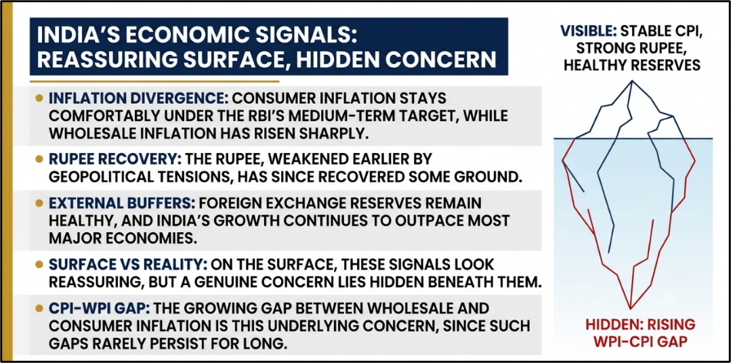
Recently, the reopening of key global shipping routes has moderated international oil prices, creating a strategic opportunity for India. This comes even as India’s economy shows a mixed picture, with wholesale inflation rising sharply despite consumer inflation staying below the Reserve Bank of India’s (RBI) medium-term target.
Key Takeaways:
Explanation:
The Inflation Divergence:
- Wholesale inflation reflects producer costs, while consumer inflation reflects what households pay.
- Higher fuel and power costs have raised input costs in chemicals, textiles, and engineering goods.
- Producers usually absorb such costs briefly before raising prices, so consumer inflation rises with a lag.
Macroeconomic Opportunities:
- Savings from lower oil prices can strengthen foreign exchange reserves, which discourage currency speculation and protect against shocks.
- Lower energy costs also reduce transport and logistics expenses, improving export competitiveness and global market share.
- India can use this window to attract long-term foreign investment and energy-intensive manufacturing, supported by infrastructure and Production-Linked Incentive (PLI) schemes.
- Cheaper oil also offers a chance to speed up India’s shift towards renewable energy and electric mobility.
Risks of Mismanagement:
- Falling oil prices often tempt governments to expand subsidies or routine spending instead of building long-term strength.
- A weaker monsoon could separately reverse food inflation gains and strain households.
Way Forward:
- Direct oil-price savings towards building foreign exchange reserves, not short-term spending.
- Use lower costs to boost export competitiveness and attract manufacturing investment.
- Accelerate renewable energy and electric mobility to cut future oil dependence.
- Channel savings into capital expenditure and deficit reduction to preserve fiscal credibility.
- Strengthen food buffer stocks in advance to guard against monsoon-related risks.
Conclusion:
Lower oil prices offer India a temporary window to strengthen its buffers, competitiveness, and fiscal position. The real test lies in using this calm period to build resilience rather than easing short-term pressure. Careful use of this window can turn a passing advantage into lasting strength.
Source: (The Indian Express)
La Excellence IAS Academy, the best IAS coaching in Hyderabad, known for delivering quality content and conceptual clarity for UPSC 2026 preparation.
FOLLOW US ON:
◉ YouTube : https://www.youtube.com/@CivilsPrepTeam
◉ Facebook: https://www.facebook.com/LaExcellenceIAS
◉ Instagram: https://www.instagram.com/laexcellenceiasacademy/
GET IN TOUCH:
Contact us at info@laex.in, https://laex.in/contact-us/
or Call us @ +91 9052 29 2929, +91 9052 99 2929, +91 9154 24 2140
OUR BRANCHES:
Head Office: H No: 1-10-225A, Beside AEVA Fertility Center, Ashok Nagar Extension, VV Giri Nagar, Ashok Nagar, Hyderabad, 500020
Madhapur: Flat no: 301, survey no 58-60, Guttala begumpet Madhapur metro pillar: 1524, Rangareddy Hyderabad, Telangana 500081
Bangalore: Plot No: 99, 2nd floor, 80 Feet Road, Beside Poorvika Mobiles, Chandra Layout, Attiguppe, Near Vijaya Nagara, Bengaluru, 560040