
Paper: GS – II, Subject: International Relations, Topic: Agreements involving India and/or affecting India’s interests, Issue: India–New Zealand Free Trade Agreement (Rules of Origin).
Context:
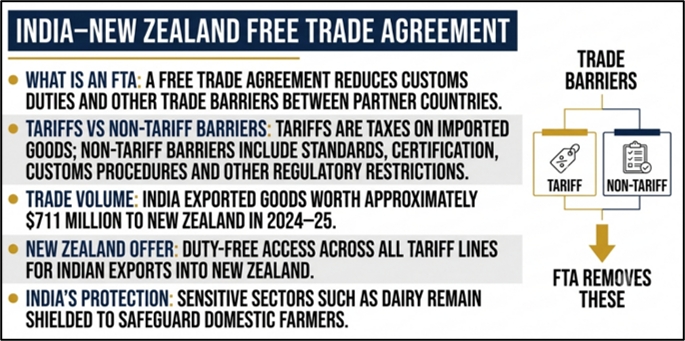
Recently, the proposed India–New Zealand Free Trade Agreement (FTA) has drawn attention for offering wider market access, duty-free trade and investment opportunities. Bilateral merchandise trade was about $1.3 billion in 2024–25, showing considerable scope for growth. The agreement aims to expand trade while protecting sensitive Indian sectors.
Key Takeaways:
Explanation:
Benefits for Indian Exports:
- Duty-free access can make Indian products cheaper and more competitive in New Zealand.
- Textiles, garments, leather and handicrafts may gain because they earlier faced duties of up to 10%.
- Better market access can increase exports and create jobs in labour-intensive sectors.
Services and Investment:
- India has strong capabilities in information technology, consulting, engineering, healthcare and education.
- Easier movement of professionals and students can help Indian companies expand in New Zealand.
- A proposed investment commitment of about $20 billion over 15 years can support long-term economic cooperation.
Benefits Beyond Lower Tariffs:
- Faster customs clearance and digital certificates can reduce delays at ports.
- Simpler procedures can lower storage costs, improve cash flow and make supply chains more reliable.
- Cooperation on standards and approvals can reduce non-tariff barriers, which are rules or procedures that restrict trade even without customs duties.
- Pharmaceuticals, food processing, chemicals and agriculture may benefit from clearer regulations.
| Rules of Origin (RoO) ensure that only goods genuinely produced in an FTA partner country receive lower duties, based on product conditions and proper documentation. |
Business Preparedness:
- Exporters should correctly identify products under the Harmonised System (HS) classification.
- They must check RoO eligibility and maintain clear sourcing and production records.
- Businesses should also compare total landed costs and identify suitable export opportunities.
- The success of the FTA will depend on compliance, traceability and careful planning.
Conclusion:
The India–New Zealand FTA can turn a modest trade relationship into a broader economic partnership. Its benefits will depend on lower trade barriers, easier services trade and effective business compliance.
Source: (The Hindu)
La Excellence IAS Academy, the best IAS coaching in Hyderabad, known for delivering quality content and conceptual clarity for UPSC 2026 preparation.
FOLLOW US ON:
◉ YouTube : https://www.youtube.com/@CivilsPrepTeam
◉ Facebook: https://www.facebook.com/LaExcellenceIAS
◉ Instagram: https://www.instagram.com/laexcellenceiasacademy/
GET IN TOUCH:
Contact us at info@laex.in, https://laex.in/contact-us/
or Call us @ +91 9052 29 2929, +91 9052 99 2929, +91 9154 24 2140
OUR BRANCHES:
Head Office: H No: 1-10-225A, Beside AEVA Fertility Center, Ashok Nagar Extension, VV Giri Nagar, Ashok Nagar, Hyderabad, 500020
Madhapur: Flat no: 301, survey no 58-60, Guttala begumpet Madhapur metro pillar: 1524, Rangareddy Hyderabad, Telangana 500081
Bangalore: Plot No: 99, 2nd floor, 80 Feet Road, Beside Poorvika Mobiles, Chandra Layout, Attiguppe, Near Vijaya Nagara, Bengaluru, 560040