
Paper: GS – I, Subject: Health and Governance, Topic: Social Sector – Health, Issue: Nipah virus containment and lessons for India’s public health systems.
Context:
A fresh Nipah case in Kozhikode, Kerala was contained with no secondary cases through intensive contact tracing. The episode highlights ecological drivers of zoonotic disease and institutional lessons India must draw for national pandemic preparedness.
Key Takeaways:
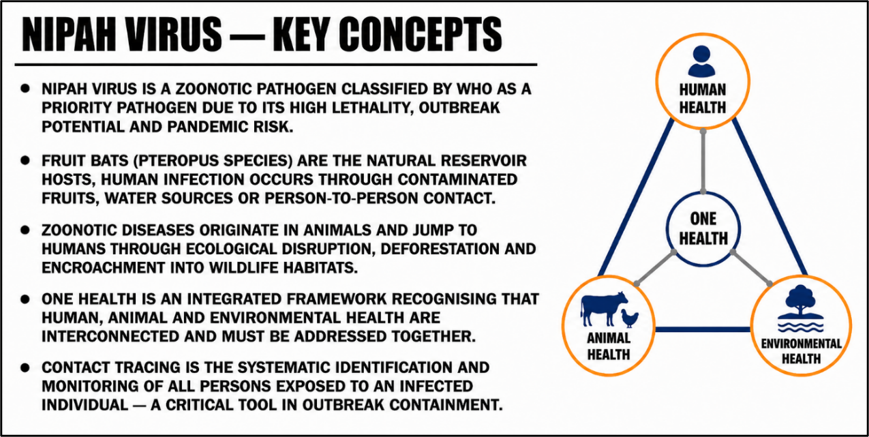
Explanation:
1. Kerala’s Vulnerability and Outbreak History:
- Kerala’s forest cover, fruit bat habitats and human encroachment on forest fringes create recurring Nipah spillover conditions during monsoon season.
- The 2018 outbreak caused 17 deaths; the index patient transmitted the virus to 15 others including healthcare workers.
- Outbreaks continued in 2019, 2021, 2023, 2024 and 2025; West Bengal recorded cases in 2001, 2007 and January 2026.
2. Ecological and Transmission Drivers:
- Transmission occurs through bat-contaminated fruits and water sources; person-to-person transmission amplifies risk in healthcare settings.
- Human encroachment into bat habitats makes Nipah an ecological and land-use problem, not merely a health issue.
3. The One Health Imperative:
- Containment requires coordination across health, forest, agriculture and environment departments.
- Deforestation and agricultural expansion must be treated as upstream drivers of zoonotic disease emergence.
4. Key Lessons from Kerala’s Model:
- A high index of suspicion for acute encephalitis at primary and secondary hospital levels enables early detection without tertiary referral.
- Rapid contact tracing, isolation protocols and cluster surveillance at district level prevent community spread.
- Repeated outbreaks have built institutional muscle memory, enabling fast action without fresh deliberation each time.
- Healthcare workers must be protected through trained infection control protocols; hospitals can become amplification sites without them.
5. Lessons for National Preparedness:
- Primary and secondary health systems must be trained in zoonotic surveillance nationally.
- India needs a national zoonotic disease preparedness framework anchored in One Health with rapid diagnostics and district-level isolation infrastructure.
- Early warning systems linking forest, animal husbandry and public health data can detect spillovers before human transmission chains form.
Conclusion:
Kerala’s Nipah experience offers India a replicable template built on early detection, trained district systems and ecological awareness. National preparedness requires institutionalising these lessons through a One Health framework.
Source: (The Hindu)
La Excellence IAS Academy, the best IAS coaching in Hyderabad, known for delivering quality content and conceptual clarity for UPSC 2026 preparation.
FOLLOW US ON:
◉ YouTube : https://www.youtube.com/@CivilsPrepTeam
◉ Facebook: https://www.facebook.com/LaExcellenceIAS
◉ Instagram: https://www.instagram.com/laexcellenceiasacademy/
GET IN TOUCH:
Contact us at info@laex.in, https://laex.in/contact-us/
or Call us @ +91 9052 29 2929, +91 9052 99 2929, +91 9154 24 2140
OUR BRANCHES:
Head Office: H No: 1-10-225A, Beside AEVA Fertility Center, Ashok Nagar Extension, VV Giri Nagar, Ashok Nagar, Hyderabad, 500020
Madhapur: Flat no: 301, survey no 58-60, Guttala begumpet Madhapur metro pillar: 1524, Rangareddy Hyderabad, Telangana 500081
Bangalore: Plot No: 99, 2nd floor, 80 Feet Road, Beside Poorvika Mobiles, Chandra Layout, Attiguppe, Near Vijaya Nagara, Bengaluru, 560040