
Paper: GS – II, Subject: International Relations, Topic: Global issues, Issue: U.S.-Iran MoU and the Geopolitics of West Asia.
Context:
A U.S.-Iran Memorandum of Understanding (MoU) adopted in June 2026 provides for cessation of hostilities and a 60-day negotiation window. Unresolved issues including nuclear enrichment, Hormuz sovereignty and proxy networks make a durable settlement uncertain.
Key Takeaways:
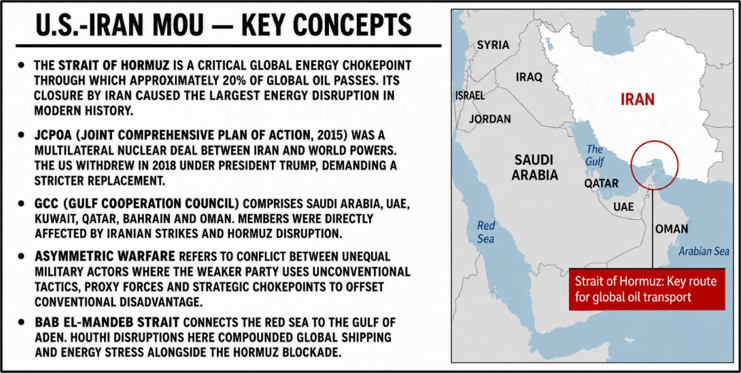
Explanation:
1. Background and Core Issues:
- Both sides recognised asymmetric wars were militarily unwinnable; both lost international credibility and faced domestic discontent.
- Key unresolved demands include lifting US sanctions, releasing $100 billion in frozen assets, Iran’s nuclear enrichment programme and its sovereignty claim over the Strait of Hormuz.
- External influencers include Israel and Gulf Cooperation Council (GCC) on the US side and China, Russia and Pakistan on Iran’s side.
2. Long-Term Geopolitical Shifts:
- Limits of American hyperpower: The conflict exposed the limits of US military dominance, air power doctrine and coercive diplomacy against asymmetric tactics and chokepoint leverage.
- Multilateralism revival: Failure of ad-hoc coercive diplomacy may restore multilateral frameworks as the preferred mode of conflict resolution.
- GCC realignment: US failure to protect GCC states from Iranian retaliation without prior consultation has seriously undermined American credibility as a security guarantor; GCC states are reassessing geostrategic alignments.
- Iran’s deterrence shift: A growing minority in Iran’s leadership now views Hormuz control as a more potent deterrence than nuclear ambiguity, signalling a potential strategic doctrinal shift.
- Energy implications: Sustained disruption accelerates peak oil scenarios, underscores the need for strategic petroleum reserves and hastens the global clean energy transition.
3. Residual Risks:
- Pro-Iran militias in Iraq and Lebanon may go underground, waging proxy conflicts against perceived enemies.
- Weakening of Iran’s proxy network may create a power vacuum, giving a second wind to Sunni non-state actors including Islamic State, al-Qaeda, Hamas and IS-Khorasan.
- For India, Hormuz and Bab el-Mandeb disruptions directly threaten energy security, reinforcing the need for higher strategic petroleum reserves and accelerated renewable energy transition.
Conclusion:
The U.S.-Iran MoU is a fragile first step in a deeply volatile region. The geopolitical realignments triggered by this conflict will reshape West Asian and global energy architecture for decades.
Source: (The Indian Express, The Hindu, Live Mint)
La Excellence IAS Academy, the best IAS coaching in Hyderabad, known for delivering quality content and conceptual clarity for UPSC 2026 preparation.
FOLLOW US ON:
◉ YouTube : https://www.youtube.com/@CivilsPrepTeam
◉ Facebook: https://www.facebook.com/LaExcellenceIAS
◉ Instagram: https://www.instagram.com/laexcellenceiasacademy/
GET IN TOUCH:
Contact us at info@laex.in, https://laex.in/contact-us/
or Call us @ +91 9052 29 2929, +91 9052 99 2929, +91 9154 24 2140
OUR BRANCHES:
Head Office: H No: 1-10-225A, Beside AEVA Fertility Center, Ashok Nagar Extension, VV Giri Nagar, Ashok Nagar, Hyderabad, 500020
Madhapur: Flat no: 301, survey no 58-60, Guttala begumpet Madhapur metro pillar: 1524, Rangareddy Hyderabad, Telangana 500081
Bangalore: Plot No: 99, 2nd floor, 80 Feet Road, Beside Poorvika Mobiles, Chandra Layout, Attiguppe, Near Vijaya Nagara, Bengaluru, 560040