
Paper: GS – II, Subject: International Relations, Topic: Agreements involving India and/or affecting India’s interests, Issue: Iran’s Nuclear Programme: Deterrence Without Weaponisation.
Context:
Iran Nuclear Capability has triggered global concern due to uncertainty over its true intent – civilian energy or potential weaponisation – leading to sanctions and geopolitical tensions.
Key Takeaways:
Background:
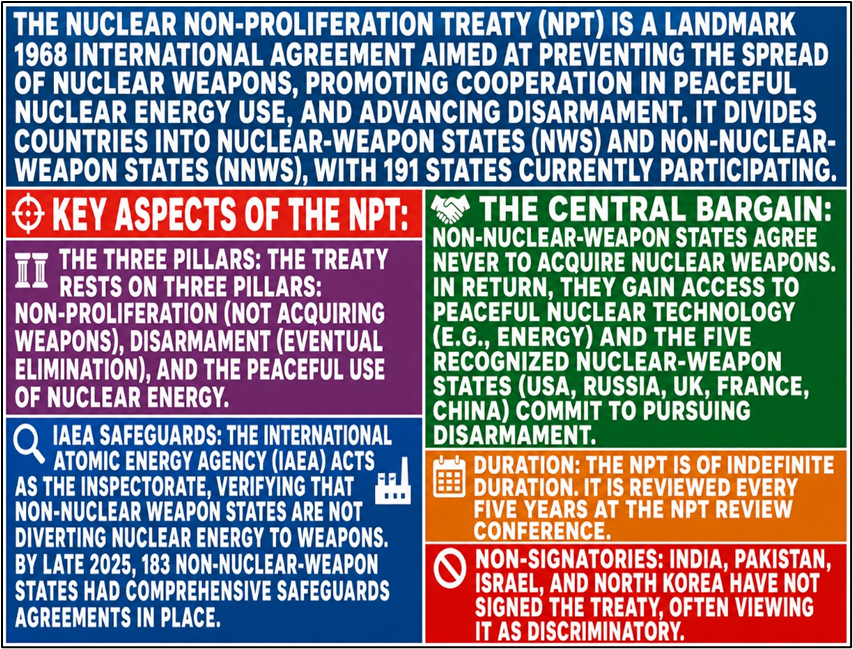
Explanation:
- Core Problem: Intent vs Capability: The central issue is not whether Iran has nuclear capability, but whether it intends to convert that capability into weapons. Nuclear technology inherently allows both peaceful and military uses, making intent difficult to verify.
- Limits of the NPT Framework: The NPT regulates diversion of nuclear material but does not fully prevent countries from developing the capacity to build weapons. As long as Iran operates within declared facilities, it can legally advance its nuclear expertise.
- Threshold State Dynamics: Iran is considered a threshold state, meaning it has developed sufficient technical capability (e.g., high uranium enrichment) to produce a weapon quickly if it chooses. This creates strategic uncertainty for other countries.
- Breakout Time and Strategic Leverage: By increasing enrichment levels (up to ~60%), Iran has reduced its breakout time—the time required to produce weapons-grade material. This enhances its bargaining power without openly violating weaponisation norms.
- Impact of JCPOA Collapse: Iran was part of the Joint Comprehensive Plan of Action (JCPOA), which limited its nuclear activities in exchange for sanctions relief. The U.S. withdrawal from JCPOA (2018) led to renewed sanctions and Iran gradually expanding its nuclear activities. The JCPOA had imposed limits on enrichment and stockpiles, increasing transparency. After the U.S. withdrawal, Iran gradually reduced compliance, leading to reduced oversight and increased suspicion.
- Security Justifications by Iran: Iran argues that its nuclear advancement is a response to external threats, particularly from the U.S. and Israel. Maintaining near-weapon capability acts as a deterrence strategy without crossing the red line.
- International Response and Constraints: Sanctions aim to curb Iran’s programme but have had mixed results, often pushing Iran to accelerate nuclear development instead of restraining it.
- Strategic Ambiguity as Policy: Iran appears to deliberately maintain ambiguity—neither confirming weaponisation nor abandoning capability—thus gaining deterrence while avoiding full-scale international retaliation.
Conclusion:
Iran’s nuclear issue is fundamentally about managing uncertainty rather than eliminating capability. Effective resolution requires balancing non-proliferation goals with security concerns through sustained diplomacy and credible verification mechanisms.
Source: (The Hindu)
La Excellence IAS Academy, the best IAS coaching in Hyderabad, known for delivering quality content and conceptual clarity for UPSC 2026 preparation.
FOLLOW US ON:
◉ YouTube : https://www.youtube.com/@CivilsPrepTeam
◉ Facebook: https://www.facebook.com/LaExcellenceIAS
◉ Instagram: https://www.instagram.com/laexcellenceiasacademy/
GET IN TOUCH:
Contact us at info@laex.in, https://laex.in/contact-us/
or Call us @ +91 9052 29 2929, +91 9052 99 2929, +91 9154 24 2140
OUR BRANCHES:
Head Office: H No: 1-10-225A, Beside AEVA Fertility Center, Ashok Nagar Extension, VV Giri Nagar, Ashok Nagar, Hyderabad, 500020
Madhapur: Flat no: 301, survey no 58-60, Guttala begumpet Madhapur metro pillar: 1524, Rangareddy Hyderabad, Telangana 500081
Bangalore: Plot No: 99, 2nd floor, 80 Feet Road, Beside Poorvika Mobiles, Chandra Layout, Attiguppe, Near Vijaya Nagara, Bengaluru, 560040