
Paper: GS – III, Subject: Science and Technology, Topic: Defence Technologies, Issue: Drones or Unmanned Aerial Vehicles.
Context:
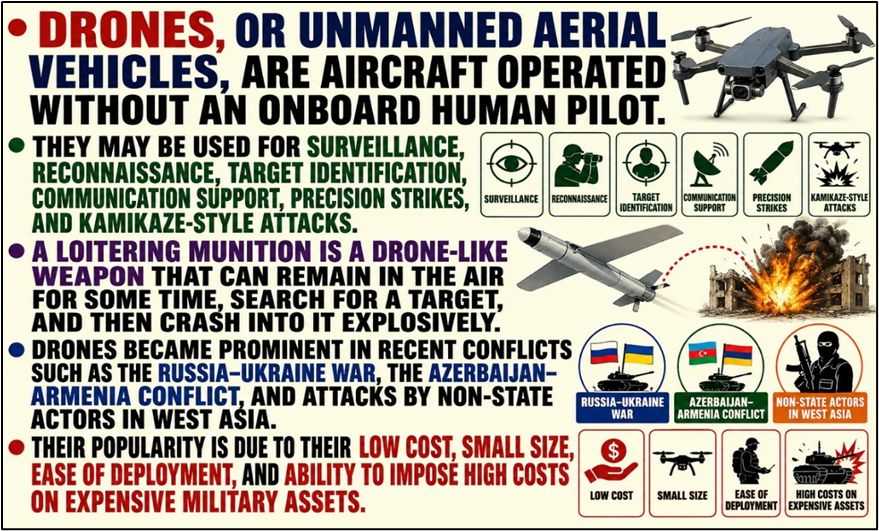
Drones have become a major feature of modern conflicts because they are cheap, flexible, and difficult to detect. However, their growing use must be understood realistically, as drones are important force multipliers but not complete substitutes for conventional military power.
Key Takeaways:
Explanation:
Why Drones are Attractive in Modern Warfare?
- Drones are attractive because they are cheaper than fighter aircraft, missiles, or helicopters, yet they can perform useful military tasks.
- Small drones are difficult to detect because of their low altitude, small radar signature, and slow movement.
- They can be used in large numbers, creating a swarm effect, where air defence systems are overwhelmed by too many incoming targets.
- For weaker militaries or non-state actors, drones offer an affordable way to challenge technologically superior forces.
Limits of Drone Warfare:
- The article warns against treating drones as a magical weapon that can independently decide wars.
- Drones are still part of the air domain and depend on communication links, navigation systems, intelligence, and ground support.
- Conventional air power, such as fighter jets, helicopters, missiles, and integrated air defence systems, remains crucial.
- Drones are vulnerable to jamming, spoofing, directed energy weapons, electronic warfare, and kinetic interception.
Doctrinal Issues:
- A key issue is whether drones are truly revolutionary or only an evolutionary addition to warfare.
- The article suggests that drones have changed battlefield tactics, but not the basic principles of warfare such as intelligence, deception, air superiority, logistics, and command control.
- Drone operations require a separate doctrine because they operate between ground forces and conventional air forces.
Strategic Concerns for India:
- For India, drones pose a serious challenge because they can be used for cross-border surveillance, attacks on military assets, and terrorism-linked operations.
- Pakistan’s reported use of drones and China’s growing drone ecosystem make the issue more important for Indian defence planning.
- India needs strong counter-UAS systems, including radar, electronic warfare, laser systems, drone walls, and better integration between the Army, Air Force, and security agencies.
Conclusion:
Drones are reshaping the conduct of warfare, but they are not war-winning weapons by themselves. A balanced strategy combining drones, counter-drone systems, conventional air power, and strong doctrine is essential for future security preparedness.
Source: (The Hindu)
La Excellence IAS Academy, the best IAS coaching in Hyderabad, known for delivering quality content and conceptual clarity for UPSC 2026 preparation.
FOLLOW US ON:
◉ YouTube : https://www.youtube.com/@CivilsPrepTeam
◉ Facebook: https://www.facebook.com/LaExcellenceIAS
◉ Instagram: https://www.instagram.com/laexcellenceiasacademy/
GET IN TOUCH:
Contact us at info@laex.in, https://laex.in/contact-us/
or Call us @ +91 9052 29 2929, +91 9052 99 2929, +91 9154 24 2140
OUR BRANCHES:
Head Office: H No: 1-10-225A, Beside AEVA Fertility Center, Ashok Nagar Extension, VV Giri Nagar, Ashok Nagar, Hyderabad, 500020
Madhapur: Flat no: 301, survey no 58-60, Guttala begumpet Madhapur metro pillar: 1524, Rangareddy Hyderabad, Telangana 500081
Bangalore: Plot No: 99, 2nd floor, 80 Feet Road, Beside Poorvika Mobiles, Chandra Layout, Attiguppe, Near Vijaya Nagara, Bengaluru, 560040
Drone Doctrine and Counter-UAS Strategy