
Paper: GS – II, Subject: Polity, Topic: Judiciary, Issue: Supreme Court Upholds Special Intensive Revision (SIR) of Electoral Rolls.
Context:
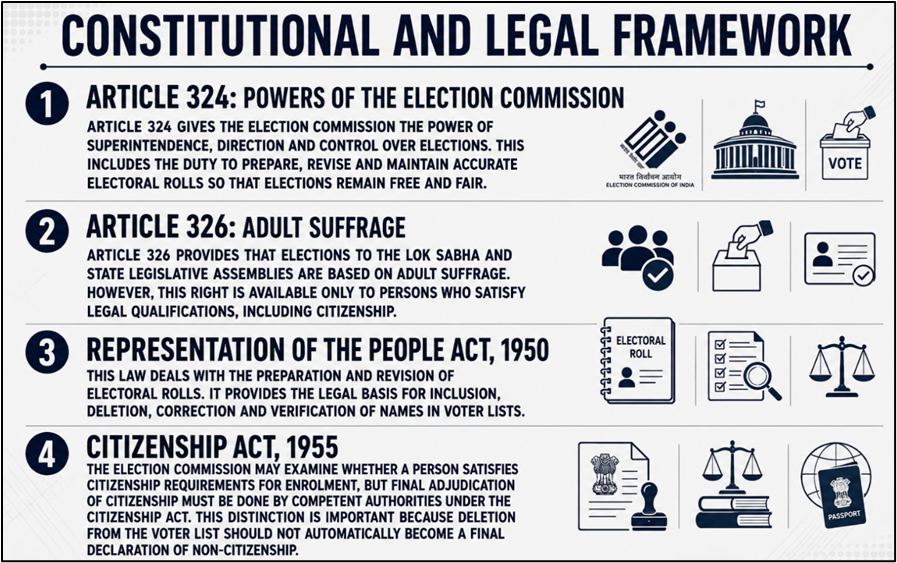
The Supreme Court has upheld the Special Intensive Revision of electoral rolls, stating that preparation and purification of voter lists is part of the Election Commission’s constitutional duty. The Court held that citizenship is a necessary condition for inclusion in electoral rolls, but cases involving doubtful citizenship must be referred to the competent authority under the Citizenship Act.
Key Takeaways:
Why Electoral Roll Revision Matters:
Electoral rolls are the foundation of representative democracy. If ineligible persons are included, the fairness of elections is affected. At the same time, if genuine citizens are wrongly deleted, their democratic right to participate in elections is harmed. Therefore, voter-list revision must balance two goals: purity of electoral rolls and protection of eligible voters.
What the Supreme Court Clarified:
- The Election Commission can conduct intensive revision of electoral rolls as part of its constitutional responsibility.
- Citizenship is a condition precedent for voter enrolment.
- The Election Commission can verify citizenship-related questions for the limited purpose of voter-list inclusion or exclusion.
- However, the Election Commission cannot finally determine citizenship in the strict legal sense.
- Names deleted on citizenship-related grounds must be referred to the competent authority under the Citizenship Act.
- The revision exercise must follow fairness, transparency and procedural safeguards.
- The Court treated clean electoral rolls as essential to the idea of free and fair elections.
Key Concerns:
- Risk of Wrongful Exclusion: Large-scale revision may wrongly exclude genuine citizens, especially poor persons, migrant workers, elderly voters, women, marginalised communities and those lacking formal documents.
- Citizenship Versus Voting Eligibility: A person may be removed from the electoral roll for failure to satisfy enrolment conditions, but that does not automatically mean the person has legally lost Indian citizenship. Citizenship determination requires a separate statutory process.
- Administrative Burden: Intensive revision involves huge verification work. If done hastily, it may create errors, confusion and litigation.
- Political Sensitivity: Voter-list revision can become politically controversial if people believe it targets particular regions, communities or social groups. Therefore, neutrality and transparency are essential.
Significance of the Judgment:
- The judgment strengthens the Election Commission’s authority to maintain accurate voter lists. It also recognises that electoral purity is part of free and fair elections. At the same time, by requiring referral of doubtful citizenship cases to competent authorities, it protects individuals from arbitrary citizenship-related consequences.
- The ruling therefore creates a balance: the Election Commission can verify voter eligibility, but it must remain within constitutional and statutory limits.
Way Forward:
- The Election Commission must issue clear guidelines on documents, deadlines and verification procedure.
- No name should be deleted without notice and reasonable opportunity of hearing.
- Appeal and grievance redressal mechanisms must be simple, local and time-bound.
- Vulnerable groups should be helped through special camps, local-language communication and doorstep assistance where necessary.
- Technology may be used for efficiency, but human verification must remain central.
- Political parties, civil society and observers should be allowed to monitor the process within legal limits.
- Cases involving doubtful citizenship must be referred to competent authorities and not decided finally through electoral roll revision alone.
Conclusion:
The judgment underlines that clean electoral rolls are essential for democracy, but so is the protection of every eligible citizen’s voting right. The Election Commission has the constitutional duty to maintain accurate voter lists, yet this power must be exercised with fairness, transparency and due process. The real test lies in ensuring that electoral purification does not become democratic exclusion.
Source: (The Indian Express, The Hindu, Live Mint)
La Excellence IAS Academy, the best IAS coaching in Hyderabad, known for delivering quality content and conceptual clarity for UPSC 2026 preparation.
FOLLOW US ON:
◉ YouTube : https://www.youtube.com/@CivilsPrepTeam
◉ Facebook: https://www.facebook.com/LaExcellenceIAS
◉ Instagram: https://www.instagram.com/laexcellenceiasacademy/
GET IN TOUCH:
Contact us at info@laex.in, https://laex.in/contact-us/
or Call us @ +91 9052 29 2929, +91 9052 99 2929, +91 9154 24 2140
OUR BRANCHES:
Head Office: H No: 1-10-225A, Beside AEVA Fertility Center, Ashok Nagar Extension, VV Giri Nagar, Ashok Nagar, Hyderabad, 500020
Madhapur: Flat no: 301, survey no 58-60, Guttala begumpet Madhapur metro pillar: 1524, Rangareddy Hyderabad, Telangana 500081
Bangalore: Plot No: 99, 2nd floor, 80 Feet Road, Beside Poorvika Mobiles, Chandra Layout, Attiguppe, Near Vijaya Nagara, Bengaluru, 560040