
Paper: GS – III, Subject: Science and Technology, Topic: Computer and ICT, Issue: Nvidia’s RTX Spark: Redefining AI-Powered Personal Computing.
Context:
Artificial Intelligence is transforming the design of computers, the organisation of industries and the nature of geopolitical power. Modern AI systems require specialised chips, massive computing capacity, high-speed memory and secure digital infrastructure. Therefore, semiconductors are no longer only industrial inputs; they have become strategic assets linked with economic competitiveness, national security and digital sovereignty.
Key Takeaways:
Explanation:
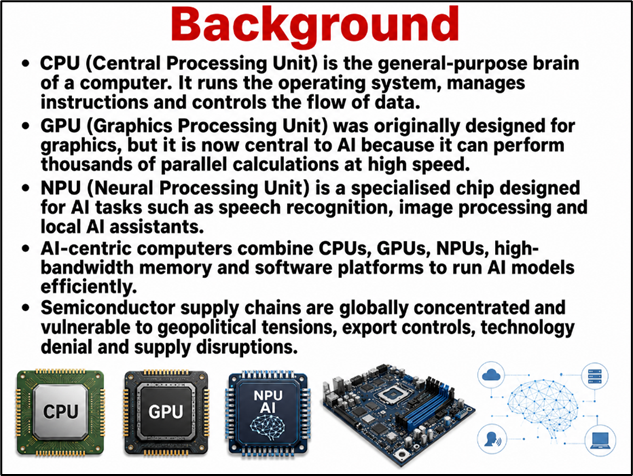
1. Shift from CPU-centric to AI-centric computing:
- Traditional computers were largely CPU-centric because most tasks required sequential processing, such as opening applications, managing files, browsing the internet and running general software like Word and Excel.
- AI workloads are different because they require massive parallel processing for training, inference, graphics, simulations and large language models.
- Hence, the future computer is becoming AI-centric, where the CPU manages the system, the GPU performs large-scale parallel computation, and the NPU handles specialised AI tasks efficiently.
2. Purpose of GPU and Nvidia’s advantage:
- Nvidia is an American semiconductor company that became globally dominant in AI infrastructure through its powerful GPUs.
- Nvidia’s advantage came not only from hardware, but also from its CUDA (Compute Unified Device Architecture) software ecosystem.
- CUDA allowed researchers and developers to use Nvidia GPUs for deep learning, scientific computing, generative AI and AI model training.
- This hardware-software integration gave Nvidia an early advantage over traditional chipmakers and made its GPUs central to data centres and AI development.
3. Emergence of superchips:
- The new race is moving towards integrated “superchips” that combine CPU, GPU, memory and high-speed interconnects.
- Nvidia’s GB10 Grace Blackwell Superchip, used in DGX Spark, represents this trend of compact AI supercomputing.
- Such chips aim to run advanced AI models locally on laptops, desktops and workstations, reducing dependence on remote cloud servers.
- This also marks a shift from ordinary personal computers to AI-enabled personal computing devices.
4. New global chip race:
- The earlier computer-chip race was dominated by CPU leaders such as Intel.
- The present race includes Nvidia, Intel, AMD, Apple, Qualcomm and major cloud companies competing in AI chips, personal computing, data centres and software ecosystems.
- Future power will depend not only on chip speed, but also on memory bandwidth, energy efficiency, AI software platforms, chip design and supply-chain control.
5. India Semiconductor Mission:
- India Semiconductor Mission seeks to build domestic capacity in chip fabrication, design, assembly, testing, marking and packaging.
- It provides incentives for fabs, compound semiconductors, display fabs and design-linked support.
- However, India still faces challenges such as high capital cost, long fab gestation, dependence on imported equipment, shortage of specialised talent and limited ecosystem depth.
- For India, semiconductor manufacturing is important because dependence on foreign chips can create risks for electronics, defence, telecommunications, automobiles and digital infrastructure.
6. NITI Aayog’s recommendations:
- NITI Aayog stresses that India should not blindly chase only the most advanced chips.
- It recommends focus on mature nodes, compound semiconductors, chip design, packaging, R&D, talent development and trusted partnerships.
- It also calls for strategic depth, capital efficiency and import substitution in high-volume domestic segments.
- This approach can help India move from mere assembly and import dependence towards a resilient semiconductor ecosystem.
Conclusion:
AI has made semiconductors the foundation of economic and strategic power. The global race is shifting from ordinary computing to AI-centric computing built around GPUs, NPUs and superchips. For India, success depends on patient capital, skilled manpower, design strength, trusted supply chains and a realistic semiconductor strategy.
Source: (The Indian Express, The Hindu)
La Excellence IAS Academy, the best IAS coaching in Hyderabad, known for delivering quality content and conceptual clarity for UPSC 2026 preparation.
FOLLOW US ON:
◉ YouTube : https://www.youtube.com/@CivilsPrepTeam
◉ Facebook: https://www.facebook.com/LaExcellenceIAS
◉ Instagram: https://www.instagram.com/laexcellenceiasacademy/
GET IN TOUCH:
Contact us at info@laex.in, https://laex.in/contact-us/
or Call us @ +91 9052 29 2929, +91 9052 99 2929, +91 9154 24 2140
OUR BRANCHES:
Head Office: H No: 1-10-225A, Beside AEVA Fertility Center, Ashok Nagar Extension, VV Giri Nagar, Ashok Nagar, Hyderabad, 500020
Madhapur: Flat no: 301, survey no 58-60, Guttala begumpet Madhapur metro pillar: 1524, Rangareddy Hyderabad, Telangana 500081
Bangalore: Plot No: 99, 2nd floor, 80 Feet Road, Beside Poorvika Mobiles, Chandra Layout, Attiguppe, Near Vijaya Nagara, Bengaluru, 560040