
Paper: GS – III, Subject: Economy, Topic: Infrastructure, Issue: Coal Gasification, Dimethyl Ether and India’s Energy Security.
Context:
The West Asian crisis and disruption around the Strait of Hormuz threatened India’s crude oil and Liquefied Petroleum Gas (LPG) supplies. India managed the immediate shock through diversified crude sourcing, flexible refineries and higher domestic LPG production. However, concentrated LPG import dependence remains a long-term vulnerability, requiring a domestic alternative through coal chemistry.
Key Takeaways:
How India Managed the Crude Oil Crisis?
- India shifted imports towards Russia, Africa and the Americas. Its flexible refineries could process different grades of crude, raising non-Hormuz sourcing from about 55% to 70%. This resilience resulted from sustained investment in refinery technology, infrastructure and skilled manpower.
How India Managed the LPG Crisis?
- India maximised LPG recovery from available crude and used its expanded terminals, pipelines and storage network. Domestic production increased from about 35,000 to 54,000 tonnes per day within five days.
- However, LPG suppliers are concentrated in a few regions. Emergency measures can manage a temporary shortage, but India still needs a reliable domestic substitute.
Coal Chemistry: The Long-Term Solution
- Coal chemistry means converting coal into gases, fuels and industrial chemicals instead of merely burning it for electricity. It can produce syngas, methanol, hydrogen, fertilisers, synthetic natural gas and Dimethyl Ether.
- India can therefore use its abundant coal resources to reduce dependence on imported petroleum-based fuels and chemicals.
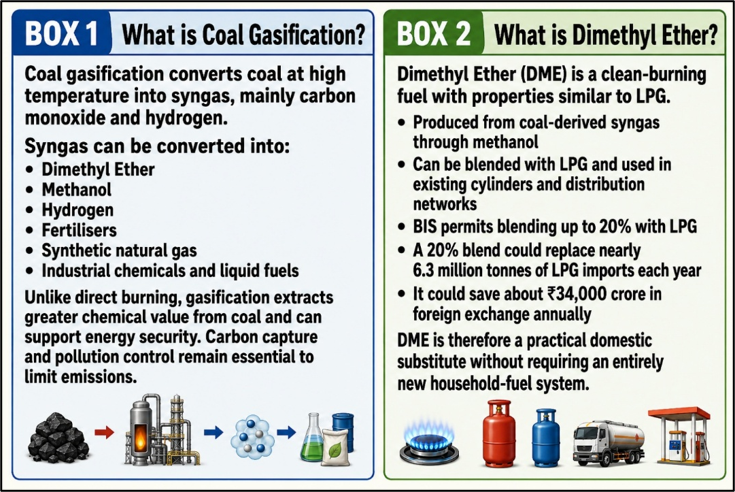
Why Coal Gasification and DME Suit India?
- Reduced imports: Domestic DME can lower dependence on a few foreign LPG suppliers.
- Energy security: India can produce essential fuel from its own coal resources.
- Existing infrastructure: DME blending can use much of the present LPG network.
- Foreign-exchange savings: Lower fuel imports can reduce the import bill.
- Industrial development: Gasification can support chemicals, fertilisers, hydrogen and manufacturing.
- Strategic autonomy: Domestic production reduces exposure to geopolitical disruptions.
Government Push for Coal Gasification:
Union Cabinet has approved a ₹37,500-cr scheme to promote coal & lignite gasification. The policy:
- Targets gasification of 100 million tonnes of coal annually by 2030;
- Provides incentives of up to 20% of plant and machinery costs;
- Supports capital-intensive and long-gestation projects;
- Encourages the commercial scaling of indigenous technologies.
The CSIR–National Chemical Laboratory has already developed indigenous technology for converting methanol into DME. The main challenge is now commercial execution at scale.
Critical Assessment:
Coal gasification is strategically useful, but it is not automatically clean or economical.
- Indian coal has high ash content, making processing difficult.
- Plants require large investments, water and advanced technology.
- Gasification can produce high carbon emissions without Carbon Capture, Utilisation and Storage.
- Excessive investment may create long-term dependence on coal.
- India still lacks adequate domestic capability in catalysts, equipment and large-scale process engineering.
Therefore, coal chemistry should complement renewable energy, electrification and energy efficiency rather than replace them.
Need for Indigenous Capability:
- India survived the crude and LPG shock because it had spent years building flexible refineries, trained engineers, port facilities and distribution networks. Coal chemistry requires the same long-term discipline.
- Research laboratories must develop technologies, government must provide stable policy support, and industry must scale them commercially. India should build domestic expertise in gasifiers, catalysts, metallurgy, ash management and carbon capture.
Conclusion:
The West Asian crisis showed that diversified imports alone cannot guarantee energy security. India needs the domestic capacity to produce critical fuels and chemicals. Coal gasification and DME can strengthen strategic autonomy, provided they are commercially viable, technologically indigenous and environmentally responsible.
Source: (The Indian Express, The Hindu)
La Excellence IAS Academy, the best IAS coaching in Hyderabad, known for delivering quality content and conceptual clarity for UPSC 2026 preparation.
FOLLOW US ON:
◉ YouTube : https://www.youtube.com/@CivilsPrepTeam
◉ Facebook: https://www.facebook.com/LaExcellenceIAS
◉ Instagram: https://www.instagram.com/laexcellenceiasacademy/
GET IN TOUCH:
Contact us at info@laex.in, https://laex.in/contact-us/
or Call us @ +91 9052 29 2929, +91 9052 99 2929, +91 9154 24 2140
OUR BRANCHES:
Head Office: H No: 1-10-225A, Beside AEVA Fertility Center, Ashok Nagar Extension, VV Giri Nagar, Ashok Nagar, Hyderabad, 500020
Madhapur: Flat no: 301, survey no 58-60, Guttala begumpet Madhapur metro pillar: 1524, Rangareddy Hyderabad, Telangana 500081
Bangalore: Plot No: 99, 2nd floor, 80 Feet Road, Beside Poorvika Mobiles, Chandra Layout, Attiguppe, Near Vijaya Nagara, Bengaluru, 560040
Coal Chemistry in India: Strategic Industrial Capability