
Paper: GS – III, Subject: Economy, Topic: Agriculture – Inputs, Issue: India’s Pesticide Regulation.
Context:
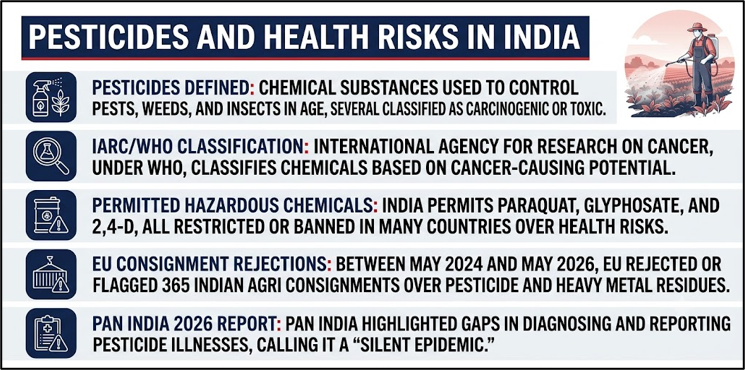
Recently, concerns have intensified over India’s continued use of pesticides that are banned or restricted in many countries, including paraquat, glyphosate, and 2,4-D. Rising export rejections due to pesticide residues and increasing evidence of pesticide-related health risks have brought India’s regulatory framework under renewed scrutiny.
Key Takeaways:
Explanation:
Regulatory Challenges:
- Pesticide approval in India often relies on data given by manufacturers, not independent tests.
- Health experts have little say in deciding which pesticides are allowed.
- Some pesticides banned in many countries, like paraquat, are still legal in India.
- A national ban on paraquat is still pending before the Supreme Court.
- Doctors get little training in pesticide-related illness, so many cases go undetected.
Public Health Concerns:
- Paraquat has no known antidote and can cause kidney damage and Parkinson’s disease.
- Glyphosate is called a probable cancer-causing chemical by health experts.
- 2,4-D is linked to possible cancer risk in animal studies.
- District hospitals often lack basic tests to detect pesticide poisoning.
- Health clusters have been reported in Punjab’s Malwa region, Maharashtra’s Yavatmal, and Kerala’s Kasaragod.
- Chronic pesticide exposure may also add to India’s persistent anaemia problem.
Trade and Environmental Implications:
- Between 2024 and 2026, the European Union rejected 365 Indian farm export consignments over pesticide residues.
- Nepal recently restricted Indian mango imports over similar concerns, joining Japan, the EU, and Saudi Arabia.
- Export rejections raise costs for Indian farmers and traders.
- Some pesticides, like acephate, harm bees and butterflies, affecting crop pollination.
Way Forward:
- Establish an independent scientific risk assessment mechanism for pesticide approvals.
- Include doctors and health experts in pesticide regulatory bodies.
- Strengthen toxicology laboratories and pesticide surveillance in district hospitals.
- Promote safer alternatives like Integrated Pest Management.
- Gradually align India’s Maximum Residue Limits (MRLs) with international standards.
Conclusion:
India’s pesticide policy must balance agricultural productivity, public health, and export competitiveness. Strengthening scientific regulation, improving healthcare capacity, and promoting safer farming practices can ensure sustainable agriculture while protecting both farmers and consumers.
Source: (The Hindu)
La Excellence IAS Academy, the best IAS coaching in Hyderabad, known for delivering quality content and conceptual clarity for UPSC 2026 preparation.
FOLLOW US ON:
◉ YouTube : https://www.youtube.com/@CivilsPrepTeam
◉ Facebook: https://www.facebook.com/LaExcellenceIAS
◉ Instagram: https://www.instagram.com/laexcellenceiasacademy/
GET IN TOUCH:
Contact us at info@laex.in, https://laex.in/contact-us/
or Call us @ +91 9052 29 2929, +91 9052 99 2929, +91 9154 24 2140
OUR BRANCHES:
Head Office: H No: 1-10-225A, Beside AEVA Fertility Center, Ashok Nagar Extension, VV Giri Nagar, Ashok Nagar, Hyderabad, 500020
Madhapur: Flat no: 301, survey no 58-60, Guttala begumpet Madhapur metro pillar: 1524, Rangareddy Hyderabad, Telangana 500081
Bangalore: Plot No: 99, 2nd floor, 80 Feet Road, Beside Poorvika Mobiles, Chandra Layout, Attiguppe, Near Vijaya Nagara, Bengaluru, 560040