
Paper: GS – III, Subject: Science and Technology, Topic: Indigenization and Development of Technologies, Issue: India’s First Hydrogen-Powered Train.
Context:
India’s first indigenously designed hydrogen fuel-cell train is scheduled to begin operations on the Jind – Sonipat section of Northern Railway on July 17, 2026. The pilot project aims to demonstrate low-emission rail transport while building domestic capabilities in hydrogen propulsion, refuelling and safety systems.
Key Takeaways:
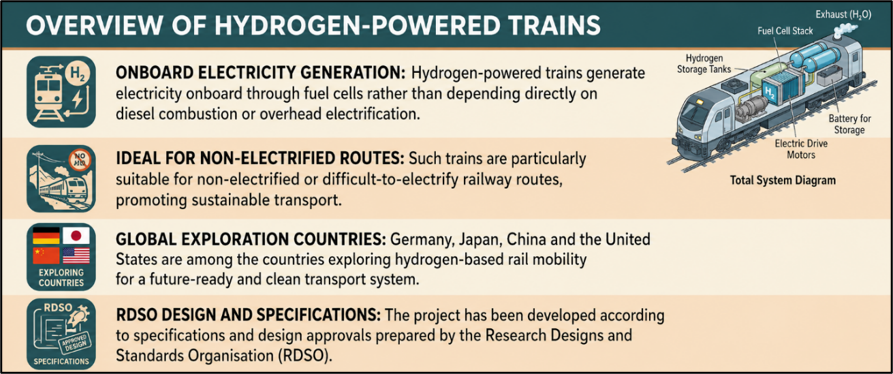
Explanation:
- It supports the National Green Hydrogen Mission, Atmanirbhar Bharat and Indian Railways’ objective of achieving net-zero carbon emissions.
- As a pilot initiative, it will generate operational knowledge for the future expansion of hydrogen-powered mobility.
Key Features:
- The train is a 10-car trainset comprising two Hydrogen Driving Power Cars and eight trailer coaches.
- It uses a 1,200-kW hydrogen fuel-cell propulsion system and can carry approximately 2,600 passengers.
- It has an approved operational speed of 75 kmph and a design speed of 110 kmph.
How Does It Work?
- Its principal energy source is a Proton Exchange Membrane Fuel Cell (PEMFC).
- Inside the fuel cell, hydrogen reacts electrochemically with atmospheric oxygen across a proton-conducting membrane to generate electricity.
- Electricity powers the traction motors, while water vapour and heat are the principal onboard by-products.
- Lithium iron phosphate batteries store supplementary energy, support acceleration and regulate fluctuations in power demand.
- Hydrogen has a gravimetric energy content of around 120 MJ/kg, compared with approximately 43 MJ/kg for diesel. However, it requires specialised high-pressure storage because of its low volumetric energy density.
Hydrogen Infrastructure:
- India’s largest railway hydrogen storage and refuelling facility has been established at Jind, Haryana, with a capacity of nearly 3,000 kg.
- The PESO-licensed facility contains hydrogen compressors, dispensing equipment, critical spares and a standby compressor.
- It follows NFPA-2 and ISO 19880 standards and has undergone independent safety assessment by TUV SUD.
Operational Safety:
- Hydrogen and flame detectors continuously monitor production, storage and dispensing facilities.
- Continuous ventilation prevents gas accumulation, while automatic systems can stop the hydrogen supply upon detecting heat, flame or smoke.
- Real-time displays communicate system health to the loco pilot, and an emergency mode enables the train to be moved to safety.
- Trained personnel, technical staff, regular audits, prescribed maintenance and round-the-clock monitoring strengthen operational preparedness.
Significance and Concerns:
- The project promotes indigenous technological capability and can reduce local air pollution and dependence on imported fossil fuels.
- It can support green-hydrogen demand and provide clean transport on routes where full electrification is uneconomical.
- Nevertheless, green hydrogen remains expensive, requires considerable renewable electricity and presents storage and transportation challenges.
- Its lifecycle emissions depend on the production method; hydrogen derived from fossil fuels cannot provide fully clean mobility.
- The pilot must therefore evaluate cost, efficiency, durability, infrastructure requirements and safety before large-scale deployment.
Conclusion:
The hydrogen train is not merely a new trainset but a demonstration of an entire clean-mobility ecosystem. Its success can enable wider adoption, provided India expands affordable green-hydrogen production, maintains rigorous safety standards and deploys the technology on routes where it offers clear advantages over electrification.
Source: (PIB)
La Excellence IAS Academy, the best IAS coaching in Hyderabad, known for delivering quality content and conceptual clarity for UPSC 2026 preparation.
FOLLOW US ON:
◉ YouTube : https://www.youtube.com/@CivilsPrepTeam
◉ Facebook: https://www.facebook.com/LaExcellenceIAS
◉ Instagram: https://www.instagram.com/laexcellenceiasacademy/
GET IN TOUCH:
Contact us at info@laex.in, https://laex.in/contact-us/
or Call us @ +91 9052 29 2929, +91 9052 99 2929, +91 9154 24 2140
OUR BRANCHES:
Head Office: H No: 1-10-225A, Beside AEVA Fertility Center, Ashok Nagar Extension, VV Giri Nagar, Ashok Nagar, Hyderabad, 500020
Madhapur: Flat no: 301, survey no 58-60, Guttala begumpet Madhapur metro pillar: 1524, Rangareddy Hyderabad, Telangana 500081
Bangalore: Plot No: 99, 2nd floor, 80 Feet Road, Beside Poorvika Mobiles, Chandra Layout, Attiguppe, Near Vijaya Nagara, Bengaluru, 560040