
Paper: GS -II , Subject: Polity, Topic: Executive, Issue: Ladakh Hill Councils and the Decentralisation Debate
Context: The Ladakh administration has proposed establishing an Autonomous Hill Development Council (AHDC) in each of the Union Territory’s seven districts. Although intended to deepen grassroots governance, the move has been opposed by major civil society groups, which fear political fragmentation and dilution of Ladakh’s demand for constitutional safeguards.
Key Takeaways:
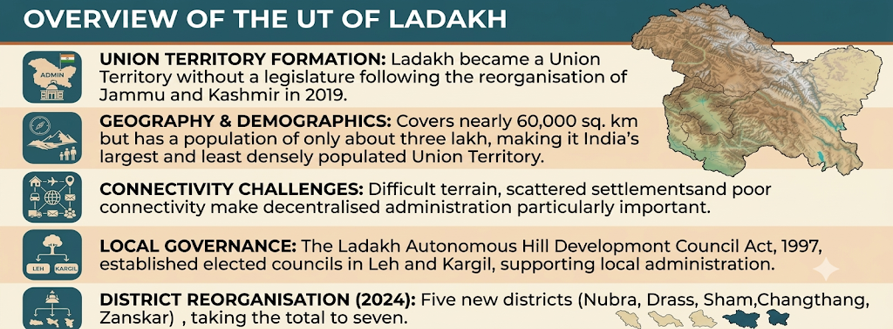
Explanation
Rationale for New Councils
- District-level councils can bring decision-making closer to remote communities and ensure that development reflects their geographic, cultural and livelihood requirements.
- They may improve local participation, administrative accessibility and equitable distribution of public resources.
Powers and Limitations of AHDCs
- AHDCs undertake district planning and prepare budgets and development programmes.
- They may manage village administration, land use, local roads and certain natural resources, besides collecting specified local taxes.
- However, they are statutory bodies and lack the independent legislative, judicial and constitutional authority enjoyed by Autonomous District Councils under the Sixth Schedule.
- Their effectiveness depends heavily on the powers, finances and personnel transferred by the Union Territory administration.
Concerns of Civil Society
- The Leh Apex Body and Kargil Democratic Alliance argue that seven councils could divide Ladakh’s collective political voice during negotiations with the Union Government.
- They fear that powers expected to be vested in a proposed Union Territory-level representative institution under Article 371 may instead be dispersed among weaker district councils.
- Existing AHDCs allege that their authority over land, recruitment, finances and development has declined since Ladakh became a Union Territory.
- Questions have also arisen over consultation, as representatives reportedly did not approve the proposal recorded during negotiations.
- Thus, multiplying councils without clearly devolving the “three Fs”—functions, funds and functionaries – may create administrative fragmentation rather than substantive decentralisation.
Conclusion
Ladakh’s geography makes decentralised governance indispensable, but institutional expansion alone cannot guarantee self-government. New councils should be established through meaningful consultation and supported by constitutional clarity, adequate finances, administrative authority and safeguards for Ladakh’s cultural identity.
Source: (The Indian Express)
La Excellence IAS Academy, the best IAS coaching in Hyderabad, known for delivering quality content and conceptual clarity for UPSC 2026 preparation.
FOLLOW US ON:
◉ YouTube : https://www.youtube.com/@CivilsPrepTeam
◉ Facebook: https://www.facebook.com/LaExcellenceIAS
◉ Instagram: https://www.instagram.com/laexcellenceiasacademy/
GET IN TOUCH:
Contact us at info@laex.in, https://laex.in/contact-us/
or Call us @ +91 9052 29 2929, +91 9052 99 2929, +91 9154 24 2140
OUR BRANCHES:
Head Office: H No: 1-10-225A, Beside AEVA Fertility Center, Ashok Nagar Extension, VV Giri Nagar, Ashok Nagar, Hyderabad, 500020
Madhapur: Flat no: 301, survey no 58-60, Guttala begumpet Madhapur metro pillar: 1524, Rangareddy Hyderabad, Telangana 500081
Bangalore: Plot No: 99, 2nd floor, 80 Feet Road, Beside Poorvika Mobiles, Chandra Layout, Attiguppe, Near Vijaya Nagara, Bengaluru, 560040