
Paper: GS – I, Subject: Society and Social Justice, Topic: Population and Associated Issues, Issue: Caste Enumeration 2027: Need for Standardised Coding.
Context:
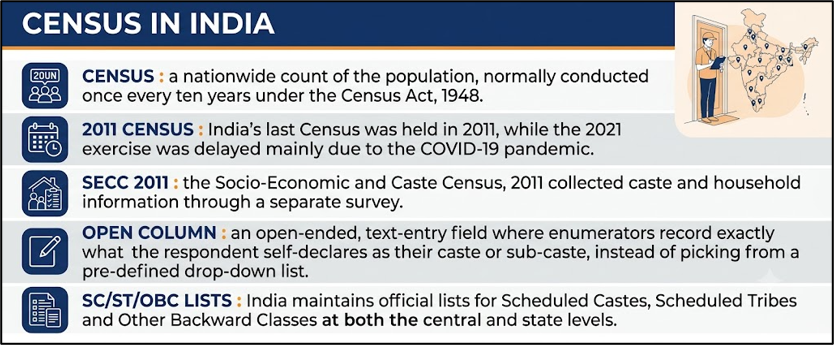
Recent news reports indicate that the rehearsal for the second phase of Census 2027 includes an “open column” for recording caste. While the government has clarified that the final methodology will be decided after evaluating feedback from the test exercise, experience from previous surveys suggests that relying solely on an open-text response without a standardised coding framework can undermine the objective of caste enumeration.
Key Takeaways:
Explanation:
Problems with an Open Column:
- An open column allows people to write caste names freely.
- The same caste may have different spellings, titles, sub-castes or regional names.
- One community may therefore appear as several separate entries.
- SECC 2011 reportedly produced over 46 lakh caste entries. Many were repeated or unclear versions of similar names.
- Cleaning such data is difficult. It may delay publication and reduce policy value.
Need for Standardised Coding:
- Every recognised caste should receive a fixed code.
- Enumerators can match responses with an approved master list.
- This is like selecting from a dropdown menu instead of typing freely.
- A limited open field may remain for genuinely unlisted communities.
- Bihar and Telangana used structured lists in their caste surveys. Their data was easier to classify.
Importance of Accurate Data:
- Reliable data can reveal social and economic inequality.
- It can improve reservations, scholarships and welfare programmes.
- Privacy safeguards are needed to prevent misuse and social tension.
Way Forward:
- Form an expert committee to build a standardised caste code list, combining state lists, central OBC list, and inputs from NCBC and Anthropological Survey of India.
- Assign standard codes; map regional synonyms to one parent category, while preserving state-wise variation in status.
- Extend classification to communities outside SC/ST/OBC (EWS records as a starting point).
- Train enumerators; audit doubtful entries; retain a limited open field for unlisted communities.
- Ensure confidentiality and transparency to prevent misuse and stigmatisation.
Conclusion:
Caste enumeration is not only about counting communities. The data must be clear, comparable and usable. Census 2027 should combine standardised coding with limited space for new entries. This can support social justice and avoid the errors of SECC 2011.
Source: (The Indian Express)
La Excellence IAS Academy, the best IAS coaching in Hyderabad, known for delivering quality content and conceptual clarity for UPSC 2026 preparation.
FOLLOW US ON:
◉ YouTube : https://www.youtube.com/@CivilsPrepTeam
◉ Facebook: https://www.facebook.com/LaExcellenceIAS
◉ Instagram: https://www.instagram.com/laexcellenceiasacademy/
GET IN TOUCH:
Contact us at info@laex.in, https://laex.in/contact-us/
or Call us @ +91 9052 29 2929, +91 9052 99 2929, +91 9154 24 2140
OUR BRANCHES:
Head Office: H No: 1-10-225A, Beside AEVA Fertility Center, Ashok Nagar Extension, VV Giri Nagar, Ashok Nagar, Hyderabad, 500020
Madhapur: Flat no: 301, survey no 58-60, Guttala begumpet Madhapur metro pillar: 1524, Rangareddy Hyderabad, Telangana 500081
Bangalore: Plot No: 99, 2nd floor, 80 Feet Road, Beside Poorvika Mobiles, Chandra Layout, Attiguppe, Near Vijaya Nagara, Bengaluru, 560040