
Paper: GS – II, Subject: International Relations, Topic: India and its neighbourhood, Issue: Renewing the India–Bangladesh Ganga Water Treaty.
Context:
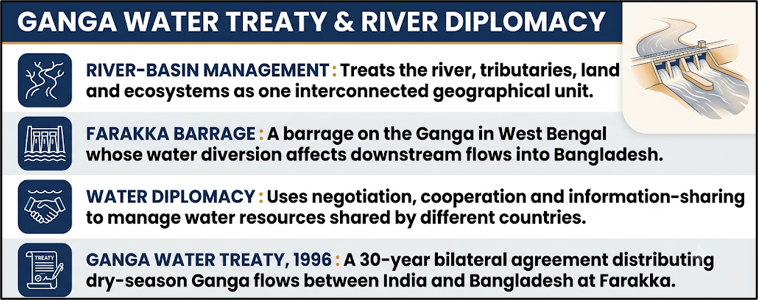
Recently, the approaching expiry of the 1996 India–Bangladesh Ganga Water Treaty has renewed debate. Negotiations offer an opportunity to create a climate-resilient, basin-wide framework instead of simply extending the existing arrangement.
Key Takeaways:
Explanation:
Need for a Broader Framework:
- The treaty mainly divides dry-season water at Farakka, while current challenges affect the entire Ganga basin.
- Climate change is altering rainfall, floods, droughts, glaciers and ecosystems, making earlier water-flow assumptions unreliable.
- A new agreement should include ecological protection, climate adaptation, navigation, fisheries and coordinated disaster management.
Key Challenges:
- Bilateral relations are less favourable than in 1996, while anti-India sentiment may complicate negotiations in Bangladesh.
- Water sharing remains politically sensitive in West Bengal; therefore, cooperation between the Union and State governments is essential.
- Bangladesh’s engagement with China over the Teesta may create strategic concerns, although constructive engagement could also provide opportunities.
- Existing institutions have limited capacity to manage ecological change, uncertain water availability and emerging disputes.
Importance of Cooperation:
- Shared rivers create mutual dependence, while cooperation can support flood control, navigation, trade, fisheries and ecosystem restoration.
- A basin-wide approach would avoid the “territorial trap” of managing a connected river strictly through national boundaries.
- Cooperation could eventually include other basin countries and strengthen regional responses to Himalayan climate vulnerability.
Way Forward:
- Both countries should strengthen the Joint Rivers Commission through scientific expertise, regular monitoring and effective dispute-resolution mechanisms.
- Real-time information about rainfall, river flows, floods and ecological conditions should be exchanged transparently.
- Negotiations should combine Track 1 official diplomacy with Track 2 engagement involving experts, communities and civil society.
- India must involve Bihar and West Bengal, while both countries rebuild trust through sustained dialogue.
Conclusion:
The treaty’s renewal should move beyond narrow water allocation towards cooperative river-basin governance. A flexible, inclusive and science-based framework can protect national interests while addressing shared ecological and climate risks.
Source: (The Indian Express)
La Excellence IAS Academy, the best IAS coaching in Hyderabad, known for delivering quality content and conceptual clarity for UPSC 2026 preparation.
FOLLOW US ON:
◉ YouTube : https://www.youtube.com/@CivilsPrepTeam
◉ Facebook: https://www.facebook.com/LaExcellenceIAS
◉ Instagram: https://www.instagram.com/laexcellenceiasacademy/
GET IN TOUCH:
Contact us at info@laex.in, https://laex.in/contact-us/
or Call us @ +91 9052 29 2929, +91 9052 99 2929, +91 9154 24 2140
OUR BRANCHES:
Head Office: H No: 1-10-225A, Beside AEVA Fertility Center, Ashok Nagar Extension, VV Giri Nagar, Ashok Nagar, Hyderabad, 500020
Madhapur: Flat no: 301, survey no 58-60, Guttala begumpet Madhapur metro pillar: 1524, Rangareddy Hyderabad, Telangana 500081
Bangalore: Plot No: 99, 2nd floor, 80 Feet Road, Beside Poorvika Mobiles, Chandra Layout, Attiguppe, Near Vijaya Nagara, Bengaluru, 560040