
Paper: GS – I, Subject: Society and Social Justice, Topic: Population and associated issues, Issue: Young Indians, Family Aspirations and Falling Fertility.
Context:
Recently, the United Nations Population Fund released its Demographic Futures Survey, covering 1.08 lakh young adults across 73 countries. It shows that young Indians want families but face economic, social and environmental barriers.
Key Takeaways:
Explanation:
Fertility Decline and Choice:
- Falling fertility is partly a policy achievement supported by girls’ education, maternal healthcare, contraceptive choice and the National Health Mission.
- The share of young women married before 18 fell from 23.3% to 20.1%, indicating greater agency and delayed motherhood.
- Healthy Timing and Spacing of Pregnancies places voluntary choice, rather than numerical targets, at the centre of family planning.
| Demographic Dividend is the economic growth potential that occurs when a country’s working-age population (ages 15–64) is larger than its dependent population (under 15 and 65+). |
Aspirations and Barriers:
- Four in ten women and one-third of men consider two children ideal.
- However, inadequate income, costly housing, insecure jobs and childcare concerns often delay their plans.
- Climate change, conflict, unemployment and economic insecurity further weaken confidence and affect mental health.
Unequal Care Burden:
- Young women perform over five hours of unpaid care daily, while young men contribute about half an hour.
- Only 15% of young women are in paid work, compared with 55% of young men.
- This creates a double burden for working women, combining employment with disproportionate domestic responsibilities.
Need for Differentiated Policy:
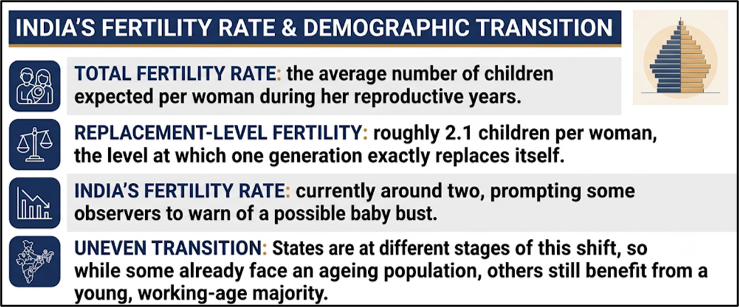
- Fertility varies widely, from 2.7 in Bihar to 1.0 in Sikkim, because demographic transition proceeds at different speeds.
- Higher-fertility States need education and reproductive healthcare, while low-fertility States require stronger family support.
Way Forward:
- India needs a rights-based approach protecting voluntary decisions about whether, when and how many children people have.
- A State-specific population policy should replace uniform targets and address distinct demographic needs.
- Governments and employers should provide dignified jobs, parental leave, flexible work, childcare and mental-health support.
Conclusion:
India’s fertility decline reflects progress, but unmet aspirations reveal insecurity and gender inequality. Policy must protect reproductive choice and help young people form families freely.
Source: (The Hindu)
La Excellence IAS Academy, the best IAS coaching in Hyderabad, known for delivering quality content and conceptual clarity for UPSC 2026 preparation.
FOLLOW US ON:
◉ YouTube : https://www.youtube.com/@CivilsPrepTeam
◉ Facebook: https://www.facebook.com/LaExcellenceIAS
◉ Instagram: https://www.instagram.com/laexcellenceiasacademy/
GET IN TOUCH:
Contact us at info@laex.in, https://laex.in/contact-us/
or Call us @ +91 9052 29 2929, +91 9052 99 2929, +91 9154 24 2140
OUR BRANCHES:
Head Office: H No: 1-10-225A, Beside AEVA Fertility Center, Ashok Nagar Extension, VV Giri Nagar, Ashok Nagar, Hyderabad, 500020
Madhapur: Flat no: 301, survey no 58-60, Guttala begumpet Madhapur metro pillar: 1524, Rangareddy Hyderabad, Telangana 500081
Bangalore: Plot No: 99, 2nd floor, 80 Feet Road, Beside Poorvika Mobiles, Chandra Layout, Attiguppe, Near Vijaya Nagara, Bengaluru, 560040