
Paper: GS – II, Subject: International Relations, Topic: India and Its Neighborhood, Issue: Indus Waters Treaty.
Context:
India’s decision to place the Indus Waters Treaty (IWT) in abeyance has intensified water-related tensions with Pakistan. India is now considering faster utilisation of its allocated waters, expansion of hydropower projects and modernisation of reservoirs to meet emerging developmental, climatic and strategic requirements.
Key Takeaways:
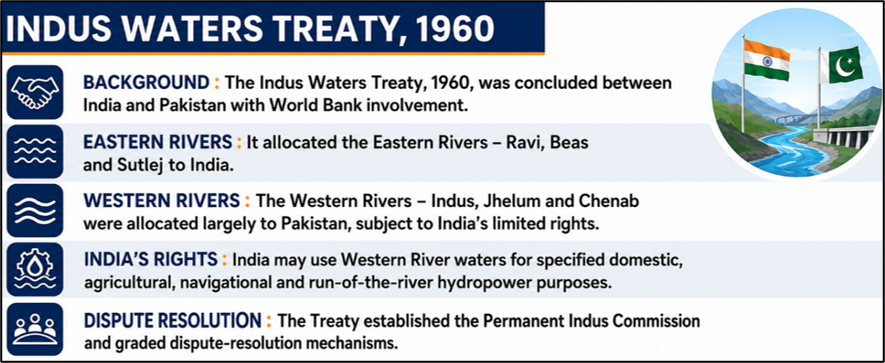
Explanation:
- India argues that terrorism, climate change, water stress and technological advances have altered the circumstances under which the Treaty operates.
Why India seeks greater utilization?
- India considers it necessary to prevent the avoidable wastage of its allocated Eastern River waters, some of which presently flow into Pakistan.
- Greater storage and irrigation capacity can address groundwater depletion and water stress in Punjab, Haryana, Rajasthan and Jammu and Kashmir.
- Accelerated hydropower development on the Chenab basin can support clean energy, grid stability and regional development.
Hydropower projects:
- Important projects include Sawalkot, Pakal Dul, Ratle, Kiru and Kwar.
- The Ujh Multipurpose Project, a tributary project of the Ravi, is intended to provide irrigation, drinking water, flood moderation and hydropower benefits.
- India may modernise existing reservoirs through improved sediment management, gated spillways, low-level outlets and flexible operating practices.
India – Pakistan disagreement:
- Pakistan frequently objects to Indian hydropower projects on Western Rivers, particularly their design and reservoir-operating features.
- India argues that modern engineering and climate-resilient practices were not fully anticipated when the Treaty was drafted.
- It also maintains that seasonal snowmelt, temperature variations, sediment flushing and maintenance operations may temporarily affect downstream flows without constituting deliberate interference.
Wider concerns:
- Climate change is altering snowfall, glacial melt, rainfall and flood patterns across the Indus basin.
- Pakistan’s water crisis is also aggravated by canal seepage, inadequate storage, inefficient irrigation and water-intensive cropping.
- Unilateral action or hostile rhetoric could nevertheless intensify regional instability, making transparency and verifiable hydrological data essential.
Conclusion:
The Indus basin requires a framework that recognises India’s legitimate developmental rights while protecting downstream water security. Modernisation, climate adaptation, transparent data-sharing and structured negotiations offer a more sustainable path than indefinite confrontation.
Source: (The Indian Express)
La Excellence IAS Academy, the best IAS coaching in Hyderabad, known for delivering quality content and conceptual clarity for UPSC 2026 preparation.
FOLLOW US ON:
◉ YouTube : https://www.youtube.com/@CivilsPrepTeam
◉ Facebook: https://www.facebook.com/LaExcellenceIAS
◉ Instagram: https://www.instagram.com/laexcellenceiasacademy/
GET IN TOUCH:
Contact us at info@laex.in, https://laex.in/contact-us/
or Call us @ +91 9052 29 2929, +91 9052 99 2929, +91 9154 24 2140
OUR BRANCHES:
Head Office: H No: 1-10-225A, Beside AEVA Fertility Center, Ashok Nagar Extension, VV Giri Nagar, Ashok Nagar, Hyderabad, 500020
Madhapur: Flat no: 301, survey no 58-60, Guttala begumpet Madhapur metro pillar: 1524, Rangareddy Hyderabad, Telangana 500081
Bangalore: Plot No: 99, 2nd floor, 80 Feet Road, Beside Poorvika Mobiles, Chandra Layout, Attiguppe, Near Vijaya Nagara, Bengaluru, 560040