
Paper: GS – I, Subject: Geography, Topic: Economic Geography, Issue: Rayalaseema: From Drought-Prone Region to Industrial Hub.
Context:
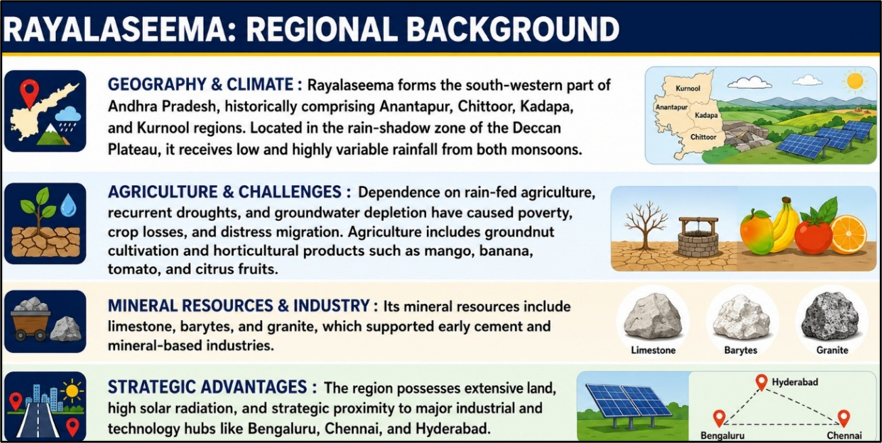
Rayalaseema, historically characterised by drought, agrarian distress and limited industrialisation, is undergoing rapid economic transformation. Investments in automobiles, steel, defence, electronics, renewable energy and food processing are creating a diversified industrial ecosystem.
Key Takeaways:
Explanation:
Ongoing Economic Transformation:
- Anantapur is developing an automobile cluster around the Kia Motors plant and its ancillary industries.
- Royal Enfield near Tirupati and manufacturing units in Sri City are strengthening the automotive, electronics and engineering ecosystem.
- The integrated steel plant in Kadapa can promote core industries, logistics and downstream manufacturing.
- Defence projects at Puttaparthi and Madakasira, alongside proximity to Sriharikota, offer opportunities in aerospace and strategic manufacturing.
- Solar parks in Kadapa and Kurnool have positioned the region as an important renewable-energy centre.
- Food processing is being promoted to add value to horticultural produce and reduce post-harvest losses.
Factors Supporting Transformation:
- Large land parcels, competitive costs, industrial corridors and proximity to major markets have improved investment attractiveness.
- Better roads, power supply, investment incentives and faster approvals have reduced operational barriers.
- Anchor industries are encouraging ancillary units, MSMEs, logistics networks, urbanisation and non-farm employment.
Sustainable Development Challenges:
- Water scarcity and groundwater over-extraction may create competition between agriculture, households and industries.
- Industrial pollution, mining, land degradation and rapid urban growth could increase ecological stress.
- Skill gaps, uneven local employment, land acquisition disputes and regional inequalities may weaken inclusive development.
Way Forward:
- Industries should adopt water recycling, rainwater harvesting, renewable energy and circular-production systems.
- Policy must prioritise local skilling, MSME linkages, transparent land acquisition and environmentally rigorous clearances.
- Regional planning should integrate industries, cities, transport, housing and social infrastructure.
Conclusion:
Rayalaseema’s transformation can correct historical regional imbalances and reduce dependence on climate-vulnerable agriculture. However, lasting progress requires industrial growth to remain water-secure, environmentally sustainable and socially inclusive.
Source: (The Hindu)
La Excellence IAS Academy, the best IAS coaching in Hyderabad, known for delivering quality content and conceptual clarity for UPSC 2026 preparation.
FOLLOW US ON:
◉ YouTube : https://www.youtube.com/@CivilsPrepTeam
◉ Facebook: https://www.facebook.com/LaExcellenceIAS
◉ Instagram: https://www.instagram.com/laexcellenceiasacademy/
GET IN TOUCH:
Contact us at info@laex.in, https://laex.in/contact-us/
or Call us @ +91 9052 29 2929, +91 9052 99 2929, +91 9154 24 2140
OUR BRANCHES:
Head Office: H No: 1-10-225A, Beside AEVA Fertility Center, Ashok Nagar Extension, VV Giri Nagar, Ashok Nagar, Hyderabad, 500020
Madhapur: Flat no: 301, survey no 58-60, Guttala begumpet Madhapur metro pillar: 1524, Rangareddy Hyderabad, Telangana 500081
Bangalore: Plot No: 99, 2nd floor, 80 Feet Road, Beside Poorvika Mobiles, Chandra Layout, Attiguppe, Near Vijaya Nagara, Bengaluru, 560040
Rayalaseema Industrial Development: Geography and Growth