
Paper: GS-III, Subject: Internal Security, Topic: Cyber security, Issue: AI and Cyberspace: An Emerging Security Challenge
Context
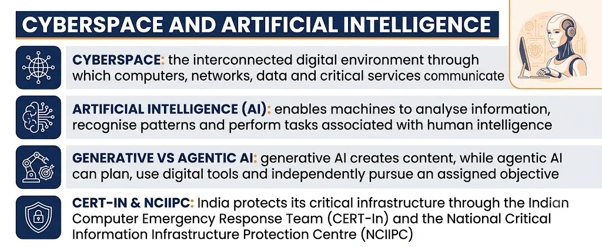
Recently, the growing use of Artificial Intelligence in cyber operations and warfare has created serious security concerns. AI-enabled systems can strengthen cyber defence, but also enable faster, adaptive and large-scale attacks.
Explanation
Emerging AI Cyber Security Nexus
- AI and cyberspace form a “double helix” because developments in each strengthen the capabilities and risks of the other.
- AI-powered malware can examine its environment, change its behaviour and bypass conventional security barriers.
- Malicious autonomous agents may discover vulnerabilities, acquire credentials, enter networks and extract sensitive information independently.
A zero-day vulnerability is an unknown software weakness for which no security patch is available.
- Such capabilities may challenge Zero Trust systems based on continuous verification.
Strategic Importance and Implications
- AI strengthens Intelligence, Surveillance and Reconnaissance (ISR) by rapidly analysing satellite images, radar signals and intercepted communications.
- It can improve early-warning systems, missile detection, threat assessment and protection of critical infrastructure.
- However, Lethal Autonomous Weapons Systems (LAWS) may identify and attack targets with limited human intervention.
- Low-cost drones and AI-enabled cyber tools create an asymmetric impact, enabling weaker actors to challenge powerful states.
Major Challenges
- AI hallucinations, embedded biases and automation bias may produce incorrect or disproportionate national-security decisions.
- Algorithmic radicalisation can amplify polarising content, while rogue groups may acquire capabilities previously limited to states.
- United States–China technological competition could intensify an AI arms race without adequate global safeguards.
Way Forward
- Governments should mandate independent audits, safety testing, accountability and secure human–machine interfaces.
- Meaningful human control must remain compulsory in autonomous weapons and defence-warning systems.
- International norms should regulate military AI, cyber operations and excessive concentration of technological power.
Conclusion
AI can improve cyber defence and strategic awareness, but autonomous deployment creates systemic risks. India and the international community must pursue cautious innovation supported by human judgement, effective regulation and continuous oversight.
Source: (The Hindu)
La Excellence IAS Academy, the best IAS coaching in Hyderabad, known for delivering quality content and conceptual clarity for UPSC 2026 preparation.
FOLLOW US ON:
◉ YouTube : https://www.youtube.com/@CivilsPrepTeam
◉ Facebook: https://www.facebook.com/LaExcellenceIAS
◉ Instagram: https://www.instagram.com/laexcellenceiasacademy/
GET IN TOUCH:
Contact us at info@laex.in, https://laex.in/contact-us/
or Call us @ +91 9052 29 2929, +91 9052 99 2929, +91 9154 24 2140
OUR BRANCHES:
Head Office: H No: 1-10-225A, Beside AEVA Fertility Center, Ashok Nagar Extension, VV Giri Nagar, Ashok Nagar, Hyderabad, 500020
Madhapur: Flat no: 301, survey no 58-60, Guttala begumpet Madhapur metro pillar: 1524, Rangareddy Hyderabad, Telangana 500081
Bangalore: Plot No: 99, 2nd floor, 80 Feet Road, Beside Poorvika Mobiles, Chandra Layout, Attiguppe, Near Vijaya Nagara, Bengaluru, 560040