
Paper: GS-I, Subject: Geography, Topic: Resources – World and India, Issue: Critical Minerals: Foundation of India’s Strategic Power (Critical Mineral Mission)
Context:
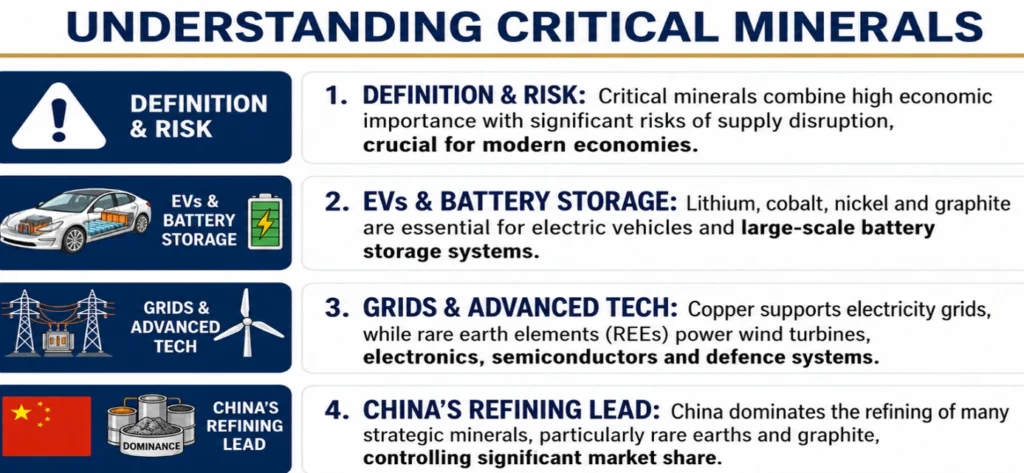
Critical minerals have become central to industrial policy, energy security and national defence. Rising demand, concentrated global supply chains and geopolitical restrictions make secure access to these minerals essential for India’s energy transition and strategic autonomy.
Explanation
Growing Strategic Importance
- Decarbonisation, electrification, artificial intelligence and semiconductor manufacturing are rapidly increasing mineral demand. Global demand for energy-transition minerals could reach about 169 million tonnes by 2070 under a net-zero scenario.
- Supply expansion may not keep pace with demand. The global copper project pipeline indicates a possible 30% supply shortfall by 2035, while demand for rare earths is expected to rise with wind power and electronics.
India’s Potential and Vulnerability
- India possesses resources of cobalt, copper, graphite and nickel, besides monazite deposits containing rare earth oxides.
- However, mineral reserves do not automatically guarantee supply security. India remains import-dependent for lithium, cobalt and nickel, while its graphite and rare-earth processing is constrained.
- The principal weakness lies in midstream activities, particularly high-purity processing, refining, smelting and purification.
Structural Constraints
- Exploration remains shallow, regulatory clearances are time-consuming and private investment is limited.
- Remote mining areas face infrastructure and commercial-viability problems.
- Recycling may eventually supply a significant share of copper and graphite, but it cannot replace primary mining in the near term because collection systems, feedstock and technology remain inadequate.
India’s Policy Response
- India has identified 30 critical minerals and launched the National Critical Mineral Mission to strengthen exploration, production, processing, recycling and overseas acquisition.
- Khanij Bidesh India Limited (KABIL) is pursuing overseas mineral assets, including lithium exploration in Argentina.
- India must create strategic stockpiles, provide predictable approvals, promote private capital, strengthen geological data and build partnerships with trusted mineral-producing countries.
Conclusion
Critical mineral security will shape India’s energy transition, industrial competitiveness and strategic autonomy. India must move from identifying mineral potential to developing integrated domestic and diversified overseas supply chains, with processing and recycling treated as national priorities.
Source: (The Hindu)
La Excellence IAS Academy, the best IAS coaching in Hyderabad, known for delivering quality content and conceptual clarity for UPSC 2026 preparation.
FOLLOW US ON:
◉ YouTube : https://www.youtube.com/@CivilsPrepTeam
◉ Facebook: https://www.facebook.com/LaExcellenceIAS
◉ Instagram: https://www.instagram.com/laexcellenceiasacademy/
GET IN TOUCH:
Contact us at info@laex.in, https://laex.in/contact-us/
or Call us @ +91 9052 29 2929, +91 9052 99 2929, +91 9154 24 2140
OUR BRANCHES:
Head Office: H No: 1-10-225A, Beside AEVA Fertility Center, Ashok Nagar Extension, VV Giri Nagar, Ashok Nagar, Hyderabad, 500020
Madhapur: Flat no: 301, survey no 58-60, Guttala begumpet Madhapur metro pillar: 1524, Rangareddy Hyderabad, Telangana 500081
Bangalore: Plot No: 99, 2nd floor, 80 Feet Road, Beside Poorvika Mobiles, Chandra Layout, Attiguppe, Near Vijaya Nagara, Bengaluru, 560040