
Paper: GS-I, Subject: Geography, Topic: Resources – World and India, Issue: Mineral Wealth, District Mineral Foundation and Persistent Poverty in Jharkhand
Context:
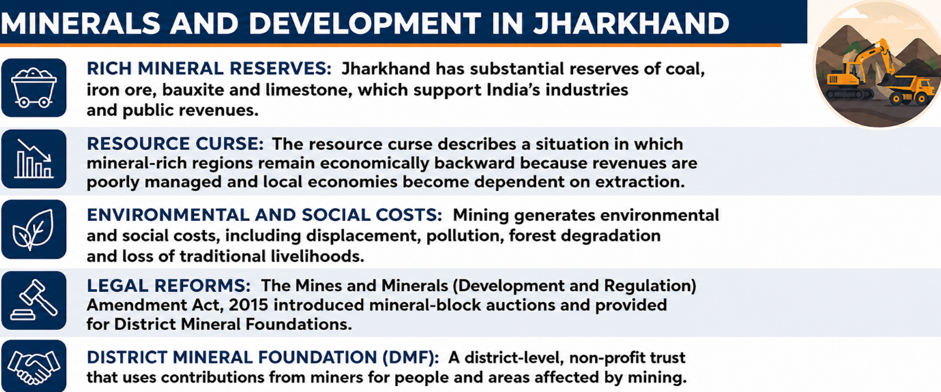
Jharkhand possesses nearly 40% of India’s mineral wealth, yet many mining districts continue to experience poverty, unemployment, inadequate public services and environmental degradation. The contrast highlights how mineral abundance without effective governance may fail to produce inclusive development.
Explanation
Development Paradox
- Mineral-producing communities often bear the costs of extraction but receive an inadequate share of its benefits.
- Mining districts may continue to lack hospitals, schools, drinking water, roads and diversified employment despite collecting substantial DMF funds.
- Weak linkages between mining and local enterprises restrict employment generation and create an enclave economy.
Problems in DMF Implementation
- Information on collections, expenditure, approved projects and outcomes is often outdated, inaccessible or incomplete.
- Mining-affected communities have limited participation in identifying projects and monitoring expenditure.
- Funds may be underutilised or directed towards general infrastructure rather than the specific needs of displaced and pollution-affected communities.
Governance and Revenue Constraints
- Delayed mineral auctions and the expiry of mining leases can reduce production, royalty receipts and contributions to DMFs.
- The comparison with Odisha indicates that mineral deposits alone do not determine revenue; timely auctions, administrative capacity and production management are equally important.
- Declining mining activity also affects workers, transporters, local markets and small businesses.
Way Forward
- States should conduct timely, transparent auctions while ensuring environmental and social safeguards.
- DMF portals must provide real-time information, independent audits and measurable project outcomes.
- Gram Sabhas and affected communities should participate in planning under the Panchayats (Extension to Scheduled Areas) Act, 1996.
- Investments should prioritise health, education, clean water, livelihood diversification, ecological restoration and mine-closure planning.
Conclusion
Mineral wealth becomes meaningful only when it improves the lives of people living near mining areas. Transparent institutions, community participation and accountable reinvestment of mining revenues are essential to convert resource extraction into sustainable and inclusive development.
Source: (The Indian Express)
La Excellence IAS Academy, the best IAS coaching in Hyderabad, known for delivering quality content and conceptual clarity for UPSC 2026 preparation.
FOLLOW US ON:
◉ YouTube : https://www.youtube.com/@CivilsPrepTeam
◉ Facebook: https://www.facebook.com/LaExcellenceIAS
◉ Instagram: https://www.instagram.com/laexcellenceiasacademy/
GET IN TOUCH:
Contact us at info@laex.in, https://laex.in/contact-us/
or Call us @ +91 9052 29 2929, +91 9052 99 2929, +91 9154 24 2140
OUR BRANCHES:
Head Office: H No: 1-10-225A, Beside AEVA Fertility Center, Ashok Nagar Extension, VV Giri Nagar, Ashok Nagar, Hyderabad, 500020
Madhapur: Flat no: 301, survey no 58-60, Guttala begumpet Madhapur metro pillar: 1524, Rangareddy Hyderabad, Telangana 500081
Bangalore: Plot No: 99, 2nd floor, 80 Feet Road, Beside Poorvika Mobiles, Chandra Layout, Attiguppe, Near Vijaya Nagara, Bengaluru, 560040