
Paper: GS – III, Subject: Environment and Ecology, Topic: Renewable Energy, Issue: Ethanol Blending: Growing Dependence on Foodgrains.
Context:
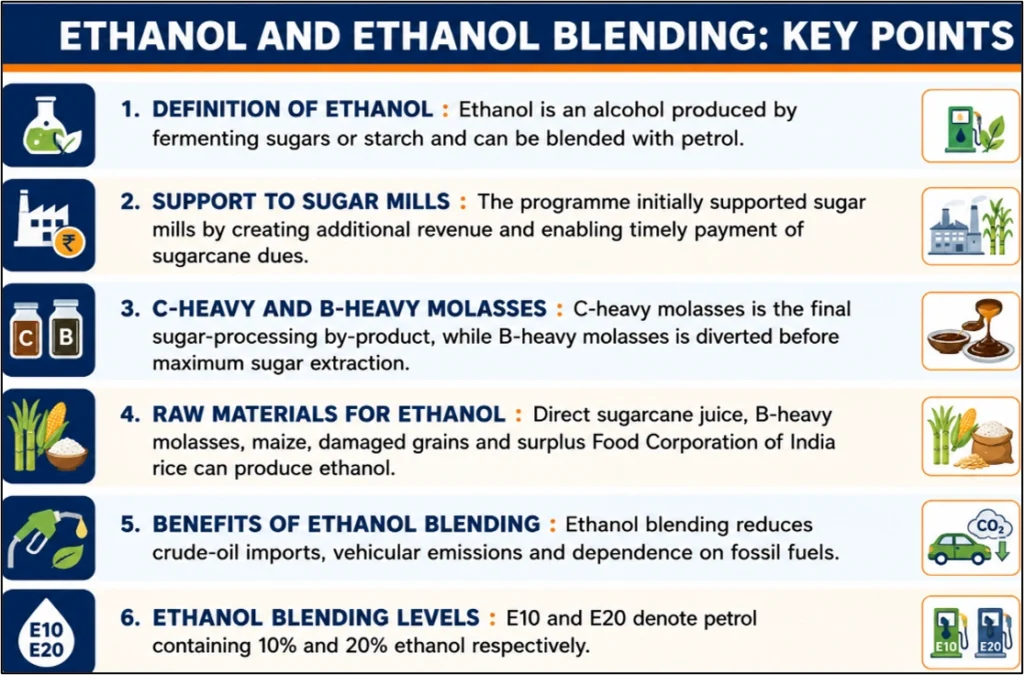
India’s Ethanol Blended Petrol (EBP) Programme has expanded rapidly towards the E20 target, under which petrol contains 20% ethanol. However, its increasing dependence on maize and subsidised rice raises concerns about food security, water use, livestock-feed prices and fiscal sustainability.
Key Takeaways:
Explanation:
Shift from Sugarcane to Grains:
- Until 2017–18, ethanol supplied to oil-marketing companies came mainly from C-heavy molasses.
- Grain-based production subsequently expanded because it provided distilleries with an off-season feedstock.
- Ethanol supply increased from 38 crore litres in 2013–14 to an allocated 1,048 crore litres in 2025–26.
- For 2025–26, grains account for approximately 72.5% of allocated ethanol, while sugarcane-based feedstocks contribute only 27.5%.
Why Grain Dependence Is Problematic:
- Diversion of maize to ethanol can increase prices for poultry and livestock-feed manufacturers.
- Sugarcane diversion may be restricted when sugar production is low, further increasing reliance on grains.
- The government has allocated surplus FCI rice to distilleries, but rice is highly water-intensive.
- Supplying subsidised FCI rice for fuel can create competition between food, animal feed and energy uses.
- Standalone grain distilleries may become dependent on publicly maintained food stocks instead of developing sustainable feedstocks.
Wider Policy Contradiction:
- The programme was intended to support sugarcane farmers and improve sugar-mill liquidity, but grain ethanol has become its principal source.
- Rapid expansion towards E20 and proposed higher blends may prioritise distillery capacity over feedstock availability.
- Reduced maize availability, climatic shocks and weaker harvests can make ambitious blending targets difficult to sustain.
Way Forward:
- Ethanol production should be diversified towards less water-intensive crops such as millets, sorghum and broken grains.
- Support for distilleries relying heavily on subsidised FCI rice should be gradually reduced.
- Blending targets must reflect food stocks, water availability and agricultural production.
- India can temporarily consolidate E10 – E15 rather than pursuing higher targets irrespective of feedstock conditions.
Conclusion:
Ethanol blending remains valuable for energy security and farm incomes, but its benefits should not come at the cost of food, fodder and water security. India requires flexible blending targets and a diversified, resource-efficient feedstock strategy.
Source: (The Hindu)
La Excellence IAS Academy, the best IAS coaching in Hyderabad, known for delivering quality content and conceptual clarity for UPSC 2026 preparation.
FOLLOW US ON:
◉ YouTube : https://www.youtube.com/@CivilsPrepTeam
◉ Facebook: https://www.facebook.com/LaExcellenceIAS
◉ Instagram: https://www.instagram.com/laexcellenceiasacademy/
GET IN TOUCH:
Contact us at info@laex.in, https://laex.in/contact-us/
or Call us @ +91 9052 29 2929, +91 9052 99 2929, +91 9154 24 2140
OUR BRANCHES:
Head Office: H No: 1-10-225A, Beside AEVA Fertility Center, Ashok Nagar Extension, VV Giri Nagar, Ashok Nagar, Hyderabad, 500020
Madhapur: Flat no: 301, survey no 58-60, Guttala begumpet Madhapur metro pillar: 1524, Rangareddy Hyderabad, Telangana 500081
Bangalore: Plot No: 99, 2nd floor, 80 Feet Road, Beside Poorvika Mobiles, Chandra Layout, Attiguppe, Near Vijaya Nagara, Bengaluru, 560040