
Paper: GS – II, Subject: International Relations, Topic: India and its neighborhood, Issue: India-China Boundary Talks: Progress but a Long Road Ahead.
Context:
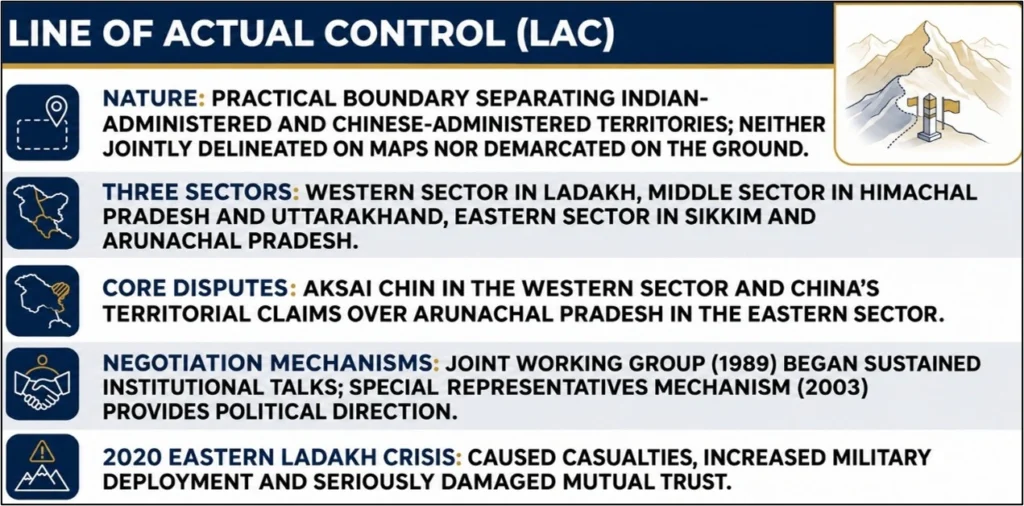
Recently, the 25th round of talks between the Special Representatives of India and China produced an eight-point consensus on maintaining stability along the border and advancing boundary negotiations. Although communication mechanisms have been strengthened, the absence of an agreed boundary and continuing strategic distrust make a final settlement difficult.
Key Takeaways:
Explanation:
Three Stages of Boundary Settlement:
- A final settlement requires agreement on political principles, development of an acceptable framework, and subsequent delimitation and demarcation.
- Delimitation means describing the boundary legally and drawing it on maps, whereas demarcation means physically marking it on the ground.
- India and China have made some progress on political principles, but substantive delimitation has not yet begun.
Eight-Point Consensus:
- Both sides agreed to maintain peace and tranquillity and continue seeking a fair and mutually acceptable settlement.
- An Expert Group on Boundary Delimitation will examine technical aspects of the boundary.
- The diplomatic-level Working Mechanism for Consultation and Coordination will intensify consultations and support the negotiating process.
- The countries will explore an “early harvest”, under which less contentious sectors may be resolved before more difficult areas.
Border-Management Measures:
- Additional senior military-level mechanisms will be established for the Eastern and Middle Sectors, supplementing the existing Chushul–Moldo mechanism in the Western Sector.
- Existing hotlines will be strengthened and additional direct communication channels may be created at sensitive locations.
- Border Personnel Meetings, flag meetings and local commander-level contacts can reduce misunderstandings and prevent patrol encounters from escalating.
- The resumption of the Kailash Mansarovar Yatra, direct flights and border trade indicates limited improvement in wider relations.
Continuing Obstacles:
- Different perceptions of the LAC, incomplete exchange of maps and competing territorial claims continue to delay settlement.
- Difficult terrain, military deployments, infrastructure construction and the trust deficit created by earlier confrontations increase the risk of renewed tensions.
- Border-management arrangements can control crises, but they cannot substitute for political agreement.
Conclusion:
The latest talks have strengthened communication and created new institutional pathways for negotiation. However, lasting peace requires LAC clarification, military de-escalation, restoration of trust and sustained political commitment to a mutually accepted boundary.
Source: (The Indian Express)
La Excellence IAS Academy, the best IAS coaching in Hyderabad, known for delivering quality content and conceptual clarity for UPSC 2026 preparation.
FOLLOW US ON:
◉ YouTube : https://www.youtube.com/@CivilsPrepTeam
◉ Facebook: https://www.facebook.com/LaExcellenceIAS
◉ Instagram: https://www.instagram.com/laexcellenceiasacademy/
GET IN TOUCH:
Contact us at info@laex.in, https://laex.in/contact-us/
or Call us @ +91 9052 29 2929, +91 9052 99 2929, +91 9154 24 2140
OUR BRANCHES:
Head Office: H No: 1-10-225A, Beside AEVA Fertility Center, Ashok Nagar Extension, VV Giri Nagar, Ashok Nagar, Hyderabad, 500020
Madhapur: Flat no: 301, survey no 58-60, Guttala begumpet Madhapur metro pillar: 1524, Rangareddy Hyderabad, Telangana 500081
Bangalore: Plot No: 99, 2nd floor, 80 Feet Road, Beside Poorvika Mobiles, Chandra Layout, Attiguppe, Near Vijaya Nagara, Bengaluru, 560040