
Paper: GS – II, Subject: Polity, Topic: Fundamental Rights/Protection of Vulnerable Sections, Issue: Caste-based Purification and Untouchability.
Context:
Recently, a shuddhikaran ritual was performed at Haldwani’s Ramlila ground two days after Congress president Mallikarjun Kharge, a Dalit leader, addressed a rally there. The incident raised questions about whether purification linked to a person’s caste identity or presence could violate Article 17.
Key Takeaways:
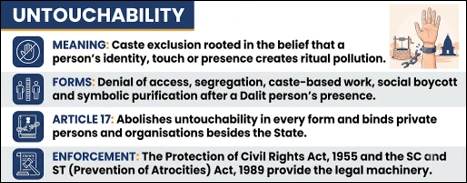
Explanation:
Scope of Article 17:
- The Constitution leaves “untouchability” undefined, enabling courts to address its changing forms. Article 17 does not expressly mention social boycott.
- However, a caste-based boycott may fall within Article 17 when it imposes exclusion arising from untouchability. The 1955 Act penalises social disabilities and denial of services.
Judicial Interpretation:
- In Sukanya Shantha v. Union of India (2024), the Supreme Court connected untouchability with “purity and pollution” and stigma based on existence, touch or presence.
- In Surya Narayan Choudhary v. State of Rajasthan (1988), the High Court invalidated compulsory purification of Dalit devotees before temple entry under Articles 14, 15 and 17.
Legal Test in Haldwani:
- Liability depends on whether Kharge’s caste identity or presence was considered to have polluted the venue.
- Organisers’ statements, witnesses, ritual purpose and treatment after non-Dalit rallies may prove this connection; timing or terminology alone cannot.
- In Hitesh Verma v. State of Uttarakhand (2020), the Supreme Court held that an insult becomes an atrocity only when connected with caste identity.
- Section 3(1)(r) requires intentional insult or intimidation, intention to humiliate an SC/ST member, action by a non-SC/ST person and occurrence within “public view”.
Conclusion:
The issue is not purification itself but its caste-based purpose. A boycott or purification ritual may violate Article 17 when it enforces notions of pollution and exclusion. Liability must rest on evidence, protecting dignity without prejudging facts.
Source: (The Hindu)
La Excellence IAS Academy, the best IAS coaching in Hyderabad, known for delivering quality content and conceptual clarity for UPSC 2026 preparation.
FOLLOW US ON:
◉ YouTube : https://www.youtube.com/@CivilsPrepTeam
◉ Facebook: https://www.facebook.com/LaExcellenceIAS
◉ Instagram: https://www.instagram.com/laexcellenceiasacademy/
GET IN TOUCH:
Contact us at info@laex.in, https://laex.in/contact-us/
or Call us @ +91 9052 29 2929, +91 9052 99 2929, +91 9154 24 2140
OUR BRANCHES:
Head Office: H No: 1-10-225A, Beside AEVA Fertility Center, Ashok Nagar Extension, VV Giri Nagar, Ashok Nagar, Hyderabad, 500020
Madhapur: Flat no: 301, survey no 58-60, Guttala begumpet Madhapur metro pillar: 1524, Rangareddy Hyderabad, Telangana 500081
Bangalore: Plot No: 99, 2nd floor, 80 Feet Road, Beside Poorvika Mobiles, Chandra Layout, Attiguppe, Near Vijaya Nagara, Bengaluru, 560040