
Paper: GS – III, Subject: Environment, Ecology and Disaster Management, Topic: Disaster Management, Issue: Himalayan Cooperation: India, China and Nepal.
Context:
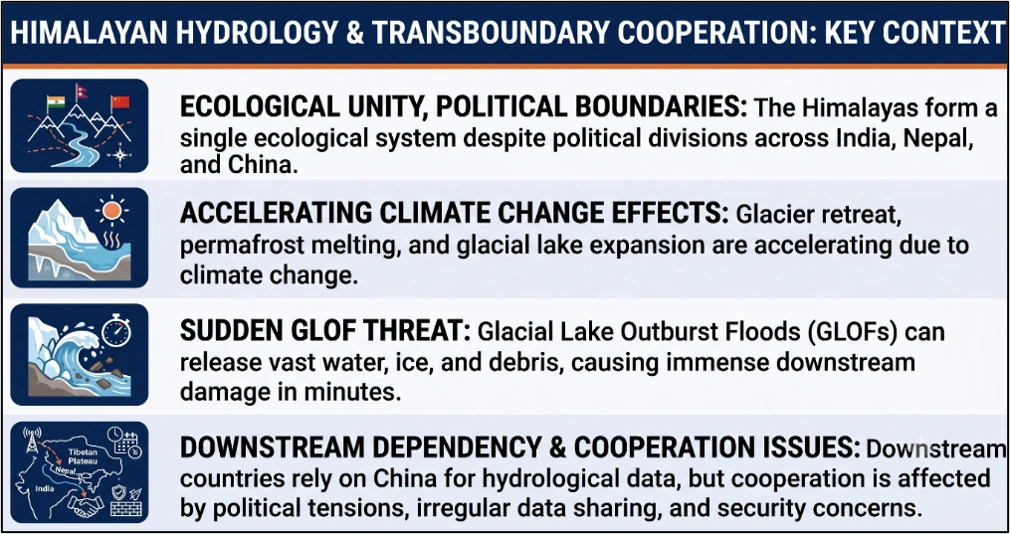
A recent mountain disaster in Nepal has again highlighted the fragile and interconnected ecology of the Himalayas. Floods, glacial-lake bursts and landslides originating in one country can quickly affect communities across national borders. This makes India-China-Nepal cooperation on Himalayan climate and water security essential.
Key Takeaways:
Explanation:
Why the Himalayas create a shared destiny?
Natural processes ignore borders:
- Glaciers, rivers, rainfall systems and landslides do not recognise international boundaries.
- A glacial collapse or extreme rainfall event in Tibet or Nepal can generate flooding downstream in another country.
- Therefore, purely national disaster-management systems are inadequate for many Himalayan hazards.
Climate change increases risks:
- The Himalayas are warming rapidly, destabilising glaciers and mountain slopes.
- Expanding glacial lakes increase the possibility of GLOFs.
- Extreme rainfall can combine with unstable slopes to produce flash floods, landslides and debris flows.
Main weakness: lack of real-time information:
Hydrological data gaps:
- Downstream countries need information on: River levels, Rainfall, Glacier movement
- Glacial-lake conditions and Sudden upstream water releases.
- Delayed information can leave downstream populations with only minutes or hours to respond.
Existing cooperation is insufficient:
- Hydrological information sharing has often depended on periodic bilateral arrangements.
- Political tensions can interrupt scientific cooperation precisely when continuous data exchange is most necessary.
What cooperation should look like:
Trilateral early-warning mechanism:
- India, Nepal and China should create a permanent Himalayan disaster-warning mechanism.
- Information sharing should become automatic rather than dependent on diplomatic requests during emergencies.
Common monitoring network:
- Establish: Automated river gauges, Weather stations, Seismic sensors, Satellite-based monitoring and Real-time telemetry systems.
- Data should be accessible simultaneously to emergency agencies of all three countries.
Joint mapping of high-risk areas:
- Scientists should jointly identify dangerous glacial lakes, unstable slopes and vulnerable river valleys.
- Shared risk maps can help governments decide where settlements, roads, dams and other infrastructure require additional protection.
Joint scientific and disaster-response cooperation:
- Conduct cross-border research on glaciers and climate change.
- Organise joint disaster-response exercises involving both civilian and specialised agencies.
- Where dangerous glacial lakes threaten settlements, countries can jointly undertake measures such as controlled drainage, reinforcement and continuous monitoring.
Larger significance:
- Himalayan cooperation is not merely an environmental issue; it concerns water security, food security, livelihoods, infrastructure and human survival.
- Environmental collaboration can also build trust among neighbours even when wider political relations remain difficult.
Conclusion:
The Himalayas bind India, China and Nepal into a common ecological future. Since climate disasters cannot be stopped at political borders, scientific cooperation, real-time data sharing and joint disaster preparedness must become permanent features of regional diplomacy.
Source: (The Indian Express)
La Excellence IAS Academy, the best IAS coaching in Hyderabad, known for delivering quality content and conceptual clarity for UPSC 2026 preparation.
FOLLOW US ON:
◉ YouTube : https://www.youtube.com/@CivilsPrepTeam
◉ Facebook: https://www.facebook.com/LaExcellenceIAS
◉ Instagram: https://www.instagram.com/laexcellenceiasacademy/
GET IN TOUCH:
Contact us at info@laex.in, https://laex.in/contact-us/
or Call us @ +91 9052 29 2929, +91 9052 99 2929, +91 9154 24 2140
OUR BRANCHES:
Head Office: H No: 1-10-225A, Beside AEVA Fertility Center, Ashok Nagar Extension, VV Giri Nagar, Ashok Nagar, Hyderabad, 500020
Madhapur: Flat no: 301, survey no 58-60, Guttala begumpet Madhapur metro pillar: 1524, Rangareddy Hyderabad, Telangana 500081
Bangalore: Plot No: 99, 2nd floor, 80 Feet Road, Beside Poorvika Mobiles, Chandra Layout, Attiguppe, Near Vijaya Nagara, Bengaluru, 560040