
Paper: GS-II | Subject: Social Justice | Topic: Welfare Schemes for Vulnerable Sections | Issue: Women-Centred Welfare versus Electoral Freebies
Context
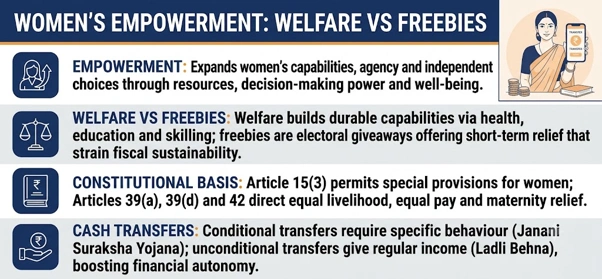
Recently, women-targeted transfers dominated five Assembly elections in 2026. Their mixed electoral impact renewed debate over whether such benefits create lasting empowerment or only temporary relief.
Explanation
Legal framework
- In S. Subramaniam Balaji v. State of Tamil Nadu (2013), the Supreme Court held manifesto promises were not corrupt practices.
- It directed the Election Commission to frame Model Code of Conduct guidelines requiring rationale and financing details.
- The Fiscal Responsibility and Budget Management framework demands fiscal prudence.
Benefits and initiatives
- Schemes like Ladli Behna and Gruha Lakshmi strengthen consumption security and intra-household bargaining.
- Shakti and Vidiyal Payanam improve mobility, education and employment access.
- The Jan Dhan-Aadhaar-Mobile (JAM) trinity enables Direct Benefit Transfers, but account ownership may not ensure women’s control.
- Lakhpati Didi, women-owned housing and political reservation strengthen women’s agency.
Challenges
- The Periodic Labour Force Survey 2025 recorded women’s Labour Force Participation Rate at 40% under usual status; only 18.2% held regular salaried jobs.
- The Time Use Survey 2024 shows women’s unequal unpaid-care burden, creating time poverty.
- Feminisation of agriculture increases women’s farm work, but many lack wages, land titles and institutional credit.
- The Reserve Bank of India warns that subsidies may crowd out spending on infrastructure, health and education.
Way forward
- Apply Amartya Sen’s capability approach by combining income support with skills, credit, childcare, safe transport and decent jobs.
- Policy must distinguish merit goods, such as healthcare and education, from unsustainable non-merit giveaways.
- Outcome-based gender budgeting and social audits should measure agency, employment and control over resources.
Conclusion
Women-centred transfers provide protection, but become empowerment only when they expand choices. India needs support, fiscal prudence, universal services and capability building.
Source: (Business Standard)
La Excellence IAS Academy, the best IAS coaching in Hyderabad, known for delivering quality content and conceptual clarity for UPSC 2026 preparation.
FOLLOW US ON:
◉ YouTube : https://www.youtube.com/@CivilsPrepTeam
◉ Facebook: https://www.facebook.com/LaExcellenceIAS
◉ Instagram: https://www.instagram.com/laexcellenceiasacademy/
GET IN TOUCH:
Contact us at info@laex.in, https://laex.in/contact-us/
or Call us @ +91 9052 29 2929, +91 9052 99 2929, +91 9154 24 2140
OUR BRANCHES:
Head Office: H No: 1-10-225A, Beside AEVA Fertility Center, Ashok Nagar Extension, VV Giri Nagar, Ashok Nagar, Hyderabad, 500020
Madhapur: Flat no: 301, survey no 58-60, Guttala begumpet Madhapur metro pillar: 1524, Rangareddy Hyderabad, Telangana 500081
Bangalore: Plot No: 99, 2nd floor, 80 Feet Road, Beside Poorvika Mobiles, Chandra Layout, Attiguppe, Near Vijaya Nagara, Bengaluru, 560040