
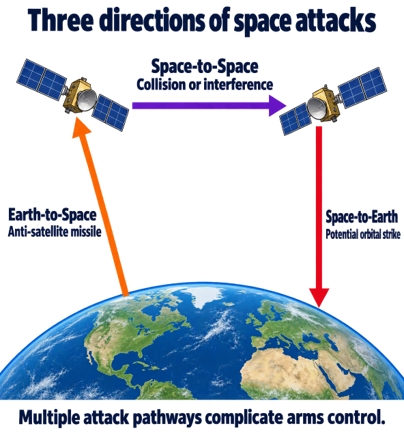
Outer space supports communication, navigation and national security. Growing anti-satellite capabilities expose weaknesses in international agreements, although these frameworks remain essential safeguards against unrestricted weaponisation.
Existing safeguards
- Outer Space Treaty, 1967: Prohibits nuclear weapons and other weapons of mass destruction in orbit; reserves celestial bodies for peaceful purposes, banning military bases, weapons testing and manoeuvres there.
- UN Charter: Its restrictions on the threat or use of force also apply to space activities.
- Supporting conventions: The Liability Convention and Registration Convention provide mechanisms for responsibility, compensation and identifying space objects.
Why these agreements are inadequate
- Limited coverage: The Outer Space Treaty does not comprehensively prohibit conventional weapons in orbit or ground-launched anti-satellite systems.
- Technological gaps: Cyberattacks, signal jamming and interference challenge rules developed before these capabilities became prominent.
- Verification difficulties: Dual-use spacecraft can repair satellites or damage them, making hostile intentions difficult to establish.
- Weak enforcement: Attribution problems, strategic secrecy and geopolitical rivalries obstruct accountability and agreement on stronger restrictions.
- Shared environmental risks: Destructive attacks generate debris, potentially triggering cascading collisions – Kessler syndrome – and endangering uninvolved countries’ satellites.
A balanced assessment and way forward
- Existing treaties establish restraints and legal principles; their inadequacy reflects incomplete coverage and implementation rather than complete irrelevance.
- States should negotiate verifiable restrictions on destructive anti-satellite activities, establish notification and crisis-communication mechanisms, and strengthen debris-mitigation commitments.
- India, having demonstrated anti-satellite capability through Mission Shakti, should combine satellite resilience with responsible behaviour and multilateral diplomacy.
Thus, preventing weaponisation requires updating existing frameworks while preserving their foundational principles of peaceful cooperation and international responsibility.
La Excellence IAS Academy, the best IAS coaching in Hyderabad, known for delivering quality content and conceptual clarity for UPSC 2026 preparation.
FOLLOW US ON:
◉ YouTube : https://www.youtube.com/@CivilsPrepTeam
◉ Facebook: https://www.facebook.com/LaExcellenceIAS
◉ Instagram: https://www.instagram.com/laexcellenceiasacademy/
GET IN TOUCH:
Contact us at info@laex.in, https://laex.in/contact-us/
or Call us @ +91 9052 29 2929, +91 9052 99 2929, +91 9154 24 2140
OUR BRANCHES:
Head Office: H No: 1-10-225A, Beside AEVA Fertility Center, Ashok Nagar Extension, VV Giri Nagar, Ashok Nagar, Hyderabad, 500020
Madhapur: Flat no: 301, survey no 58-60, Guttala begumpet Madhapur metro pillar: 1524, Rangareddy Hyderabad, Telangana 500081
Bangalore: Plot No: 99, 2nd floor, 80 Feet Road, Beside Poorvika Mobiles, Chandra Layout, Attiguppe, Near Vijaya Nagara, Bengaluru, 560040