
Paper: GS-II, Subject: Polity, Topic: Evolution of Constitution, Issue: Uniform Civil Code
Context
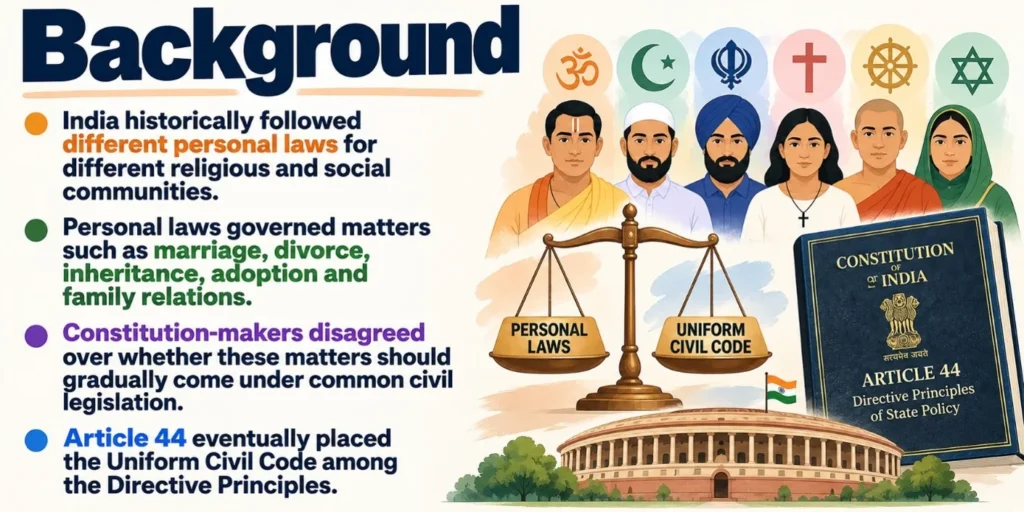
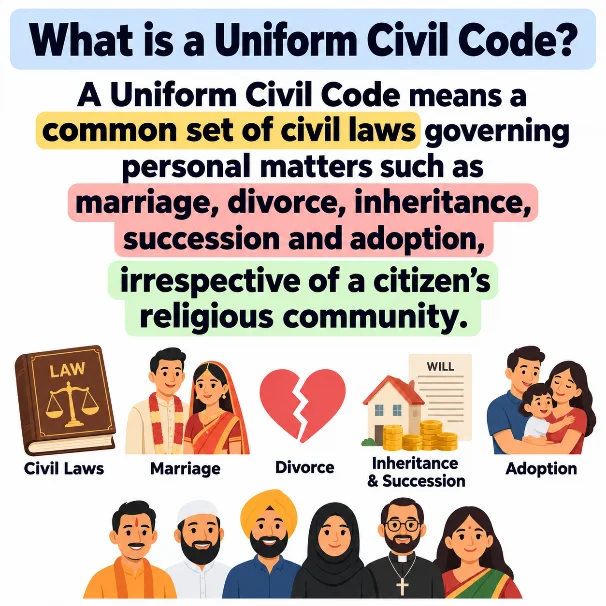
The Uniform Civil Code was one of the important questions considered during constitution-making in India. The debate reflected a larger constitutional challenge involving religious freedom, cultural diversity, equality, social reform and legal uniformity.
1. Arguments Against Immediate Uniformity
1.1 Protection of Religious and Cultural Practices
- Several members considered personal laws closely connected with religion and community identity.
- They feared compulsory uniformity could interfere with established customs followed by minority communities.
- Sudden legal change could generate resistance where personal practices remained socially significant.
- Religious freedom was therefore viewed as requiring caution in reforming personal-law systems.
1.2 Diversity of Indian Society
- India contained substantial differences in customs, social practices and levels of development.
- A single code introduced abruptly could ignore legitimate variations among communities and regions.
- Some members therefore preferred gradual social reform rather than immediate legal uniformity.
- Consensus-building was considered important for maintaining social trust during major legal transformation.
2. Arguments Supporting a Uniform Civil Code
2.1 Separation of Religion and Secular Civil Matters
- Supporters argued that every personal-law practice could not automatically receive permanent religious protection.
- Marriage, inheritance and succession also create legal rights with wider social consequences.
- The State could therefore regulate secular aspects without necessarily interfering with essential religious belief.
- Social reform would become difficult if all customary practices remained beyond legislative scrutiny.
2.2 Equality and Social Reform
- Common civil principles were considered capable of strengthening equality before law among citizens.
- Reform of personal laws could also address discriminatory practices affecting women within communities.
- Legal uniformity in civil matters was viewed as compatible with broader constitutional citizenship.
- Supporters emphasised that social welfare could justify reform of long-established personal practices.
2.3 Existing Legal Uniformity
- India already possessed common laws in criminal, commercial and several civil matters.
- Therefore, legal uniformity was not entirely new to the Indian constitutional system.
- Personal law remained one of the major areas where community-specific rules continued.
- A future code was consequently viewed as an extension of an existing legal process.
3. The Constitutional Compromise
3.1 Article 44 and Gradual Reform
- Article 44 requires the State to endeavour to secure a Uniform Civil Code.
- Its placement among Directive Principles avoided immediate compulsory enforcement upon all citizens.
- The provision allowed future governments to pursue reform according to social and political conditions.
- This approach preserved the constitutional goal while permitting gradual and democratic legal development.
Conclusion
The UCC debate was fundamentally about reconciling diversity with equality and reform. The constitutional settlement neither imposed immediate uniformity nor abandoned the objective, instead leaving space for gradual change within India’s democratic framework.
Source: (The Indian Express)
La Excellence IAS Academy, the best IAS coaching in Hyderabad, known for delivering quality content and conceptual clarity for UPSC 2026 preparation.
FOLLOW US ON:
◉ YouTube : https://www.youtube.com/@CivilsPrepTeam
◉ Facebook: https://www.facebook.com/LaExcellenceIAS
◉ Instagram: https://www.instagram.com/laexcellenceiasacademy/
GET IN TOUCH:
Contact us at info@laex.in, https://laex.in/contact-us/
or Call us @ +91 9052 29 2929, +91 9052 99 2929, +91 9154 24 2140
OUR BRANCHES:
Head Office: H No: 1-10-225A, Beside AEVA Fertility Center, Ashok Nagar Extension, VV Giri Nagar, Ashok Nagar, Hyderabad, 500020
Madhapur: Flat no: 301, survey no 58-60, Guttala begumpet Madhapur metro pillar: 1524, Rangareddy Hyderabad, Telangana 500081
Bangalore: Plot No: 99, 2nd floor, 80 Feet Road, Beside Poorvika Mobiles, Chandra Layout, Attiguppe, Near Vijaya Nagara, Bengaluru, 560040