
Paper: GS-III, Subject: Environment, Ecology and Disaster Management, Topic: Disaster Management, Issue: Civic Infrastructure Failure
Context
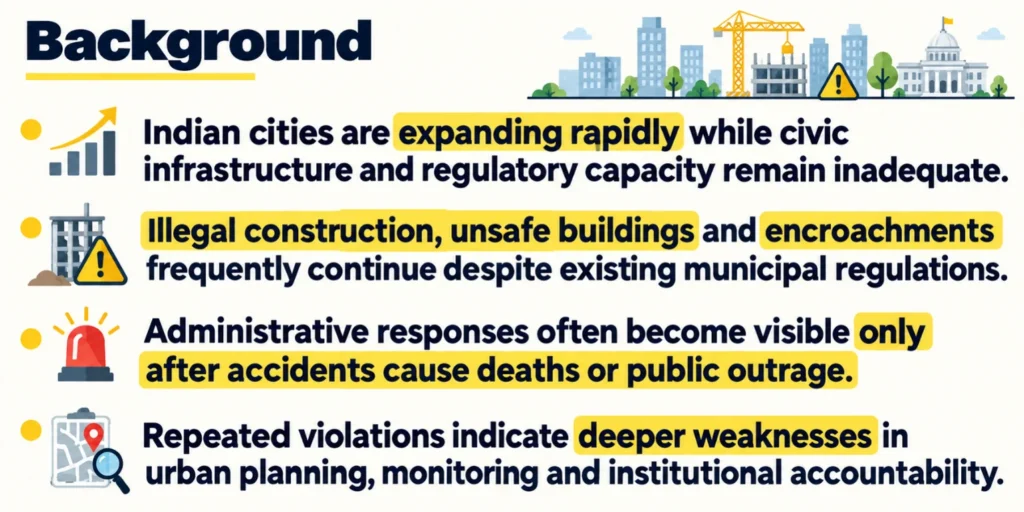
Recurring deaths from collapsing structures, fires, falling billboards, encroachments and unsafe public spaces reveal serious weaknesses in India’s civic governance. These incidents are often preventable and arise from poor planning, weak enforcement and inadequate administrative accountability.
1. Why Do Civic Disasters Continue?
1.1 Weak Enforcement of Existing Rules
- Municipal regulations often exist, but their implementation remains inconsistent across different locations.
- Unsafe structures may continue operating because inspections are irregular or violations are ignored.
- Regulatory failures become particularly dangerous in densely populated urban and commercial areas.
- Temporary enforcement after accidents rarely addresses the institutional causes behind repeated violations.
1.2 Absence of Administrative Accountability
- Responsibility should extend beyond private owners to officials responsible for regulatory supervision.
- Officials who knowingly approve unsafe structures must face meaningful administrative and legal consequences.
- Inspecting authorities should remain accountable when serious violations repeatedly escape official detection.
- Strong individual accountability can discourage negligence, corruption and deliberate disregard of civic regulations.
2. Poor Urban Planning
2.1 Unplanned Urban Expansion
- Rapid population growth has increased pressure on housing, transport and essential urban services.
- Unauthorised settlements often develop without adequate roads, drainage, fire access or open spaces.
- Regularisation without infrastructure improvement can permanently institutionalise deficiencies in urban planning.
- Encroachment on public land further reduces spaces intended for collective civic use.
2.2 Selective Application of Regulations
- Enforcement sometimes affects weaker social groups more quickly than influential property owners.
- Selective enforcement reduces public confidence in the legitimacy of municipal regulatory institutions.
- Civic regulations must therefore be applied uniformly regardless of economic or social status.
- Transparent enforcement can reduce perceptions of favouritism and improve voluntary compliance.
3. Need for Preventive Safety Governance
3.1 Regular Monitoring
- Structural safety, fire preparedness and occupancy conditions require periodic inspection by competent authorities.
- Commercial establishments should not depend permanently upon certificates issued during initial approval stages.
- Serious violations involving blocked exits or overcrowding require immediate corrective administrative action.
- Digital inspection records can improve monitoring and reduce opportunities for informal regulatory manipulation.
3.2 Role of Citizens
- Citizens require reliable information regarding the safety status of establishments they regularly use.
- Publicly accessible compliance records can help consumers make informed and safer everyday choices.
- Repeatedly unsafe establishments may also face reputational and commercial pressure from informed consumers.
- Citizen awareness should complement regulation rather than replace the primary responsibility of government.
Conclusion
India’s civic safety problem is not merely a shortage of laws, but a deficit of enforcement, planning and accountability. Safer cities require preventive inspections, transparent regulation, equal enforcement and clear responsibility across both private and public institutions.
Source: (The Hindu)
La Excellence IAS Academy, the best IAS coaching in Hyderabad, known for delivering quality content and conceptual clarity for UPSC 2026 preparation.
FOLLOW US ON:
◉ YouTube : https://www.youtube.com/@CivilsPrepTeam
◉ Facebook: https://www.facebook.com/LaExcellenceIAS
◉ Instagram: https://www.instagram.com/laexcellenceiasacademy/
GET IN TOUCH:
Contact us at info@laex.in, https://laex.in/contact-us/
or Call us @ +91 9052 29 2929, +91 9052 99 2929, +91 9154 24 2140
OUR BRANCHES:
Head Office: H No: 1-10-225A, Beside AEVA Fertility Center, Ashok Nagar Extension, VV Giri Nagar, Ashok Nagar, Hyderabad, 500020
Madhapur: Flat no: 301, survey no 58-60, Guttala begumpet Madhapur metro pillar: 1524, Rangareddy Hyderabad, Telangana 500081
Bangalore: Plot No: 99, 2nd floor, 80 Feet Road, Beside Poorvika Mobiles, Chandra Layout, Attiguppe, Near Vijaya Nagara, Bengaluru, 560040