
Context
India’s positions at the Shanghai Cooperation Organisation (SCO) and BRICS summits have raised questions about its diplomatic balancing. While India supported criticism of military strikes against Iran, it publicly urged Russia to end the Ukraine war.These contrasting positions could affect Russia’s trust in India.
Strategic Autonomy and India-Russia Relations
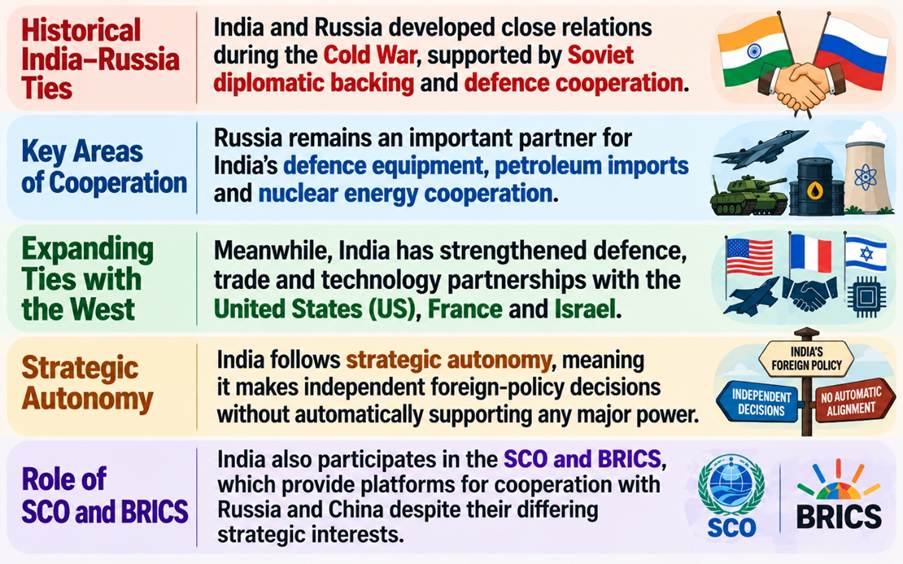
Explanation
What changed at the SCO and BRICS summits and India-Russia Relations
- At the SCO Summit in Bishkek, India supported a declaration condemning military strikes against Iran and reaffirming its sovereignty.
- Although the declaration did not name the US or Israel, it criticised military actions involving India’s important strategic partners.
- Similarly, the BRICS New Delhi Declaration reaffirmed Palestinian rights and supported peaceful dispute settlement, while avoiding direct criticism of Russia over Ukraine.
- However, India publicly urged Russia to end the prolonged Ukraine war.
- These developments revealed India’s attempt to maintain cooperation with Russia and China while continuing its strategic partnerships with Western countries.
Why could Russia’s trust weaken?
- Moscow might interpret India’s public appeal as an attempt to reassure Washington after India supported criticism of attacks against Iran.
- Russia could also question why similarly direct public appeals were not made to American or Israeli leaders regarding conflicts in West Asia.
- Such differences create concerns about diplomatic consistency, where similar international conflicts appear to receive different political responses.
- Meanwhile, India’s growing defence cooperation with Western countries and Russia’s increasing closeness with China have complicated their traditional partnership.
What is India’s larger diplomatic challenge?
- India follows multi-alignment, maintaining relationships with competing powers rather than joining one exclusive geopolitical bloc.
- This allows India to benefit from Russian energy and defence cooperation while expanding economic and security ties with Western countries.
- However, balancing competing interests becomes difficult when diplomatic statements intended to reassure one partner create mistrust among others.
- Consequently, India–Russia relations risk becoming increasingly transactional, driven by oil and defence purchases rather than long-term strategic trust.
Conclusion
India’s strategic autonomy requires maintaining relations with competing powers without compromising national interests. However, inconsistent diplomatic messaging could weaken longstanding partnerships. Preserving mutual trust while managing differences remains essential for India’s relationship with Russia.
Source: The Hindu
La Excellence IAS Academy, the best IAS coaching in Hyderabad, known for delivering quality content and conceptual clarity for UPSC 2026 preparation.
FOLLOW US ON:
◉ YouTube: https://www.youtube.com/@CivilsPrepTeam
◉ Facebook: https://www.facebook.com/LaExcellenceIAS
◉ Instagram: https://www.instagram.com/laexcellenceiasacademy/
GET IN TOUCH:
Contact us at info@laex.in, https://laex.in/contact-us/
or Call us @ +91 9052 29 2929, +91 9052 99 2929, +91 9154 24 2140
OUR BRANCHES:
Head Office: H No: 1-10-225A, Beside AEVA Fertility Center, Ashok Nagar Extension, VV Giri Nagar, Ashok Nagar, Hyderabad, 500020
Madhapur: Flat no: 301, survey no 58-60, Guttala begumpet Madhapur metro pillar: 1524, Rangareddy Hyderabad, Telangana 500081
Bangalore: Plot No: 99, 2nd floor, 80 Feet Road, Beside Poorvika Mobiles, Chandra Layout, Attiguppe, Near Vijaya Nagara, Bengaluru, 560040