
Paper: GS-II | Subject: Polity | Topic: Judiciary | Issue: Sentencing Disparities and Need for a Sentencing Council
Context
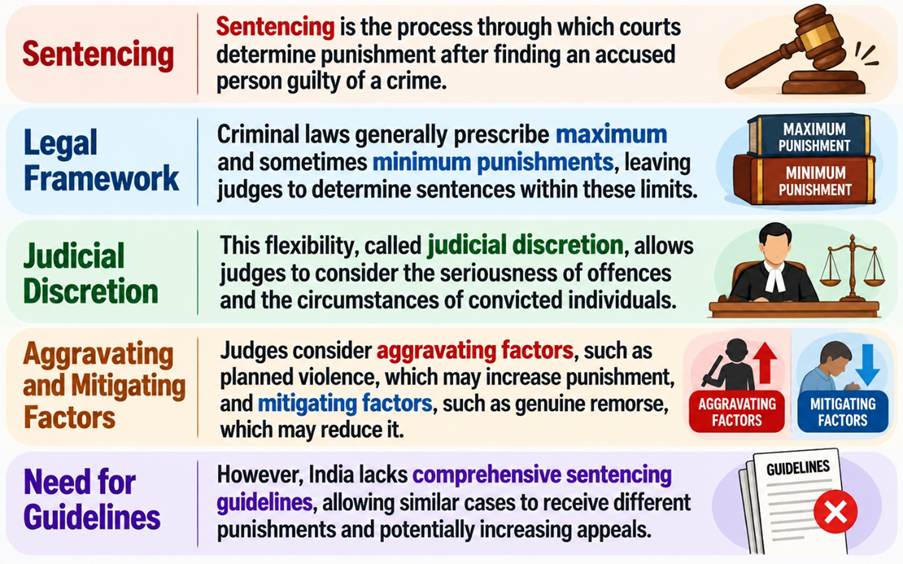
India’s courts sometimes award different punishments for similar crimes, raising concerns about fairness and unnecessary appeals. The Supreme Court has called for a national sentencing policy, prompting discussions about establishing a Sentencing Council. In India, the sentence a convicted person receives depends less on the offence than on the individual judge or Bench hearing the case.
Explanation
Why is the Existing Sentencing System Controversial?
- Imagine two individuals convicted of similar crimes receiving different prison sentences because judges assess their circumstances differently.
- Such differences may be justified by individual circumstances, but inconsistent judicial reasoning can create sentencing disparities and undermine public confidence.
- Article 14 guarantees equality before the law, while Article 21 requires fair and reasonable procedures when personal liberty is restricted.
- In Sunita Devi v. State of Bihar (2024), the Supreme Court observed that sentencing should not resemble a lottery.
- It urged the government to examine a comprehensive sentencing policy, and the Law Commission of India was tasked with studying the issue.
- Two people convicted of the same crime in India can walk away with very different sentences, and the difference often has less to do with the law than with which judge or Bench heard the case.
- Sentencing is the process where the State translates prescriptive ranges — for instance, ‘up to ten years’ imprisonment — into a specific prison term, fines, probation or community sanctions for the convict(s). In India, this decision is left almost entirely to an individual judge’s or Bench’s discretion
What Does the Existing Law Provide?
- Section 258(2) of the Bharatiya Nagarik Suraksha Sanhita (BNSS), 2023, generally requires Sessions Judges to hear convicted persons before determining punishment.
- This hearing allows courts to examine circumstances that may justify increasing or reducing the sentence.
- Sections 401 and 402 of the BNSS, alongside the Probation of Offenders Act, 1958, provide for probation and require special reasons when eligible offenders are denied its benefit.
- Probation allows eligible offenders to remain outside prison under prescribed conditions, encouraging rehabilitation instead of immediate imprisonment.
- However, no comprehensive framework guides courts in balancing deterrence (discouraging crime), rehabilitation (reforming offenders) and proportionality (punishment matching the offence).
How Would a Sentencing Council Improve the System?
- A proposed Sentencing Council, established through legislation, could develop offence-specific guidelines identifying appropriate punishment ranges and relevant circumstances.
- In England and Wales, sentencing guidelines assess culpability (degree of responsibility) and harm caused before adjusting punishment for aggravating and mitigating factors.
- India could adopt similar guidelines while allowing judges to consider individual circumstances and explain departures from recommended sentences.
- A National Sentencing Database, using the National Judicial Data Grid (NJDG), could identify sentencing disparities and support evidence-based reforms.
- Greater consistency could reduce avoidable sentencing appeals and judicial pendency, while preserving judicial independence and necessary discretion.
Conclusion
India needs sentencing reforms that ensure consistent treatment without ignoring individual circumstances. A Sentencing Council could strengthen equality, judicial accountability and public confidence while reducing unnecessary litigation.
Source: Indian Express
Source: https://indianexpress.com/article/explained/explained-law/india-sentencing-policy-national-sentencing-council-explained-10933467/
La Excellence IAS Academy, the best IAS coaching in Hyderabad, known for delivering quality content and conceptual clarity for UPSC 2026 preparation.
FOLLOW US ON:
◉ YouTube: https://www.youtube.com/@CivilsPrepTeam
◉ Facebook: https://www.facebook.com/LaExcellenceIAS
◉ Instagram: https://www.instagram.com/laexcellenceiasacademy/
GET IN TOUCH:
Contact us at info@laex.in, https://laex.in/contact-us/
or Call us @ +91 9052 29 2929, +91 9052 99 2929, +91 9154 24 2140
OUR BRANCHES:
Head Office: H No: 1-10-225A, Beside AEVA Fertility Center, Ashok Nagar Extension, VV Giri Nagar, Ashok Nagar, Hyderabad, 500020
Madhapur: Flat no: 301, survey no 58-60, Guttala begumpet Madhapur metro pillar: 1524, Rangareddy Hyderabad, Telangana 500081
Bangalore: Plot No: 99, 2nd floor, 80 Feet Road, Beside Poorvika Mobiles, Chandra Layout, Attiguppe, Near Vijaya Nagara, Bengaluru, 560040