
Context
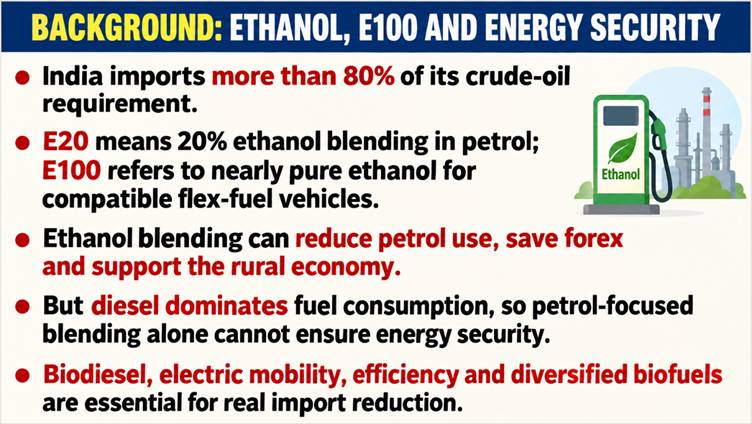
On October 26, 2026, the Union Government notified amendments to the Central Motor Vehicles Rules, 1989, enabling specially designed flex-fuel vehicles to operate on E100 (nearly pure ethanol). The development follows India’s achievement of 20% ethanol blending in petrol (E20) during 2025–26.
While ethanol blending promotes import substitution, foreign-exchange savings and energy security, its effectiveness in reducing crude-oil imports remains uncertain. The central concern is India’s much larger diesel consumption and the limited progress in biodiesel blending.
Key Issues and Dimensions: Energy Security in India: Why E100 Alone Is Not Enough
1. Achievements of Ethanol Blending
- Import Substitution: Ethanol displaces some petrol, potentially reducing petroleum imports and foreign-exchange expenditure.
- Rural Economy: Domestic ethanol procurement supports agricultural diversification, farmers’ incomes and the biofuel industry.
- Environmental Benefits: Sustainable ethanol production can lower lifecycle greenhouse-gas emissions compared with fossil fuels.
2. Why E100 Cannot Ensure Energy Security
- Limited Impact: Modelling suggests E20 could reduce petrol consumption by approximately 15.56%, without proportionately reducing crude imports.
- Refinery Economics: Crude processing simultaneously produces petrol, diesel, LPG, aviation fuel and naphtha.
- Diesel Dominance: India consumed 91.4 million tonnes of diesel against 40 million tonnes of petrol during FY2024–25.
- Infrastructure Constraints: E100 requires compatible vehicles, distribution infrastructure and adequate fuel supplies.
3. Neglected Biodiesel Sector
- Policy Gap: Biodiesel blending remains below 0.1%, against the indicative 5% target for 2030.
- Feedstock Constraints: Limited availability, high costs and fragmented collection systems hinder biodiesel production.
4. Sustainability Concerns
- Food–Fuel Trade-off: Food-grain diversion towards ethanol may threaten food security and increase price pressures.
- Water Footprint: Water-intensive feedstocks raise sustainability concerns, particularly in water-stressed regions.
- Energy Efficiency: Ethanol’s lower energy density can affect mileage, depending on vehicle compatibility.
5. Way Forward
- Promote biodiesel, used-cooking-oil collection, second-generation biofuels and diversified sustainable feedstocks.
- Accelerate electric mobility, railway electrification, public transport and energy-efficient freight logistics.
- Evaluate success through actual crude-import reduction, lifecycle emissions and foreign-exchange savings, rather than blending percentages alone.
Conclusion
India requires a diversified, technology-neutral energy transition. Ethanol blending must complement diesel substitution, electrification and energy efficiency to achieve genuine energy security and strategic autonomy.
Source: (The Indian Express)
La Excellence IAS Academy, the best IAS coaching in Hyderabad, known for delivering quality content and conceptual clarity for UPSC 2026 preparation.
FOLLOW US ON:
◉ YouTube: https://www.youtube.com/@CivilsPrepTeam
◉ Facebook: https://www.facebook.com/LaExcellenceIAS
◉ Instagram: https://www.instagram.com/laexcellenceiasacademy/
GET IN TOUCH:
Contact us at info@laex.in, https://laex.in/contact-us/
or Call us @ +91 9052 29 2929, +91 9052 99 2929, +91 9154 24 2140
OUR BRANCHES:
Head Office: H No: 1-10-225A, Beside AEVA Fertility Center, Ashok Nagar Extension, VV Giri Nagar, Ashok Nagar, Hyderabad, 500020
Madhapur: Flat no: 301, survey no 58-60, Guttala begumpet Madhapur metro pillar: 1524, Rangareddy Hyderabad, Telangana 500081
Bangalore: Plot No: 99, 2nd floor, 80 Feet Road, Beside Poorvika Mobiles, Chandra Layout, Attiguppe, Near Vijaya Nagara, Bengaluru, 560040